Household Gadgets / Fire safety
HALT Fire Fighting Spray Review: What the Foam Can Does, Where It Fits in Home Fire Safety and Where to Buy It for Less
A 10 oz aerosol can of plant-based foam for small household fires. Easy to grab and a useful extra, but it is no substitute for a proper extinguisher, and HALT's own store charges less.

By Alex Carter, Senior Tech Reviewer at Top10Gadgets
Updated 30 min readHow we test
Quick answer
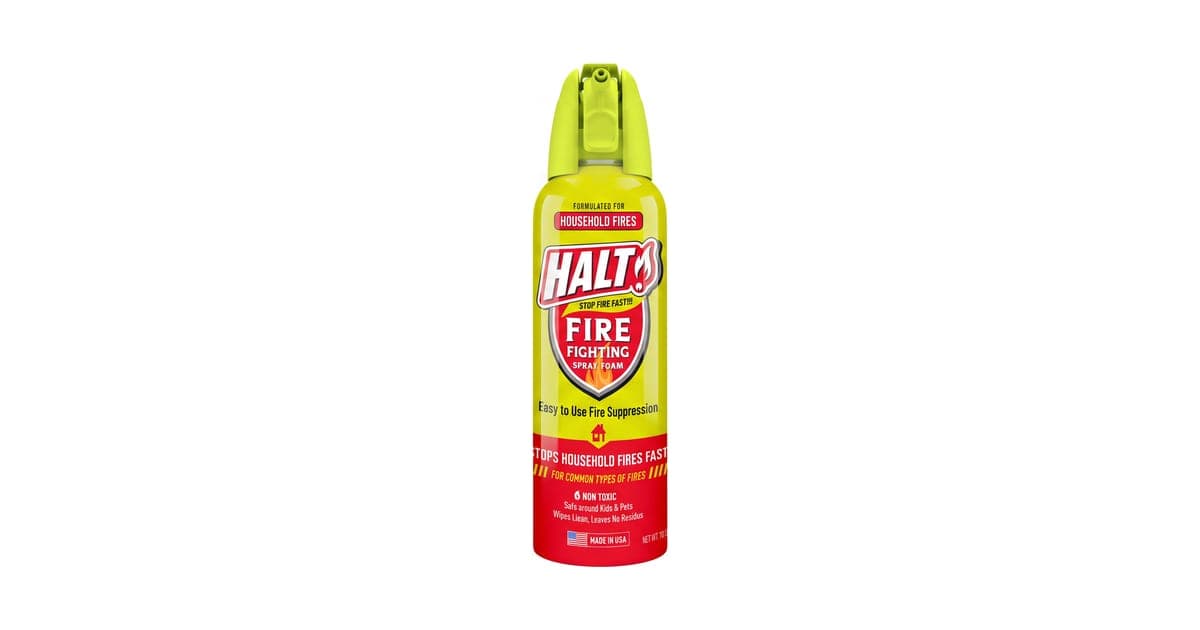
Yes, as an extra, if you already have proper fire extinguishers and want small, easy-to-grab cans in the kitchen, car or by the grill for tiny fires. HALT is a 10 oz can of plant-based firefighting foam that is simple to use.
Score 5.5/10$29.99 at HALT
Check price at HALT (opens HALT in a new tab)We may earn a commission if you buy through our links.
- Best for
- Households that already have proper extinguishers and want extra small cans in the kitchen, car or by the grill
- Not for
- Anyone planning to use it instead of a proper fire extinguisher
$29.99 at HALT
Check price at HALT (opens HALT in a new tab)We may earn a commission if you buy through our links.
On this page · 14 sections
- 01Our verdict
- 02The short version
- 03Pros & cons
- 04How it works
- 05Who it's for
- 06How much does HALT cost, and what do you get?
- 07Can HALT replace a fire extinguisher?
- 08Are HALT's claims true?
- 09Is HALT better than a fire extinguisher or fire blanket?
- 10Is HALT legit, and what should you check before buying?
- 11What do owners say, and how did we score HALT?
- 12How to use HALT for the best results
- 13What else do people ask about home fire safety?
- 14Frequently asked questions
Our verdict
Yes, as an extra, if you already have proper fire extinguishers and want small, easy-to-grab cans in the kitchen, car or by the grill for tiny fires. HALT is a 10 oz can of plant-based firefighting foam that is simple to use. But aerosol fire sprays are not a substitute for a code-rated extinguisher, the page's claims to handle almost every type of fire go too far, and HALT's own store sold it for less. It scores 5.5 out of 10. If a fire is spreading, get out and call 911.
The short version
- A 10 oz aerosol can of PFAS-free, plant-based foam, about 8.25 inches tall.
- Point, squeeze and sweep; no pin to pull.
- $29.99 for one on 3 October 2026; $59.98 for three, $89.97 for five, $149.95 for ten.
- HALT's store: $27.99 for one, $36.99 for two, $64.99 for four, $115.99 for eight.
- Not a replacement for a proper fire extinguisher.
- Best trait: simple, compact backup for very small fires.
- Biggest drawback: marketing that blurs the line between a small spray and real fire protection.
- Our score: 5.5 out of 10.
Pros & cons
HALT is a real product from a real company, sold in hardware stores. The cons are about what a small can can safely do, and about how the page presents it.
What we like
- Easy to use under stress: point and spray, with no pin to pull
- Small and light, so you can keep cans in the kitchen, garage, car and by the grill
- PFAS-free, plant-based foam that wipes up more easily than dry chemical powder, according to the brand
- Made in the US and sold through hardware and farm stores as well as online
- Can help knock down very small, early fires before they spread
What we don't
- Aerosol fire sprays are not a substitute for a code-rated fire extinguisher; consumer and safety bodies warn against relying on them alone
- A small can holds limited agent and reach compared with a standard extinguisher
- Claims to handle Class A, B, C, D, K and lithium-ion fires go well beyond what most households should attempt to fight
- "UL Recognized Component" and "NSF certified" are not the same as a UL-listed fire extinguisher
- HALT's own store was cheaper: $27.99 for one, $64.99 for four
- Trustpilot reviewers report missing items in multi-pack orders and no replies from support
Sold by HALT
HALT! Fire Fighting Spray Foam$29.99
How it works
HALT is a pressurised can of water-based foam with a wetting agent. It works like a very small foam extinguisher.
Aim at the base of the fire
Step 1: Hold the can upright, stand back at a safe distance and aim at the base of the flames, not the top.
Squeeze and sweep
Step 2: Squeeze the trigger and sweep the foam from side to side across the base of the fire. The foam cools and smothers the burning material.
Watch for re-ignition, then wipe up
Step 3: Keep watching after the flames go out, in case they flare up again. Once cool, the brand says the residue wipes away with a cloth.
Foam suppresses fire by cooling the burning material and forming a layer that cuts off oxygen. A small can delivers a limited amount over a short time, so it suits only small, early-stage fires: a pan just starting to flame, a small bin fire, a smouldering cable. Larger or spreading fires need a proper extinguisher or, more often, evacuation.
Who it's for
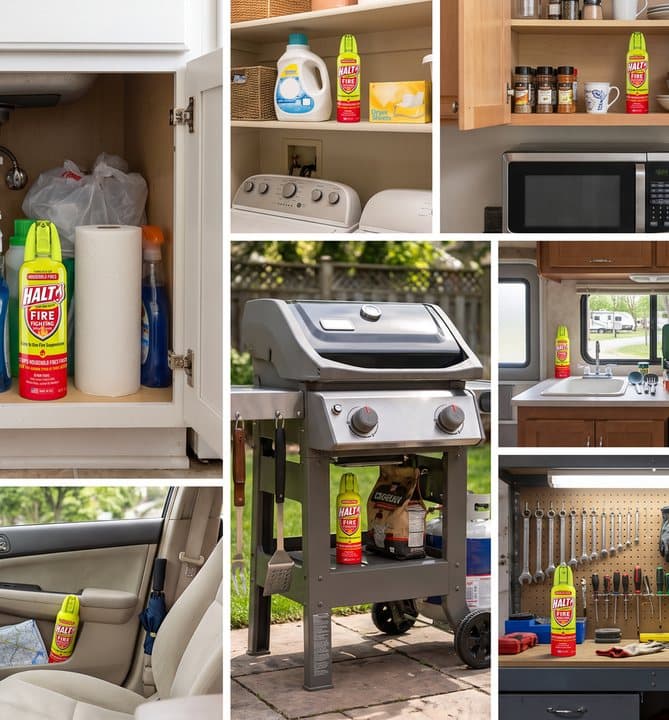
HALT suits households that want a simple backup within arm's reach in places where small fires start: next to the stove, by the grill, in the car or RV, in the garage near tools and batteries. It suits people who find full-size extinguishers intimidating and want something they would actually use.
It does not suit anyone who would rely on it instead of a proper extinguisher, or who would try to fight a fire that is already growing.
Why HALT appeals
Most homes have, at best, one fire extinguisher, often heavy, forgotten in a cupboard, and unfamiliar. In a panic, people hesitate. A light can that works like a household spray, in a bright colour you can keep in several places, removes that hesitation. The PFAS-free, non-toxic message also appeals to families worried about chemicals.
What PFAS-free means
PFAS are long-lasting "forever chemicals" historically used in some firefighting foams, and they persist in the environment and the body. Fire services have been moving away from PFAS foams. HALT says its formula is PFAS-free and fluorine-free, which is a meaningful environmental benefit compared with older foam products.
Who will notice the least difference
Homes that already keep listed extinguishers in the kitchen, garage and each level, plus a fire blanket, gain little from adding aerosol cans. The extra value is mainly convenience in places where a full extinguisher is awkward, such as a car or by the grill.
As a gift
Fire safety items make thoughtful gifts for new homeowners, students and older relatives, but pair a can with a smoke alarm or a proper extinguisher rather than giving it on its own, so the recipient does not treat it as complete protection.
Who gets the most value
People who cook a lot, grill often, keep e-bikes or power tools, or spend time in RVs and boats may value a can within reach. One owner on the page credits it with putting out a grill fire; another with a kitchen fire.
What it will not do
It will not protect a home on its own, fight a spreading fire, or make it safe to stay in a burning building. Fire services advise getting out early; the best fire safety tools are working smoke alarms and an escape plan.
A typical scenario
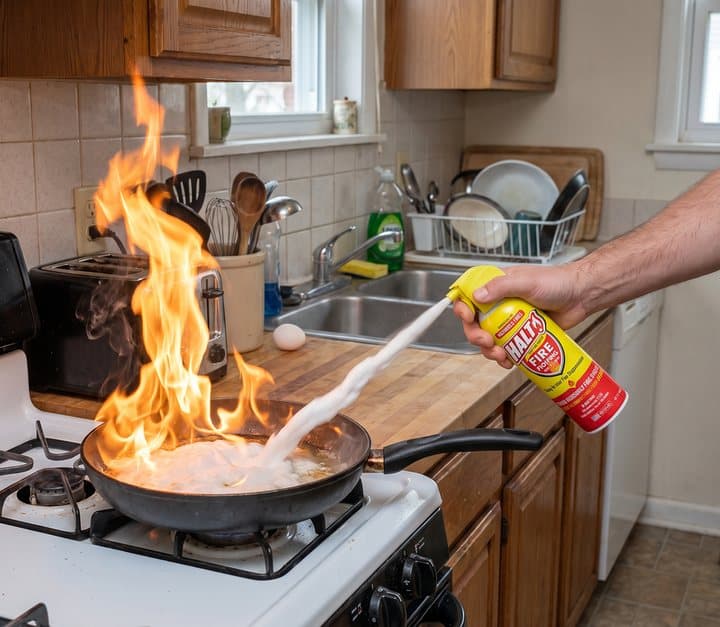
You are frying at the stove and turn away for a moment. When you look back, oil in the pan has caught fire, with flames a few inches high. The right first moves are to turn off the heat if you can reach it safely and slide a lid over the pan.
If you cannot, and the fire is still small, a can like HALT within reach, not behind the stove, gives you a second option: aim at the base and sweep. If the flames reach the cupboards or the room fills with smoke, you leave and call 911. That is the scale of fire a small can is meant for.
- Households that already have proper extinguishers and want extra small cans in the kitchen, car or by the grill
- People nervous about using a full-size extinguisher who want something simpler for tiny fires
- Campers, RV owners and boaters who want a compact backup alongside required equipment
Who should skip it
- Anyone planning to use it instead of a proper fire extinguisher
- Businesses and landlords who need code-compliant extinguishers
- Anyone who would try to fight a fire that is spreading rather than getting out
How much does HALT cost, and what do you get?
HALT cost $29.99 for one can on the offer page on 3 October 2026, with three for $59.98, five for $89.97 and ten for $149.95, about $14.99 a can, and free shipping on bundles. HALT's own store in Florida was cheaper, at $27.99 for one and $64.99 for four. You get a 10 oz aerosol can of plant-based, PFAS-free firefighting foam.
You get a bright yellow and red aerosol can labelled for household fires. HALT's store describes the standard can as 10 oz, with a 16 oz XL version sold separately.
Specifications
| Spec | HALT (brand and page figures) |
|---|---|
| Type | Aerosol fire suppression foam |
| Size | 10 oz; about 8.25 in tall |
| Agent | Plant-based, PFAS-free foam with wetting agent |
| Classes claimed | A, B, C, D, K and lithium-ion |
| Certifications claimed | NSF and USDA certified; UL Recognized Component |
| Made in | USA |
| Guarantee | 30 days (offer page) |
HALT price and bundles
On 3 October 2026 the offer page our link opens showed:
| Package | Total | Per can | Shipping |
|---|---|---|---|
| 1 can | $29.99 | $29.99 | Not marked free |
| Buy 2, get 1 free (3) | $59.98 | $19.99 | Free |
| Buy 3, get 2 free (5) | $89.97 | $17.99 | Free |
| Buy 5, get 5 free (10) | $149.95 | $14.99 | Free |
HALT's own store
HALT's store, based in Windermere, Florida, listed:
| Pack | Price | Per can |
|---|---|---|
| 1 | $27.99 | $27.99 |
| 2 | $36.99 | $18.50 |
| 4 | $64.99 | $16.25 |
| 8 | $115.99 | $14.50 |
It also sells a 16 oz XL can, grilling and lithium-ion versions, fire blankets, gloves and home bundles.
What this means for you: the brand's store was cheaper for one, two, four or eight cans. The offer page's ten-pack works out to $14.99 a can, close to the store's eight-pack price.
How many cans do you need?
| Place | Why |
|---|---|
| Kitchen | Most home fires start while cooking |
| Garage or workshop | Tools, chemicals and charging batteries |
| By the grill | Flare-ups and grease |
| Car or RV | Small vehicle fires, if safe to tackle |
| Bedroom with e-bike or scooter charging | Battery risk, though evacuation comes first |
For most homes, two to four cans in these spots, alongside proper extinguishers, is plenty. Buying more than you can place sensibly only adds cans that will expire in a cupboard.
Who makes it
HALT was launched nationally in October 2024, according to FireRescue1's launch coverage, which names Jerry Bello as founder and CEO alongside co-founders Anthony Fallon and Marc Portney. The coverage describes it as a fire suppressor for incipient-stage fires and notes it is made in the US in aluminium cans. HALT is also sold through hardware and farm retailers.

HALT! Fire Fighting Spray FoamScore 5.5/10
Best for: Households that already have proper extinguishers and want extra small cans in the kitchen, car or by the grill
$29.99 at HALT · Price checked October 3, 2026
Check price at HALT (opens HALT in a new tab)We may earn a commission if you buy through our links.
Can HALT replace a fire extinguisher?
No. Consumer Reports has warned that aerosol fire sprays are no substitute for a fire extinguisher, and HALT's own comparison image describes it as for small fires and an extinguisher as for large ones. A listed extinguisher carries more agent and reaches further. HALT fits as an extra: a small, easy-to-grab can for tiny fires, alongside smoke alarms, proper extinguishers and an escape plan.
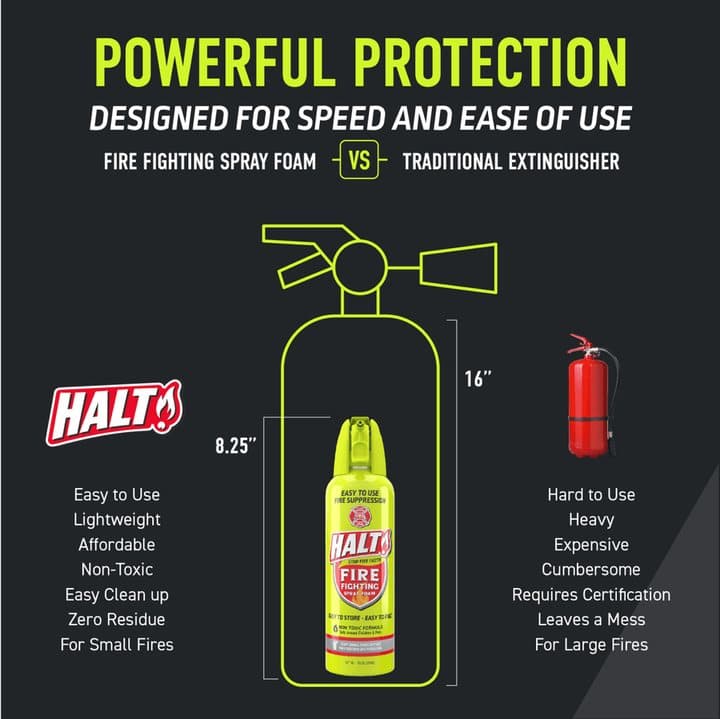
HALT's own comparison: small fires vs large fires
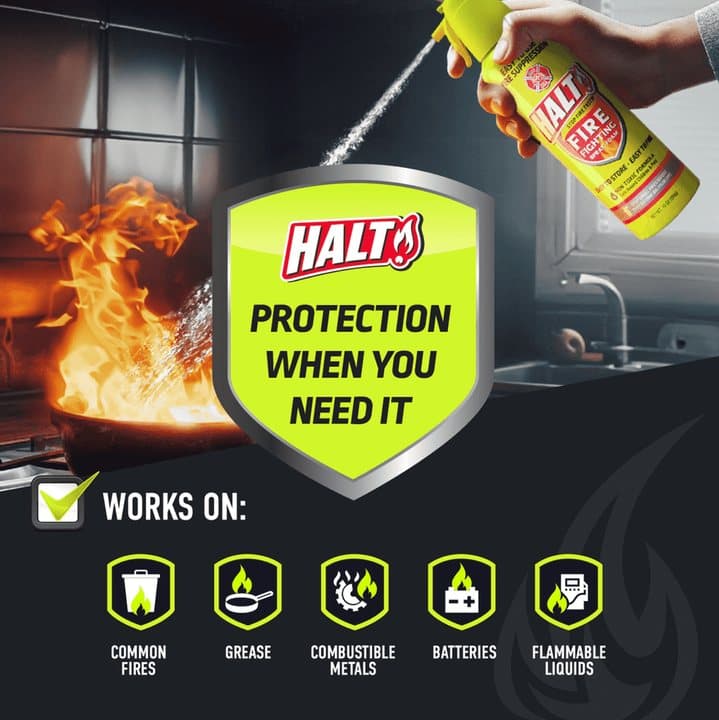
The fire types HALT says it works on
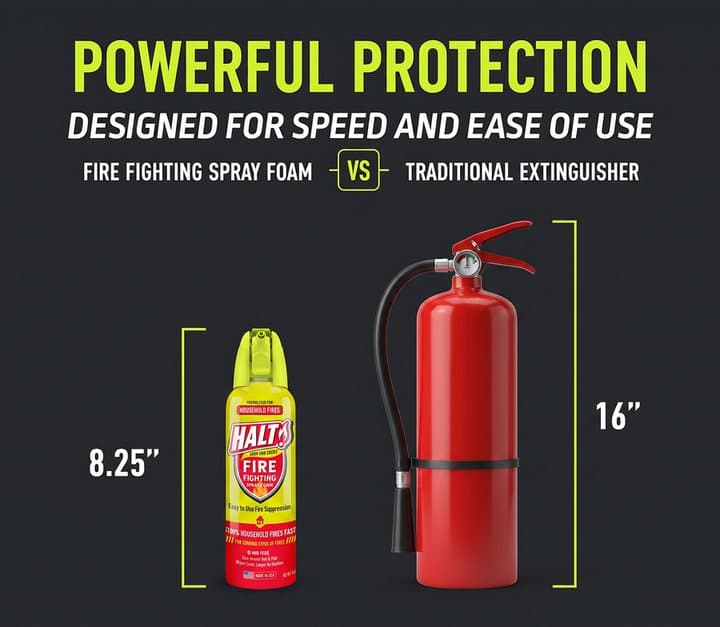
Size compared with a standard extinguisher
Nobody on our team has used HALT. This section explains how aerosol sprays compare with fire extinguishers and what fire safety guidance says.
Aerosol sprays are not fire extinguishers
Consumer Reports has warned that aerosol fire sprays are no substitute for a fire extinguisher. Aerosol products are generally labelled as not intended to replace NFPA 10-compliant portable extinguishers, the standard for fire extinguishers in buildings. Texas law goes further: under the Texas Health and Safety Code, an aerosol fire suppression device cannot be advertised as a "fire extinguisher" unless it conforms to NFPA 10 or is specifically listed for that use.
HALT's own store image comparing HALT with a traditional extinguisher describes HALT as for small fires and the extinguisher as for large fires. That is the right way to think about it.
What a standard extinguisher offers
A household ABC dry chemical extinguisher, listed by a recognised testing laboratory, carries far more agent, sprays further and has a rating that tells you what size of fire it can handle. It is heavier and messier, but it is designed and tested to put out fires of a known size.
Ratings on listed extinguishers, such as numbers before the letters A and B, indicate how large a test fire they can put out. An aerosol spray without a comparable rating does not tell you how big a fire it can handle, which is why safety guidance treats it as supplementary.
How home fires usually start
Cooking is the leading cause of home fires in many countries, followed by heating equipment, electrical problems, smoking materials and candles. Fires involving lithium-ion batteries in e-bikes, scooters and power tools are a growing concern. Most of these start small, which is when a quick response or a fast exit makes the biggest difference.
Fire classes, simply
| Class | What burns | HALT's claim | Practical advice |
|---|---|---|---|
| A | Wood, paper, cloth | Yes | Small fires only; leave if spreading |
| B | Flammable liquids, petrol | Yes | Very dangerous; evacuate if not tiny |
| C | Energised electrical equipment | Yes | Cut the power if safe; evacuate if spreading |
| D | Combustible metals | Yes | Rare at home; needs specialist agents |
| K | Cooking oils and fats | Yes | Turn off heat, cover with a lid; never water |
| Lithium-ion | Batteries | Yes | Can reignite and release toxic gas; get out and call 911 |
Claims to handle all of these, from one small can, deserve caution. Combustible metal and lithium-ion fires in particular are hazardous and can flare up again.
Smoke is the bigger danger
Most deaths in home fires are caused by smoke and toxic gases rather than flames. Smoke can make a room unsurvivable within minutes and makes it hard to see the exit. That is why fire services say: if in doubt, get out, close the door behind you and call 911 from outside.
Why a small can has limits
Every extinguishing agent works by cooling, smothering or interrupting the chemistry of a fire. The amount of agent matters: a larger fire needs more agent applied for longer from a safer distance. A 10 oz can empties quickly. That is fine for a fire the size of a frying pan or a small bin; it is not enough for a burning sofa, curtains or a room.
A home fire safety checklist
| Item | Why it matters |
|---|---|
| Smoke alarms on every level and outside sleeping areas | Early warning is the biggest lifesaver |
| Monthly alarm test | Dead batteries make alarms useless |
| Listed extinguisher in the kitchen and on each level | Rated protection for small fires |
| Fire blanket by the hob | Fast way to smother pan fires |
| Escape plan with two exits per room | Everyone knows how to get out |
| Safe battery charging spot | Reduces lithium-ion fire risk |
| Aerosol spray like HALT | Optional extra for tiny fires |
When to fight a fire, and when to leave
Fire safety guidance commonly advises only trying to put out a fire if it is small and contained, such as in a wastebasket or a pan, you have a clear escape route behind you, everyone else is leaving, and the room is not filling with smoke. Otherwise, get out, close doors behind you and call 911.
The kitchen fire alternative
For a small pan fire, turning off the heat and sliding a metal lid or baking sheet over the pan smothers it. Leave it covered to cool. Never use water on burning oil, and never carry a burning pan.
Preventing cooking fires
- Stay in the kitchen while frying, grilling or boiling. If you must leave, turn off the heat first.
- Keep tea towels, packaging and oven gloves away from the hob. Loose sleeves catch fire easily, so roll them up when cooking.
- Turn pan handles inward so they cannot be knocked.
- Heat oil gradually and never leave it unattended. Smoking oil is a warning sign; turn the heat down.
- Keep a lid that fits your frying pan within reach.
- Clean grease from the hob, extractor and grill regularly.
Battery safety at home
- Charge e-bikes, scooters and power tool batteries on a hard surface, away from exits and flammable items. A garage or outdoor shed is safer than a bedroom or hallway.
- Use the charger supplied by the manufacturer.
- Do not charge overnight or while you are out if you can avoid it.
- Stop using batteries that are swollen, damaged, hot or smell unusual.
- Fit a smoke alarm where you charge large batteries. Buy batteries and chargers from reputable brands, since cheap replacements are a common cause of battery fires.
What owners report
Owners on the page describe putting out a grill fire, a kitchen fire and a test grease fire. Trustpilot reviewers mostly comment on ordering and delivery rather than how it performed.
What we would want to see
Independent test data showing how large a standard test fire the can puts out, how long it sprays and from what distance, and how it performs on cooking oil, would make it much easier to recommend. The page shows demonstrations but no test results.
Are HALT's claims true?
HALT's PFAS-free foam is a genuine environmental plus, and simple point-and-sweep use is accurate. Other claims overreach. Stopping fires "in seconds" applies only to small, early fires. Listing Classes A, B, C, D, K and lithium-ion suggests one small can handles everything, when lithium-ion fires are notoriously difficult. "UL Recognized Component" and "NSF certified" are not the same as a UL-listed extinguisher.
"The only brand delivering NSF-certified, PFAS-free fire suppression for all major types of household fires"
The PFAS-free foam is a genuine environmental plus. "All major types" from a small aerosol is an overreach, and "only brand" cannot be verified.
"Stops household fires in seconds"
A small, early fire, yes, possibly. A fire that has taken hold, no. Fires grow very quickly; the page itself notes a small flame can get out of control in 30 seconds.
Classes A, B, C, D, K and lithium-ion
Listing every class suggests one can handles everything. Standard household extinguishers are not rated for Class D, and lithium-ion fires are notoriously difficult. Treat these claims as marketing, not a reason to stay and fight.
"NSF & USDA certified with a UL Recognized Component"
NSF certification relates to food safety and USDA to bio-based content or similar programmes. A UL Recognized Component is a part evaluated for use within a larger product. None of these is the same as a UL-listed portable fire extinguisher with a fire rating.
"Firefighter recommended" and "Fire Captain Jim"
The page quotes a fire captain identified only by first name. Individual endorsements are not the same as fire service guidance, which consistently recommends proper extinguishers, smoke alarms and escape plans.
"Government tested"
The page does not say which government body tested it or what the results were.
"No pins to pull, no confusing instructions"
Accurate and a real advantage for people who freeze in an emergency. Standard extinguishers use the PASS method: pull the pin, aim, squeeze, sweep. Learning PASS once means you can use either type.
"Won't make a mess"
Dry chemical extinguishers leave a fine powder that spreads and can damage electronics. Foam is easier to clean up, as the brand says. After any fire, cleaning up soot and smoke residue is a bigger job than the agent itself.
"Non-toxic, safe around children and pets"
The foam may be low-toxicity, but any fire produces toxic smoke. Safety comes from getting people and pets out.
"300,000+ extinguishers sold"
We could not verify the figure. The product is sold in hardware and farm stores, so meaningful sales are plausible.
Claims scorecard
| Claim | Our read |
|---|---|
| Easy to use, compact, PFAS-free | Accurate |
| Stops small household fires | Plausible for small, early fires |
| Works on A, B, C, D, K, Li-ion | Overreach for a small aerosol |
| NSF, USDA, UL Recognized Component | Not a UL-listed extinguisher |
| Firefighter recommended, government tested | Unspecified |
| Replaces bulky extinguishers | Contradicted by safety guidance and its own graphic |
| 300,000+ sold | Unverified |
Is HALT better than a fire extinguisher or fire blanket?
Not as a main tool. A listed extinguisher carries more agent, reaches further and is rated for fires of a known size, so keep one on each level and in the kitchen. A fire blanket smothers a small pan fire, never runs out and needs no pressure. HALT is lighter, simpler and less messy, which makes it a sensible extra backup at $15 to $30 a can.
| Tool | Typical cost | Best for |
|---|---|---|
| HALT aerosol spray | $15 to $30 a can | Tiny fires, as a backup |
| Listed ABC home fire extinguisher | Moderate | Small fires of known size; the core tool |
| Kitchen (Class K) or kitchen-rated extinguisher | Moderate to high | Kitchens with heavy frying |
| Fire blanket | Low | Small pan and clothing fires |
| Smoke alarms | Low | Early warning; the most important device |
| Escape plan | Free | Getting everyone out safely |
HALT vs a fire extinguisher
A listed extinguisher carries more agent, reaches further and is rated for fires of a known size. HALT is lighter, simpler and less messy, but holds much less. Keep a proper extinguisher on each level and in the kitchen, and add HALT cans if you want extra backups.
HALT vs a fire blanket
A fire blanket smothers a small pan fire or wraps a person whose clothes have caught fire. It does not run out and needs no pressure. Mount it on the wall near the kitchen exit, practise pulling the tabs, and lay it gently over the pan rather than throwing it. HALT's store also sells fire blankets; both can live in a kitchen.
HALT vs other aerosol fire sprays
Several brands sell aerosol fire sprays. Compare the agent, can size, labelled fire types, any third-party listing for the product as a whole, and the expiry date.
HALT vs a stovetop fire suppressor
Some kitchens fit small automatic suppressors under the extractor hood that release agent if flames rise from the hob. They act without anyone present and suit people who worry about forgetting a pan. They cover only the hob.
Other household products we have reviewed
Our household gadgets section and home and garden hub cover more products sold through offer pages, including Campanelli stain remover, FixIts repair sticks and the GuideLight night-light outlet cover. For another emergency tool worth keeping within reach, see our Kelvin 8 review.
If you already have proper extinguishers and want extra cans, compare HALT's own store with the HALT offer page (opens HALT in a new tab), which was more expensive for small quantities.
HALT! Fire Fighting Spray FoamScore 5.5/10
Why people buy it: Easy to use under stress: point and spray, with no pin to pull
$29.99 at HALT · Price checked October 3, 2026
Check price at HALT (opens HALT in a new tab)We may earn a commission if you buy through our links.
Is HALT legit, and what should you check before buying?
HALT is a real product from a Florida company, launched nationally in October 2024, but it is a supplement, not a replacement. Before buying, make sure you have working smoke alarms and at least one listed extinguisher on each level and in the kitchen. Compare prices with HALT's own store, which was cheaper, and check multi-pack orders on arrival, since reviewers report missing items.
Keep proper extinguishers
HALT is a supplement.
What to do: keep at least one listed fire extinguisher on each level of your home and in the kitchen, check the gauge regularly, and learn how to use it.
Smoke alarms come first
Early warning saves more lives than any extinguisher.
What to do: fit smoke alarms on every level and test them monthly.
Smoke alarm placement
Where you put alarms matters as much as having them.
What to do: fit them on ceilings outside bedrooms and on every level, away from kitchens and bathrooms where steam and cooking cause false alarms. Interlinked alarms, which all sound when one does, give everyone the earliest warning.
Insurance
Some home insurers ask about fire safety equipment.
What to do: if your policy mentions extinguishers, make sure you have the type it specifies; an aerosol spray may not count.
Know when to leave
A can of foam does not make it safe to stay.
What to do: only tackle a fire that is small and contained, with your back to an exit. If in doubt, get out and call 911.
Lithium-ion batteries
Battery fires can reignite and give off toxic gas.
What to do: if a phone, e-bike or power tool battery is smoking or burning, leave the room, close the door and call 911.
Storage and expiry
Aerosols have temperature limits and can lose pressure over time.
What to do: check the label for storage temperatures and expiry, especially for cans kept in cars, and replace any can that has been used.
Orders and support
Trustpilot reviewers report missing items from multi-packs and no replies from support.
What to do: check your delivery against your order straight away and report any missing cans in writing.
Cars and heat
Car interiors get very hot in summer and cold in winter.
What to do: check the label's storage temperature range before keeping a can in a car. Secure it so it cannot roll under the pedals, and replace it if the can is damaged or past its date.
Renters and landlords
Landlords and businesses usually have legal duties for fire safety equipment.
What to do: if you rent, check what extinguishers and alarms are provided. If you are a landlord, provide code-compliant extinguishers; aerosol sprays are not a substitute.
How to buy HALT the smart way
- Make sure you have working smoke alarms and a proper extinguisher, then compare HALT's own store with the HALT offer page (opens HALT in a new tab).
- Decide how many places you want a can: kitchen, grill, car, garage.
- Choose the cheapest option for that number of cans.
- Check shipping and the total before paying.
- Keep your order confirmation and check every can arrives.
- Read the label and expiry date on each can.
- Store cans where you can reach them quickly, not behind the hazard.
What do owners say, and how did we score HALT?
HALT scores 5.5 out of 10: claim accuracy 0.6, build durability 1.2, price competitiveness 1.0, usability 1.5 and owner satisfaction 1.2, each out of 2. Owners describe putting out grill and kitchen fires and feeling safer. Trustpilot showed 3.7 out of 5 from 25 reviews, 68% five-star and 20% one-star, with complaints mostly about fulfilment and support rather than performance.
Reviews on the page
Owners describe putting out a grill fire, a kitchen fire and a test grease fire, and feeling safer with cans at home.
Trustpilot
On 3 October 2026 the Trustpilot profile for get.haltfire.com showed a TrustScore of 3.7 out of 5 from 25 reviews, 68% five-star and 20% one-star. Positive reviews mention fast shipping and one kitchen fire put out. Negative reviews focus on incomplete multi-pack orders, an advertised free fire blanket not received, and unanswered emails. HALT had not replied to negative reviews.
What the reviews agree on
Owners who have used it on small fires are positive. Complaints are mostly about fulfilment and support rather than performance.
What we would test with HALT in hand
If we test it ourselves, we would only do so under controlled conditions with fire safety professionals, comparing discharge time, range and effect on small standard test fires against a listed household extinguisher and a fire blanket. We will update this review if we do.
How we scored HALT
Every score on the site follows the five criteria on our how we test page.
| Criterion | Score | Why |
|---|---|---|
| Claim accuracy | 0.6 / 2 | All fire classes, "only brand", government-tested and extinguisher comparisons overreach |
| Build durability | 1.2 / 2 | Simple aerosol; shelf life and storage not stated on the page |
| Price competitiveness | 1.0 / 2 | Cheaper at the brand's own store |
| Usability | 1.5 / 2 | Point, squeeze, sweep; very easy |
| Owner satisfaction | 1.2 / 2 | Positive use reports; small Trustpilot sample with fulfilment complaints |
| Total | 5.5 / 10 |
The score would rise with a third-party listing for the product as a fire suppressor with a stated fire rating, clearer limits on the page, and a published shelf life.
What we did, and did not, do
We read the offer page, HALT's store data, launch coverage, Consumer Reports' guidance, Texas law on aerosol fire suppression devices and the Trustpilot profile, all on 3 October 2026. Nobody on our team has used HALT, and no figures here come from our own testing.
How to use HALT for the best results
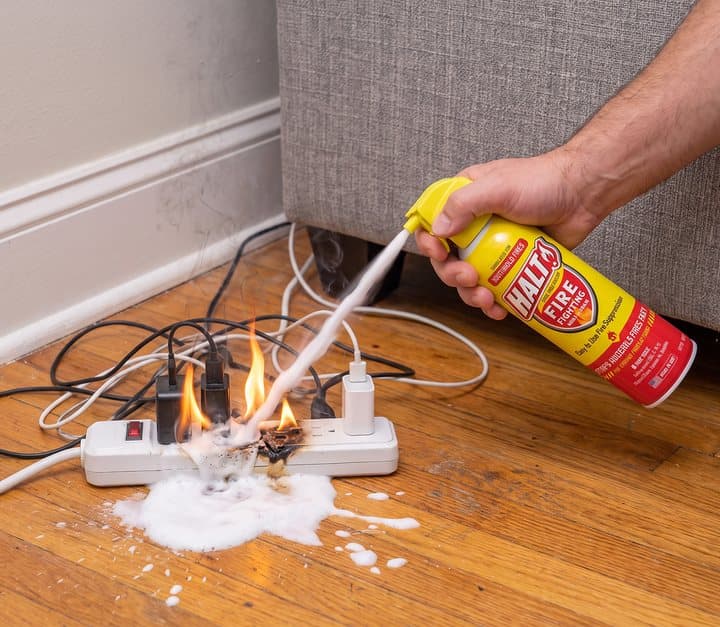
Raise the alarm and make sure everyone is leaving, then only tackle a fire that is small, contained and has a clear exit behind you. Stand back with the can upright, aim at the base of the flames, squeeze the trigger and sweep side to side. If the fire grows or the room fills with smoke, leave and call 911.
- Raise the alarm and make sure everyone is leaving.
- Only tackle the fire if it is small, contained and you have a clear exit behind you.
- Stand back a safe distance, upright, with the can upright.
- Aim at the base of the flames, not the top.
- Squeeze the trigger and sweep side to side across the base.
- If the fire is not going out quickly, stop and get out; call 911.
- After it is out, watch for re-ignition, ventilate the room and replace the can.
Where to keep cans
Near the stove but not behind it, in the garage near charging batteries, by the grill, in the car or RV, and in a workshop. Keep them visible and reachable from the exit side of the room.
Teaching the household
Show everyone in the home where the cans and extinguishers are, how to use them, and, most importantly, when not to. Visitors, babysitters and older children should know too. Children should be taught to get out and tell an adult rather than fight a fire themselves.
Practise without a fire
You cannot test a can without using it, but you can rehearse. Pick up the can, check which way the nozzle points, and practise the stance: upright, a safe distance back, exit behind you. Read the label instructions aloud with your household so everyone hears them once before they ever need them. A few seconds of rehearsal makes it much more likely you will use it correctly in a real emergency.
Checking your cans
Every few months, check each can is still where it should be, undamaged and within its date. Replace any can that has been used, even partly, since it may not have enough pressure left.
Grease fires
Turn off the heat if you can do so safely. A lid or baking sheet is often the quickest way to smother a small pan fire. Never use water and never move the pan.
If you use HALT on a pan fire, spray from a safe distance at the base of the flames rather than straight down into the oil from close up, to avoid splashing burning oil. Keep the heat off and the pan covered afterwards until it is cool.
Grill fires
Close the grill lid and turn off the gas at the burners and the tank if you can do so safely; most grill flare-ups die down without air. Keep the grill well away from the house, fences and overhanging branches. A can of HALT by the grill is a backup for small flare-ups that do not go out when the lid is closed.
Vehicle fires
If you see smoke or flames from a car, pull over, turn off the engine, get everyone out and move well away before calling 911. Do not open the bonnet. A small spray is only for a tiny fire you can reach safely from outside the car, such as a small interior fire just starting.
Electrical fires
If you can safely switch off the power at the plug or breaker, do so. Small electrical fires that do not go out quickly need the fire service.
After any fire
Even if the flames are out, smoke and heat can cause hidden damage. Open windows to clear smoke, keep children and pets away from the area until it is cool and clean, and throw away food that was exposed to smoke or foam. If a fire involved electrical wiring, batteries or structure, have it checked by a professional.
HALT! Fire Fighting Spray FoamScore 5.5/10
Before you buy: Check the final price, shipping and return terms at checkout.
$29.99 at HALT · Price checked October 3, 2026
Check price at HALT (opens HALT in a new tab)We may earn a commission if you buy through our links.
What else do people ask about home fire safety?
Most questions are about extinguishers. Fire safety organisations commonly recommend at least one on each level, with one in or near the kitchen and one in the garage or workshop. For kitchens, a listed multipurpose extinguisher or a fire blanket for pan fires works well. Never use water on an electrical fire while it is energised; turn off the power if safe, or leave and call 911.
How many fire extinguishers should a home have?
Fire safety organisations commonly recommend at least one on each level, with one in or near the kitchen, and one in the garage or workshop.
What fire extinguisher is best for a kitchen?
A listed multipurpose extinguisher suitable for the kitchen, or a fire blanket for pan fires. Heavy-frying commercial kitchens need Class K systems.
Can you use water on an electrical fire?
Not while it is energised. Turn off the power if safe, and use an extinguisher rated for electrical fires, or leave and call 911.
What should I do if a lithium-ion battery catches fire?
Get away from it, close the door if possible and call 911. These fires can reignite and release toxic gases.
How often should I check fire extinguishers?
Check the pressure gauge and condition monthly, and follow the manufacturer's guidance on servicing and replacement.
Do aerosol fire sprays expire?
Aerosols can lose pressure over time. Check the can for an expiry date and replace as directed.
Are fire sprays better than extinguishers for older people?
They are lighter and simpler, which can help people with weak grip or limited strength. But the safest plan for older adults is working smoke alarms, a clear escape route and getting out early. A light spray can be a useful extra near the kitchen.
What is the PASS method?
Pull the pin, Aim at the base of the fire, Squeeze the handle, Sweep side to side. It applies to standard extinguishers; HALT skips the pin.
Should I make a home fire escape plan?
Yes. Fire safety organisations recommend a plan with two ways out of every room, a meeting point outside, and practice at least twice a year, especially with children.
Does HALT work outdoors?
Wind can blow foam away from the fire and spread flames, so outdoor use is harder. For campfires and grills, keep water, sand or a lid nearby, and use HALT only for small, contained flare-ups.
Can HALT be used on people?
If someone's clothes catch fire, the advice is stop, drop and roll, or smother the flames with a fire blanket or heavy cloth, then cool the burn with cool running water and get medical help. Do not spray anything at a person's face.
Is HALT safe to breathe?
The brand describes the foam as non-toxic and odourless. Smoke from the fire itself is the danger; leave the room and ventilate it before returning.
What should I do after using HALT?
Make sure the fire is completely out, ventilate the room, and check nearby surfaces for heat. If anything electrical or structural was involved, have it inspected. Wipe up residue once cool and replace the can.
Can I take HALT on a plane?
Aerosol fire suppression cans are generally not allowed in aircraft luggage. Check with your airline.
Is HALT worth it?
As an extra layer of protection for tiny fires, especially for people who would not use a full-size extinguisher, it can be worth having, ideally bought at the lower store price. As a replacement for extinguishers and smoke alarms, no.
Frequently asked questions
What is HALT fire spray?
HALT Fire Fighting Spray Foam is a 10 oz aerosol can of plant-based, PFAS-free foam from a Florida company, sold for small household fires. You aim at the base of the fire, squeeze the trigger and sweep. Keep it as an extra alongside proper extinguishers.
Is HALT a fire extinguisher?
It is an aerosol fire suppression spray. Safety and consumer organisations advise that aerosol sprays are not a substitute for a code-rated portable fire extinguisher. Keep proper extinguishers and use HALT as a supplement. Check smoke alarms first. Then learn how to use your extinguishers.
How much does HALT cost?
On 3 October 2026 the offer page showed $29.99 for one, $59.98 for three, $89.97 for five and $149.95 for ten. HALT's own store listed one for $27.99, two for $36.99, four for $64.99 and eight for $115.99. Compare delivered totals before ordering.
Does HALT work on grease fires?
The page markets it for grease fires and shows a pan fire being put out. For a pan fire, turning off the heat and sliding a lid over the pan is also effective. Never use water on a grease fire.
Can HALT put out lithium-ion battery fires?
The page says it can. Lithium-ion fires can reignite and release toxic gases. If a battery is burning or smoking, get away, call 911 and let the fire service deal with it. Charge batteries on hard surfaces. Keep exits clear while charging.
Is HALT safe around children and pets?
The brand says the formula is non-toxic, biodegradable and safe around children and pets. Any fire produces smoke and gases that are dangerous; get people and pets out first. Store cans where children cannot play with them. Then call 911 from outside.
Is HALT UL listed?
The page says the formula is NSF and USDA certified with a UL Recognized Component. A recognised component is not the same as a UL-listed portable fire extinguisher. Keep a UL-listed extinguisher as your main tool, and treat HALT as an easy-to-grab backup for very small fires.
How long does HALT last?
The page does not state a shelf life. Check the can for an expiry date, store it at the temperatures on the label, and replace it after use. Check the date regularly, and avoid leaving the can in a hot car for long periods.
We may earn a commission if you buy through our links.
Prices accurate as of October 3, 2026. Check the seller's checkout for current pricing, promotions and terms.
What we checked: No hands-on use. Claims, fire classes, certifications, prices, guarantee, endorsement and testimonials from the HALT offer page our link opens (gethaltfirespray.com) on 2026-10-03. Store prices, product range, images and company location from HALT's own store data the same day. FireRescue1's launch coverage, Consumer Reports' guidance on aerosol fire sprays, the Texas Health and Safety Code on aerosol fire suppression devices, and the Trustpilot profile for get.haltfire.com were read the same day.

About the author
Alex Carter, Senior Tech Reviewer
Alex Carter is the senior tech reviewer at Top10Gadgets, covering the everyday gadgets, home and kitchen devices, smart home products and accessories most people actually buy. Alex judges a product the way a normal buyer…
- Everyday gadgets and accessories
- Smart home devices
- Home and kitchen gadgets
- Value for money
- Long-term reliability
Writing for Top10Gadgets since 2026Full profile