Household Gadgets / Garment care
riddiaPress Review: Is This Pocket-Sized Cordless Iron Good Enough for Travel Touch-Ups?
A palm-sized rechargeable dry iron that heats in about a minute. Handy for collars and a hotel shirt, but its listed 240°F is below normal cotton ironing heat.

By Alex Carter, Senior Tech Reviewer at Top10Gadgets
Updated 29 min readHow we test
Quick answer
Yes, if you travel or commute and want to smooth a collar, cuffs or a single shirt without a full iron or steamer. riddiaPress is tiny, cordless, charges by USB-C and shuts itself off, and owners like how easily it packs. But its own images list 240°F, well below normal cotton ironing heat, one charge does roughly one shirt, and "pro results on any fabric" oversells it. riddiaPress scores 6.1 out of 10, held back by limited heat and battery, not by its convenience.
Score 6.1/10$39.99 at riddia
Check price at riddia (opens riddia in a new tab)We may earn a commission if you buy through our links.
- Best for
- Travellers who want to smooth a collar, cuffs or a single shirt in a hotel room
- Not for
- Anyone who irons whole loads of cotton shirts, trousers or linen regularly
$39.99 at riddia
Check price at riddia (opens riddia in a new tab)We may earn a commission if you buy through our links.
On this page · 14 sections
- 01Our verdict
- 02The short version
- 03Pros & cons
- 04How it works
- 05Who it's for
- 06How much does riddiaPress cost, and what's in the box?
- 07Does riddiaPress work?
- 08Are riddiaPress's claims true?
- 09Is riddiaPress better than a travel steamer or a corded mini iron?
- 10Is riddiaPress legit, and what should you check before buying?
- 11What do owners say, and how did we score riddiaPress?
- 12How to use riddiaPress for the best results
- 13What else do people ask about travel irons?
- 14Frequently asked questions
Our verdict
Yes, if you travel or commute and want to smooth a collar, cuffs or a single shirt without a full iron or steamer. riddiaPress is tiny, cordless, charges by USB-C and shuts itself off, and owners like how easily it packs. But its own images list 240°F, well below normal cotton ironing heat, one charge does roughly one shirt, and "pro results on any fabric" oversells it. riddiaPress scores 6.1 out of 10, held back by limited heat and battery, not by its convenience.
The short version
- A palm-sized, cordless dry iron that heats in about 60 seconds.
- USB-C charging; dual-voltage charging for travel; auto shut-off.
- $39.99 plus shipping on 4 October 2026; three for $79.99, five for $119.99, free shipping.
- The page's image lists 240°F, much cooler than a full-size iron's cotton setting.
- Coverage says one charge presses about one dress shirt.
- No water, no steam; works on a table or bed.
- Optimised for cotton and polyester, according to the seller.
- 30-day money-back guarantee and one-year warranty.
- No independent owner ratings we could find; testimonials are positive and fairly balanced.
- Best trait: genuinely portable touch-ups.
- Biggest drawback: limited heat and battery for anything beyond touch-ups.
- Our score: 6.1 out of 10.
Pros & cons
riddiaPress does a small job well: quick touch-ups away from a full iron. Its cons come from asking more of it than its size allows.
What we like
- Truly pocket-sized and cordless, so you can touch up clothes anywhere
- Heats in about 60 seconds and switches off automatically when idle
- Charges by USB-C; dual-voltage charging for travel, according to the page
- No water tank to fill, spill or empty
- Owners praise its size for trips and quick touch-ups
What we don't
- Its own images list 240°F, well below the heat normally used to iron cotton
- Coverage says one charge does about one dress shirt; the FAQ only says "multiple uses"
- "Pro results on any fabric" overstates a small dry iron; thick fabrics need extra passes
- Owners say the grip takes getting used to
- Single unit adds shipping; generic mini irons sell for less
Sold by riddia
riddiaPress$39.99
How it works
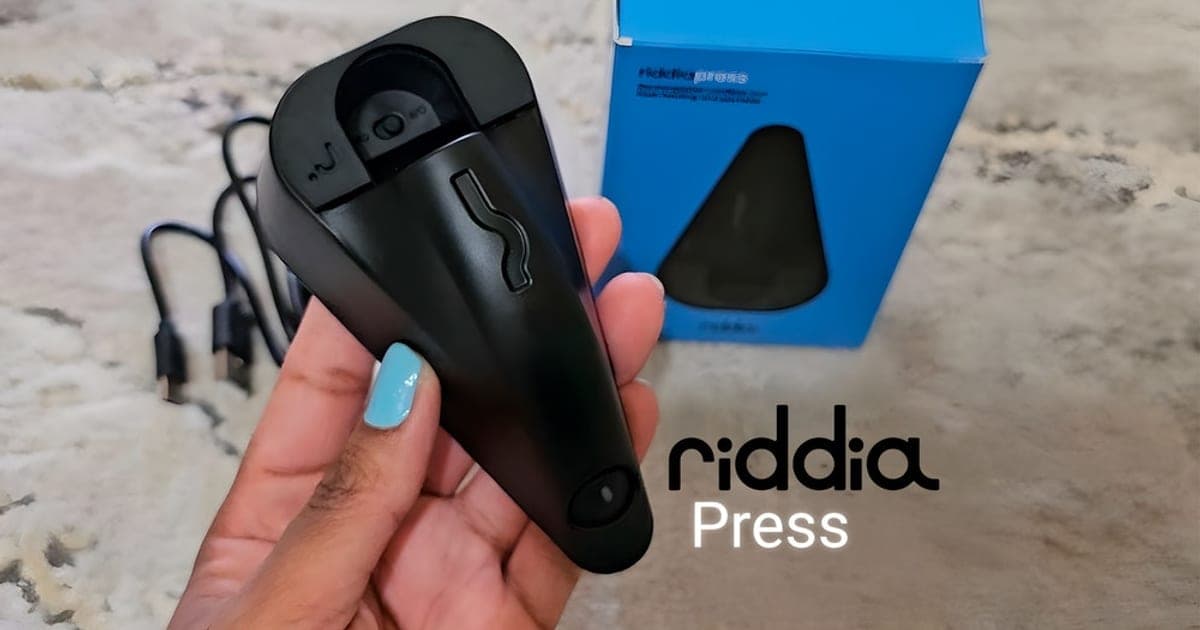
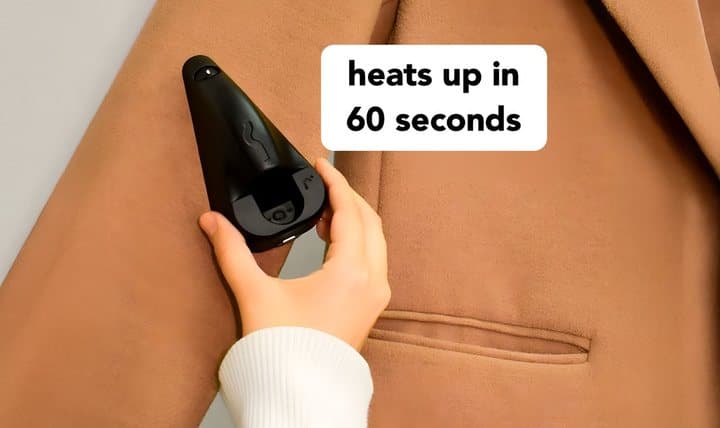
riddiaPress is a small black device shaped like a rounded wedge, roughly the size of a phone. Its flat underside is a heated plate. A rechargeable lithium battery powers a heating element, and a single button switches it on.
Charge and switch on
Step 1: Charge riddiaPress by USB-C, then press the power button. The page says it reaches working heat in about 60 seconds.
Glide over the fabric
Step 2: Lay the garment on a flat surface such as a table or bed and glide the iron over wrinkles. Hold it like a computer mouse, as one owner suggests.
Set it down to switch off
Step 3: When you put it down and stop using it, it switches itself off after being left idle. Recharge between uses.
Dry ironing
Most full-size irons combine heat, pressure and steam. Heat softens fabric fibres, pressure flattens them and steam adds moisture that helps fibres relax. riddiaPress uses heat and pressure only. Without steam, dry ironing works best on lightweight fabrics and light creases. A light mist of water from a spray bottle can help, though the seller does not suggest it.
Why steam helps
Steam carries heat deep into fabric and adds moisture, which lets fibres slip back into a flat position. That is why steam irons and steamers remove wrinkles faster than dry irons at the same temperature. Without steam, riddiaPress relies on its plate heat and your pressure alone, which works for thin fabrics and light creases but takes longer on thicker ones.
The temperature
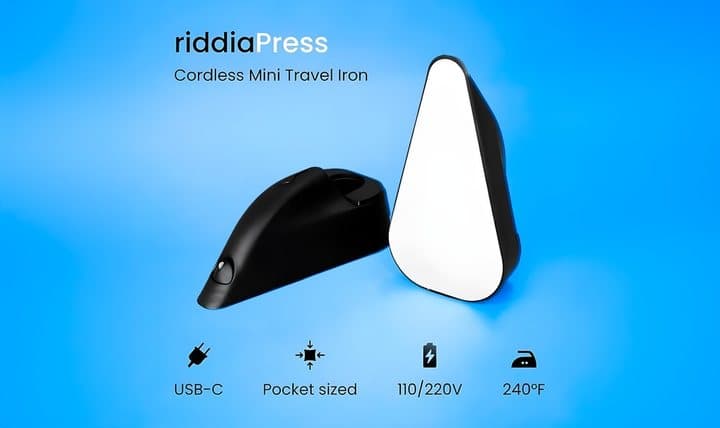
The page's product image lists 240°F, which is about 115°C. Full-size irons typically use roughly 300°F for synthetics, around 300 to 350°F for wool and silk with care, and around 400°F for cotton and linen. At 240°F, riddiaPress is closer to a low synthetic setting. That is safe for most fabrics but less effective at releasing firm creases in cotton. An owner quoted in coverage said it was not as hot as they would like but worked for temporary touch-ups. The page also says it "auto adjusts temperature" without explaining how.
The battery
Heating a metal plate takes a lot of energy for a small battery. The FAQ says it holds enough power for "multiple uses" but gives no figure. Coverage of the product says one charge presses about one standard dress shirt, and an owner on the page says it has the perfect amount of charge for a single shirt. That suits travel touch-ups; it does not suit a week's ironing.
Auto shut-off
The page says riddiaPress powers off automatically when left idle. That is an important safety feature for a hot device you might set down on a hotel bed.
Why cordless is hard for irons
Irons use a lot of power. A full-size iron draws well over a thousand watts from the wall. A small battery can only supply a fraction of that, which is why cordless travel irons run cooler and for shorter times. There is no trick around this: more heat or longer use needs a bigger, heavier battery. riddiaPress chooses tiny size over power, which makes sense for touch-ups.
The soleplate
Coverage describes a ceramic soleplate. Ceramic coatings glide smoothly and spread heat fairly evenly. On a small iron, the plate area is limited, so each stroke covers a narrow strip of fabric. Overlapping strokes help avoid leaving lines.
How the heat is controlled
The page mentions that riddiaPress auto adjusts its temperature, but there is no dial or setting for different fabrics. That keeps it simple but means you cannot turn the heat up for cotton or down for delicate synthetics. You control the effect only through how long you press and whether you add moisture.
Pressure matters
With lower heat and no steam, pressure does more of the work. Pressing firmly and slowly, rather than sliding quickly, gives fibres time to relax. A firm surface under the fabric helps, which is why a folded towel on a table works better than a soft bed.
Who it's for
riddiaPress suits travellers, commuters and professionals who want to smooth a collar, placket, cuffs or a single shirt before a meeting, wedding or dinner. It also suits people in small homes who rarely iron and do not want a full iron and board. Owners in the testimonials describe using it on business trips and holidays.
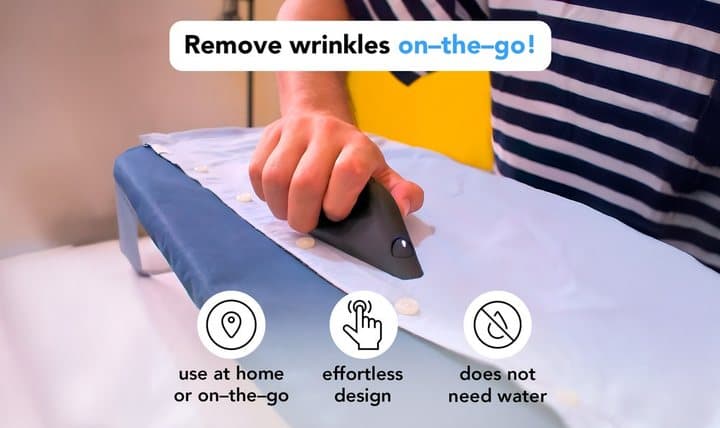
It is not designed for regular household ironing, heavy fabrics or deep creases.
Common reasons people buy it
From the testimonials and marketing, buyers usually want one of a few things: to look neat at a business meeting after travelling, to avoid unreliable hotel irons, to smooth clothes at a wedding or event venue, or to have a tiny iron at home for occasional use. The first three are the strongest fits.
Students and small spaces
Students in dorms and people in small flats often lack space for an ironing board. A tiny iron in a drawer is appealing, but for regular ironing of school or work shirts, its limited heat and battery may become frustrating. A compact corded iron and a heat-resistant ironing mat may serve better.
Why riddiaPress appeals
Hotel irons are often missing, dirty or hard to find, and travel steamers need water and an outlet. A tiny cordless iron that fits in a toiletry bag solves those problems for small jobs. It is quick, needs no setup and leaves no water marks. The USB-C charging means you can top it up from the same charger as your phone or laptop.
It also removes a small source of stress. Many travellers have arrived at a hotel to find the iron missing, broken or leaving marks. Knowing you have your own tool for the parts of an outfit that matter can make packing and preparing for a meeting easier.
A typical trip
You arrive at a hotel the night before a meeting. Your shirt is creased from the suitcase, and the room has no iron. You lay the shirt on the desk on a folded towel, switch on riddiaPress and wait a minute. You press the collar, cuffs and front placket, the parts people notice. The back stays slightly creased under your jacket. You plug it in to recharge overnight in case you need it again.
A typical week of travel
On a four-day work trip, you might use riddiaPress three or four times: once on arrival, once before each meeting and once for evening clothes. With roughly one shirt per charge, you recharge it each night alongside your phone. By the end of the trip, it has saved you from a few creased collars, but you have also noticed its limits on a linen shirt that stayed creased. That is the realistic experience: helpful for touch-ups, not a full replacement.
Business travellers with carry-on only
People who travel with only a small carry-on bag often avoid packing a steamer or iron. riddiaPress takes up about as much space as a phone, so it fits even a tightly packed bag. Packing wrinkle-resistant shirts and rolling clothes reduces how much you need it.
Commuters
A commuter might keep it in a desk drawer at work to smooth a shirt after a cycle ride or a crumpled bag journey. Because it is cordless, you can use it at your desk without looking for an outlet.
Content creators and photographers
People who photograph clothing for online shops or social media often need to smooth a small area quickly before a shot. A cordless mini iron is handy for collars and fronts. For whole garments on a rail, a steamer is usually faster.
As a gift
At about $40, riddiaPress is a practical gift for frequent travellers. Several testimonials mention buying more for travel friends.
Wedding guests and event staff
At weddings and events, outfits often get creased in transit. A cordless iron in a bag can rescue a collar or a tie. Event staff and photographers may find it useful for smoothing table linens or backdrops in small areas, though a steamer is often better for large surfaces.
Crafters
Small irons are popular with quilters and crafters for pressing seams. riddiaPress's low heat and short battery life make it less suited to this than a corded craft iron with temperature control.
- Travellers who want to smooth a collar, cuffs or a single shirt in a hotel room
- Commuters and professionals who need quick touch-ups before a meeting
- People with small homes who rarely iron and want something tiny
Who should skip it
- Anyone who irons whole loads of cotton shirts, trousers or linen regularly
- People wanting to remove deep creases from heavy fabrics
- Buyers who would rather spend less on a corded mini iron or travel steamer
- Anyone who needs to iron delicate fabrics like silk without a temperature setting they control
How much does riddiaPress cost, and what's in the box?
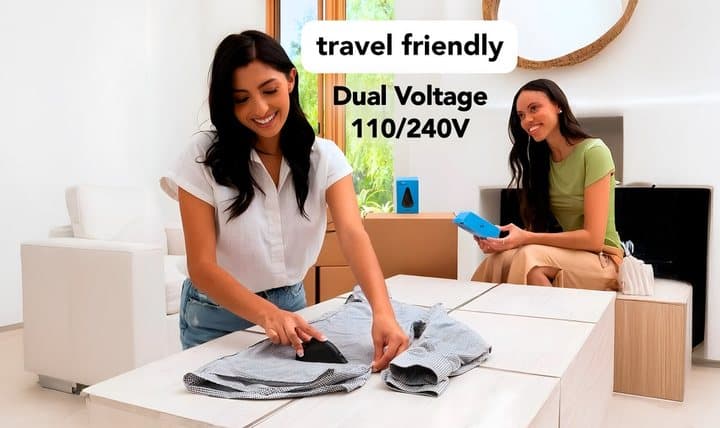
riddiaPress costs $39.99 plus shipping for one on the offer page on 4 October 2026, with three for $79.99 and five for $119.99 including free shipping. The box contains the cordless iron, a user manual and a USB-C cable, but no wall charger. It is a phone-sized dry iron that heats in about 60 seconds, works on 110 or 220V and switches itself off when idle.
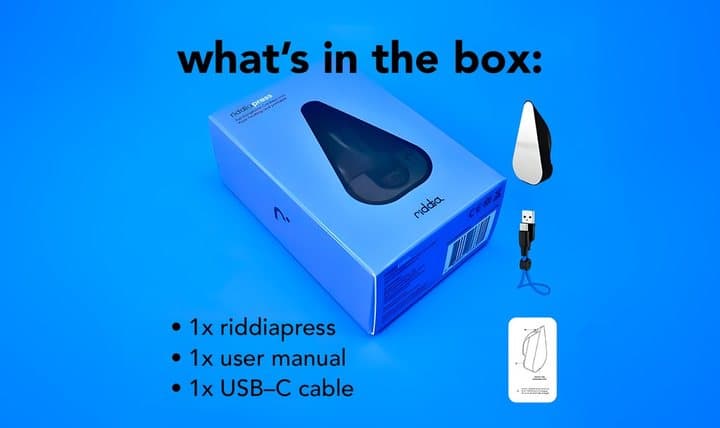
What is in the box
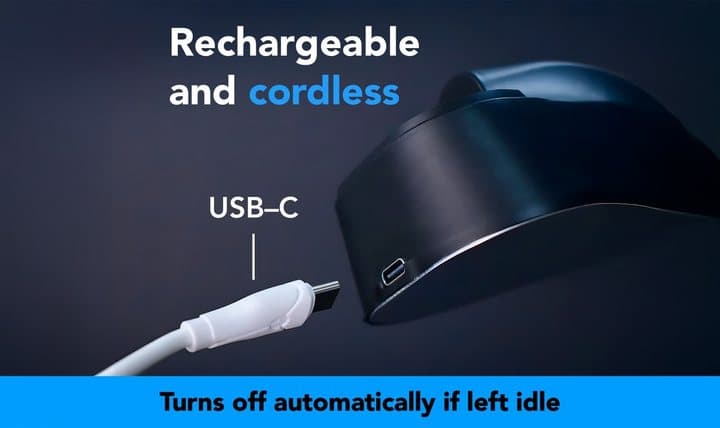
USB-C charging and auto shut-off
In the box
According to the page's image, the box contains the riddiaPress iron, a user manual and a USB-C cable. A wall charger is not shown, so use a USB charger you already own.
Specifications
| Spec | riddiaPress (according to the seller and coverage) |
|---|---|
| Type | Cordless dry iron |
| Heat | 240°F (page image); "optimal heat" in 60 seconds |
| Battery | Rechargeable lithium; about one shirt per charge (coverage) |
| Charging | USB-C; 110/220V dual voltage |
| Safety | Automatic shut-off when idle |
| Size and weight | About 140 x 60 x 25 mm, 200 g (coverage) |
| Soleplate | Ceramic (coverage) |
| Warranty | 1 year |
riddiaPress price and bundles
On 4 October 2026 the riddiaPress offer page (opens riddia in a new tab) listed:
| Package | Price | Per unit | Shipping |
|---|---|---|---|
| 1 riddiaPress | $39.99 | $39.99 | Extra |
| 3 (buy 2, get 1 free) | $79.99 | $26.66 | Free |
| 5 (buy 3, get 2 free) | $119.99 | $24.00 | Free |
Is it good value?
Corded mini travel irons and handheld steamers are widely available, often for less. riddiaPress's advantage is that it is cordless and very small. If you need cordless convenience for quick touch-ups, $39.99 is reasonable. If you will mostly use it near an outlet, a corded mini iron or travel steamer gives more heat for less money.
Cost per use
If you use it on every business trip, even a few times a year, the cost per use over several years is low. If it sits in a drawer after the first trip, it is an expensive gadget. Think about how often you actually face creased clothes without an iron before buying.
Battery lifespan
Lithium batteries lose capacity over a few years of charging. A battery that does one shirt when new may do less over time. The page does not say whether the battery can be replaced. The one-year warranty covers defects, not normal battery ageing.
The bundle prices
The "buy 2, get 1 free" and "buy 3, get 2 free" bundles bring the price per iron down to about $24 to $27. They only make sense if you are buying for several travellers. One iron per traveller is enough.
Shipping times
The page says it ships in 12 hours in one place and within 24 to 48 hours in the FAQ. Either way, US delivery is quoted at 3 to 5 business days on average.

riddiaPressScore 6.1/10
Best for: Travellers who want to smooth a collar, cuffs or a single shirt in a hotel room
$39.99 at riddia · Price checked October 4, 2026
Check price at riddia (opens riddia in a new tab)We may earn a commission if you buy through our links.
Does riddiaPress work?
riddiaPress works for light touch-ups. Owners describe it handling collars, cuffs and dress shirts well while travelling, heating quickly and packing easily. Its limits come from its specifications: the page's image lists 240°F, well below normal cotton ironing heat, there is no steam, and coverage says one charge does about one shirt. Deep creases in cotton, linen or heavy fabrics will be smoothed, not crisply pressed.
For light touch-ups
Owners in the testimonials and coverage describe it working well on dress shirts and for quick touch-ups while travelling. One says it is much smaller than other travel irons and steamers they have owned. Another says it worked well on dress shirts but takes getting used to.
Owner experiences in coverage
Coverage of the product quotes an owner who said it works exactly as described, heats quickly and charges conveniently by USB, and another who said it is not as hot as they would like but works for temporary touch-ups on flights. Together, these match what its specifications suggest.
For heavy creases
At 240°F and without steam, deep creases in cotton, linen or heavy fabrics are hard to remove. The FAQ suggests extra passes for thicker materials. Expect smoother, not crisply pressed.
Why deep creases resist
Cotton and linen fibres hold creases strongly when dry. Releasing them needs high heat and, ideally, moisture. Steam irons and steamers add both. A 240°F dry plate softens the fibres less, so creases relax only partly. Lightly dampening the crease with a spray bottle before pressing gives the iron moisture to work with and can make a noticeable difference.
Polyester and blends
Polyester and cotton-polyester blends need less heat and crease less in the first place. That is why the FAQ says riddiaPress is optimised for cotton and polyester: in practice, it is likely to perform best on blends and synthetics, and less well on pure cotton.
Heat-up time in practice
The page says it reaches working heat in 60 seconds, and owners agree it heats quickly. In cold rooms or when the battery is low, it may take a little longer. Starting with less heat-sensitive areas while it finishes warming makes good use of that time.
The grip
Two owners mention the grip. One finds it works best held like a computer mouse; another says holding it takes some getting used to. The wedge shape is compact but not as easy to steer as a handle.
Battery limits
If one charge covers about one shirt, plan to charge it between uses. On a trip with several outfits, you may need to recharge between shirts.
What a fair test would show
A useful test would press identical creased cotton, polyester and blend shirts with riddiaPress, a corded mini iron and a travel steamer, timing each and photographing the results, then measure how many garments one charge covers. We found no independent test like that. The owner comments and the 240°F label suggest it is best for light touch-ups on blends.
Realistic expectations
Expect collars, cuffs, plackets and light creases to look neater. Do not expect it to replace a full iron for regular ironing.
Who will be disappointed
People who buy riddiaPress expecting a full iron in miniature are the most likely to be disappointed. They will find it slow on cotton, limited by battery and awkward for large areas. People who buy it for collars and cuffs on the road are most likely to be pleased. Matching expectations to its design is the key to being happy with it.
Are riddiaPress's claims true?
riddiaPress's convenience claims hold up: it is pocket-sized, needs no water, shuts itself off and heats in about 60 seconds, which owners confirm. "Eliminates wrinkles" is only partly true, since deep creases may remain. "Pro results on any fabric" is overstated, because the FAQ itself says it is optimised for cotton and polyester and needs extra passes on thicker fabrics, and "multiple uses" per charge is vague.
"The pocket-sized iron that eliminates wrinkles on-the-go"
Partly true. It reduces light wrinkles; deep creases may remain.
"Pro results on any fabric"
Overstated. The FAQ itself says it is optimised for cotton and polyester and needs extra passes on thicker fabrics.
"Ready in 60 seconds"
Plausible. Owners describe quick heating.
"Holding enough power for multiple uses"
Vague. Coverage and an owner suggest roughly one shirt per charge.
"No water needed"
True. It is a dry iron.
"Automatic safety shut-off"
Plausible; a sensible feature.
"Smaller than your phone"
Roughly true for length; it is thicker than a phone.
Claims scorecard
| Claim | Our view |
|---|---|
| Eliminates wrinkles | Partly; light creases |
| Pro results on any fabric | Overstated |
| Ready in 60 seconds | Plausible |
| Multiple uses per charge | Vague; about one shirt |
| No water | True |
| Auto shut-off | Plausible |
Is riddiaPress better than a travel steamer or a corded mini iron?
riddiaPress is smaller and cordless, which makes it best for collars, cuffs and quick touch-ups anywhere. A handheld travel steamer relaxes wrinkles on hanging garments and is gentle on delicate fabrics, but needs water and usually an outlet. A corded mini iron often reaches full cotton heat and may have steam, so if you carry a power adapter anyway, it may handle more ironing for less money.
| Option | Typical cost | Cordless | Heat and steam | Best for |
|---|---|---|---|---|
| riddiaPress | $39.99 | Yes | 240°F, dry | Touch-ups anywhere |
| Corded mini travel iron | Often less | No | Higher heat, some steam | Small loads near an outlet |
| Handheld travel steamer | Often less | Usually no | Steam | Hanging garments, delicate fabrics |
| Hotel iron | Free | No | Full heat and steam | Full ironing, if available |
| Wrinkle release spray | Low | Yes | None | Light creases |
| Hanging in a steamy bathroom | Free | Yes | Steam | Light creases on knits and synthetics |
riddiaPress vs a travel steamer
Steamers relax wrinkles on hanging garments and are gentle on delicate fabrics, but need water and usually an outlet. riddiaPress is drier, smaller and cordless, better for collars and cuffs.
riddiaPress vs a corded mini iron
Corded mini irons often reach full cotton heat and may have steam. They need an outlet but can handle more ironing. If you travel with a power adapter anyway, they may be the better tool.
riddiaPress vs wrinkle-release sprays
Wrinkle-release sprays relax fibres so creases fall out as fabric is smoothed by hand. They are cheap, cordless and light, but work best on light creases and some fabrics. Combining a spray with riddiaPress can improve results on cotton, because it adds the moisture a dry iron lacks.
riddiaPress vs free tricks
Hanging clothes in the bathroom during a hot shower, using wrinkle release spray, or rolling clothes when packing can avoid or reduce creases without any device.
riddiaPress vs a cordless steamer
Some handheld steamers are cordless too, but steam needs a lot of energy, so battery steamers often run for only a few minutes. They also need water. For hanging garments, a corded steamer is usually more effective; for collars and cuffs, a small iron is often neater.
riddiaPress vs other gadgets we have reviewed
We have reviewed other small household helpers, including FixIts, Jiffys and Halt Fire, and the Ondrela tracker card for travellers. More are in our household gadgets category.
If riddiaPress suits your travel routine, compare today's riddiaPress bundles (opens riddia in a new tab) with the single unit, which adds shipping.
riddiaPressScore 6.1/10
Why people buy it: Truly pocket-sized and cordless, so you can touch up clothes anywhere
$39.99 at riddia · Price checked October 4, 2026
Check price at riddia (opens riddia in a new tab)We may earn a commission if you buy through our links.
Is riddiaPress legit, and what should you check before buying?
riddiaPress is a real product with a 30-day money-back guarantee and a one-year warranty, though we found no Trustpilot profile. Before buying, accept that it suits touch-ups rather than full ironing, plan to charge it between garments, and test it on an inside seam first, especially with synthetics. Keep it in your carry-on when flying, because it has a lithium battery, and check your airline's rules.
Heat and fabrics
What to do: test on an inside seam first, especially with synthetics and blends. Avoid using it on plastic prints, sequins, vinyl or delicate trims.
Overheating and storage
What to do: store it in a cool, dry place, away from direct sun in a car or hot bag. Lithium batteries do not like heat, and a hot battery can wear faster.
Battery
What to do: charge it fully before a trip and recharge between garments if needed.
Flying
riddiaPress contains a lithium battery and a heating element.
What to do: pack it in your carry-on, not checked luggage, and check your airline's rules for heat-producing devices with lithium batteries. Make sure it cannot switch on accidentally in your bag.
Synthetic and printed fabrics
Even at 240°F, some synthetics, printed designs and heat-transfer logos can melt or smear.
What to do: iron printed areas on the reverse side or avoid them, and test synthetics on an inside seam.
Children
What to do: keep it out of reach of children while hot and charging. Its small size can make it look like a toy.
Hot surfaces
What to do: let it cool before packing, and never leave it on bedding or near children while hot.
Grip
What to do: practise on a spare item at home before your trip.
Shipping and delivery
The page states "ships in 12 hours" in one place and "within 24 to 48 hours" in the FAQ.
What to do: order well before a trip, and check the delivery estimate at checkout.
Charging abroad
The page says it supports 110 to 220/240V, which covers most countries. You still need the right plug adapter for the wall socket.
What to do: charge from a USB charger you already use abroad, or a laptop.
Returns and warranty
What to do: test it on your usual travel clothes in the first week, and keep your confirmation for the 30-day guarantee and one-year warranty.
How to buy riddiaPress the smart way
- Decide whether you need cordless use, then go to the riddiaPress order page (opens riddia in a new tab).
- Buy one unless you are buying gifts.
- Check the total with shipping.
- Charge and test it on several fabrics at home.
- Keep your confirmation for the guarantee and warranty.
What do owners say, and how did we score riddiaPress?
riddiaPress scores 6.1 out of 10: claim accuracy 0.9, build and durability 1.2, price competitiveness 1.2, usability 1.6 and owner satisfaction 1.2, each out of 2. We found no Trustpilot profile, and coverage cites a 4.2 rating. The page's testimonials are balanced: travellers praise its size and fast USB-C charging, while noting enough charge for about one shirt and a grip that takes getting used to.
Owner ratings
We found no Trustpilot profile for riddiaPress. Coverage cites an overall rating of 4.2 out of 5 and mentions an owner who found it not as hot as they would like.
The testimonials on the page
The page shows four testimonials: a traveller who calls it a great item for touch-ups at home and away, a traveller who found it much smaller than other irons, with enough charge for a single shirt and fast USB-C charging but an awkward grip, a dress-shirt user who also found the grip took getting used to, and a holidaymaker buying more for friends. These are selected by the seller but include honest details about battery and grip.
What we would want to know from owners
Useful owner reviews would say how many garments a full charge really covers, how long it takes to recharge, how well it works on pure cotton versus blends, and how the battery holds up after a year. Those details are what decide whether it is a good travel companion.
Why we score it where we do
riddiaPress does what a tiny cordless iron can do, and owners seem broadly satisfied with it for touch-ups. Its score is held back by overstated marketing about fabrics and battery, low heat compared with a full iron, and cheaper corded alternatives. Clear battery and temperature specifications would make it easier to recommend.
How we scored riddiaPress
Scores follow the five criteria on our how we test page, each worth up to 2 points.
| Criterion | Score | Why |
|---|---|---|
| Claim accuracy | 0.9 | "Pro results on any fabric" and vague battery claims overstate |
| Build and durability | 1.2 | One-year warranty; small battery |
| Price competitiveness | 1.2 | Fair for cordless; corded options cheaper |
| Usability | 1.6 | Tiny, quick, USB-C; grip takes practice |
| Owner satisfaction | 1.2 | Positive, balanced testimonials; no independent rating |
| Total | 6.1 |
What we did, and did not, do
Nobody on our team has used riddiaPress. We checked the offer page our link opens and press coverage. We did not measure its temperature, battery life or results on fabrics.
How to use riddiaPress for the best results
Charge riddiaPress fully before you need it, and lay the garment on a flat, padded surface such as a folded towel on a table. Give it the full 60 seconds to heat, hold it like a computer mouse, as one owner suggests, and work in small sections, pressing collars, cuffs and plackets first. Start with heat-sensitive fabrics while it warms, and test synthetics on a hidden area.
- Charge fully. Charge it before you need it.
- Use a flat, padded surface. A folded towel on a table works well.
- Wait for heat. Give it the full 60 seconds.
- Hold it like a mouse. An owner suggests this grip.
- Work in small sections. Press collars, cuffs and plackets first.
- Add light moisture. A light mist of water on stubborn creases can help a dry iron.
- Let it cool before packing.
Fabric order
Start with the most heat-sensitive fabrics while it warms, then move to cotton when it is fully hot. Always test synthetics on a hidden area.
Shirts in a hurry
Focus on what shows: collar, cuffs and front placket. Under a jacket, the back and sleeves matter less.
Ties and scarves
Use the lowest heat setting your fabric allows and press through a thin cloth, such as a handkerchief, to avoid shine on silk ties and scarves. Test first, as the seller does not provide a silk setting.
Combining with hanging
When you arrive, hang clothes in the bathroom while you shower. The steam relaxes many creases. Then use riddiaPress on the collar, cuffs and placket for a sharper finish. This combination often gives better results than either method alone.
Pressing trousers
Trouser creases need heat and pressure along a long line. A small plate makes this slow. Lay the trouser leg flat, align the seams and press section by section, overlapping each stroke. For a sharp crease, a full-size iron is easier.
Packing to avoid creases
Roll or fold clothes with tissue paper, hang them as soon as you arrive, and choose wrinkle-resistant fabrics when travelling.
riddiaPressScore 6.1/10
Before you buy: Check the final price, shipping and return terms at checkout.
$39.99 at riddia · Price checked October 4, 2026
Check price at riddia (opens riddia in a new tab)We may earn a commission if you buy through our links.
What else do people ask about travel irons?
Most questions compare mini irons with full-size irons and steamers. Mini irons are designed for small areas and touch-ups, while full-size irons are hotter, heavier and usually have steam, typically around 400°F for cotton. Steamers suit hanging garments and delicate fabrics; mini irons suit crisp collars and cuffs. Always follow your garment's care label and test unfamiliar fabrics first.
Do mini irons work as well as full-size irons?
No. They are designed for small areas and touch-ups. Full-size irons are hotter, heavier and usually have steam.
Is a steamer or an iron better for travel?
Steamers are better for hanging garments and delicate fabrics; mini irons are better for crisp collars and cuffs.
What temperature should I iron cotton at?
Full-size irons typically use around 400°F for cotton. Follow your garment's care label.
Can I take an iron on a plane?
Corded irons are generally allowed. Cordless irons with lithium batteries usually must go in carry-on luggage. Check your airline.
How do I remove wrinkles without an iron?
Hang clothes in a steamy bathroom, use wrinkle release spray, or lay them flat under a heavy book.
Why does my iron leave shiny marks?
Shine happens when heat and pressure flatten fibres on dark or synthetic fabrics. Press on the reverse side or use a pressing cloth to avoid it.
Is it safe to iron on a bed?
Beds are soft and can let fabric bunch, and some bedding is heat-sensitive. A folded towel on a firm table is better. If you must use a bed, put a thick towel down and never leave the iron on it.
How do I clean the soleplate?
Let it cool completely, then wipe the plate with a damp cloth. For residue, use a little mild soap on the cloth and wipe again with clean water. Avoid abrasive pads, which can scratch ceramic coatings.
How long should a travel iron take to heat up?
Small irons usually heat within one to two minutes. riddiaPress claims about 60 seconds.
Is a cordless iron safe in a hotel room?
Generally yes, with the same care as any hot appliance. Use it on a towel on a firm surface, do not leave it unattended while hot, and keep it away from curtains and bedding. The automatic shut-off adds a layer of protection if you forget it is on.
What fabrics should I avoid with a mini iron?
Avoid vinyl, leather, sequins, heat-transfer prints, very delicate synthetics and anything labelled "do not iron". Check care labels first. When in doubt, press through a thin cotton cloth or skip ironing and hang the garment in a steamy bathroom.
How do I stop clothes creasing in a suitcase?
Roll knits and casual clothes, fold shirts around a central item or tissue paper, use packing cubes to stop movement, and hang clothes as soon as you arrive. Choosing fabrics with some stretch or synthetic content also helps.
Do I need a travel iron if hotels provide one?
Many hotels do, but not all, and some only on request. If you travel often for work or events, having your own small option avoids relying on availability. If you travel mainly for leisure in casual clothes, you may not need one at all.
Can riddiaPress replace a steamer?
Not for hanging garments, curtains or long dresses, where a steamer is far quicker. riddiaPress is better for small, precise areas.
Why is my shirt still creased after ironing?
Common reasons with a small dry iron are fabric that is too thick or too dry, a plate that has cooled as the battery runs low, strokes that are too fast, or a soft surface underneath. Lightly mist the crease, press slowly on a firm padded surface and check the battery level.
Is it worth buying more than one?
Only if several people in your household travel separately. One iron is enough for a couple travelling together, as it charges quickly between uses.
Does riddiaPress work on wool?
Wool presses best with steam and a pressing cloth. A small dry iron can smooth light creases in wool with a damp cloth between plate and fabric, but take care not to create shine. A steamer is usually better for wool suits and coats.
What should I look for in any travel iron?
Size, weight, heat level, whether it has steam, battery life if cordless, dual-voltage support, auto shut-off and a soleplate that glides smoothly. Decide which matter most for your trips before choosing.
Does riddiaPress smell when first used?
Many new heating appliances give off a faint smell the first time they heat up, as coatings and residues burn off. If you notice this, heat it in a ventilated room before using it on clothes. A strong or persistent burning smell is a reason to stop and contact support.
How should I pack it?
Let it cool completely, then pack it in a soft pouch or wrap it in a sock to protect the plate and stop the button being pressed. Keep the USB-C cable with it so you can charge it on arrival. If you are flying, keep it in an easy-to-reach pocket of your carry-on in case security staff want to inspect it, and make sure it is fully switched off before you pack it.
Many airlines ask that heat-producing devices with batteries be protected against accidental activation, so a pouch or cap over the button helps keep it safe. A quick check of your airline's website before you leave avoids surprises at the security desk, especially when changing airlines or flying internationally on a long trip abroad, where battery rules can be stricter.
Can I iron while it is charging?
The page does not say. Many battery devices can be used while charging, but check the manual, and never use it with a damaged cable.
Is riddiaPress legit?
Yes. It is a real product with balanced owner testimonials. Its marketing overstates its heat and battery.
Is riddiaPress worth it?
For travel touch-ups where cordless convenience matters, yes. For regular ironing, no.
Frequently asked questions
What is riddiaPress?
riddiaPress is a small, cordless, rechargeable dry iron about the size of a phone. It heats in about 60 seconds, charges by USB-C and switches itself off when idle. It suits touch-ups on collars, cuffs and single shirts rather than full ironing.
How much does riddiaPress cost?
On 4 October 2026 the offer page our link opens listed one riddiaPress at $39.99 plus shipping, three for $79.99 and five for $119.99, with free shipping on the bundles. Generic mini irons sell for less, so compare before buying.
How hot does it get?
The page's product image lists 240°F (about 115°C). The FAQ says only that it reaches optimal heat in 60 seconds and is optimised for cotton and polyester. Normal cotton settings on a full-size iron are much hotter. Expect smoother rather than crisply pressed cotton.
How long does the battery last?
The FAQ does not give a figure. Coverage of the product says one charge presses about one standard dress shirt, and an owner describes it as the right amount of charge for a single shirt. Recharge it by USB-C between garments if needed.
Does it need water?
No. It is a dry iron with no water tank or steam. Without steam, deep creases in cotton, linen and heavy fabrics are harder to remove, so expect smoother rather than crisply pressed results. Hanging garments in a steamy bathroom first can help relax wrinkles.
Do I need an ironing board?
No. The FAQ says any flat surface such as a table or bed will do. A folded towel underneath helps. Avoid surfaces that could scorch, and let the iron cool completely before packing it away in a soft pouch.
Can I take it on a plane?
It has a built-in lithium battery, so keep it in your carry-on and check your airline's rules for heated devices with lithium batteries. Pack it switched off in a soft pouch so the button cannot be pressed by accident.
What is the guarantee?
The page shows a 30-day money-back guarantee and a one-year warranty. Charge it and test it on a shirt as soon as it arrives, and keep your order confirmation. Shipping is extra on a single unit, so compare the total before ordering.
We may earn a commission if you buy through our links.
Prices accurate as of October 4, 2026. Check the seller's checkout for current pricing, promotions and terms.
What we checked: No hands-on use. Claims, features, images (including the 240°F and 110/220V labels), box contents, FAQ answers, prices, bundles, guarantee, warranty and testimonials from the riddiaPress offer page our link opens (getriddiapress.com) on 2026-10-04. Battery life per charge, size and weight from press coverage. We found no Trustpilot profile for the brand.

About the author
Alex Carter, Senior Tech Reviewer
Alex Carter is the senior tech reviewer at Top10Gadgets, covering the everyday gadgets, home and kitchen devices, smart home products and accessories most people actually buy. Alex judges a product the way a normal buyer…
- Everyday gadgets and accessories
- Smart home devices
- Home and kitchen gadgets
- Value for money
- Long-term reliability
Writing for Top10Gadgets since 2026Full profile