Hearing / Sound amplifiers
HearingAid Max Review: A $79 Sound Amplifier Sold Under a Hearing Aid Name
A single behind-the-ear amplifier with a volume dial and button batteries. It makes sound louder, but the page calls itself an amplifier and shows no FDA hearing aid status.

By James Wilson, Consumer Tech Writer at Top10Gadgets
Updated 15 min readHow we test
Quick answer
No if you have hearing loss; an OTC hearing aid is the right tool and can cost less per pair. HearingAid Max is a small behind-the-ear amplifier with a volume dial, run on button batteries, and it can make the TV or a quiet chat louder.
Score 3.3/10$79.00 at G Com Pte Ltd
Check price at G Com Pte Ltd (opens G Com Pte Ltd in a new tab)We may earn a commission if you buy through our links.
- Best for
- Adults without diagnosed hearing loss who want a little extra volume for TV or quiet chats
- Not for
- Anyone with known or suspected hearing loss in both ears
$79.00 at G Com Pte Ltd
Check price at G Com Pte Ltd (opens G Com Pte Ltd in a new tab)We may earn a commission if you buy through our links.
On this page · 14 sections
- 01Our verdict
- 02The short version
- 03Pros & cons
- 04How it works
- 05Who it's for
- 06Is HearingAid Max a hearing aid or a sound amplifier?
- 07When should you see a doctor instead?
- 08How much does HearingAid Max cost, and what do the add-ons add?
- 09Is HearingAid Max better than an OTC hearing aid?
- 10Is HearingAid Max legit, and what should you check before buying?
- 11How did we score HearingAid Max?
- 12How to use HearingAid Max safely if you buy it
- 13What else do people ask about cheap hearing aids?
- 14Frequently asked questions
Our verdict
No if you have hearing loss; an OTC hearing aid is the right tool and can cost less per pair. HearingAid Max is a small behind-the-ear amplifier with a volume dial, run on button batteries, and it can make the TV or a quiet chat louder. But its own title calls it a "hearing amplifier", we found no sign of FDA hearing aid status, and the FDA says amplifiers are not meant to compensate for hearing loss. It is one ear for $79, while Audien's OTC Atom One pair is $98. HearingAid Max scores 3.3 out of 10, held back by what it is.
The short version
- What it is: a behind-the-ear personal sound amplifier with a volume control, for one ear.
- Price: $79 for one on 6 October 2026, with a five-pack for $197 flagged as the best seller.
- Best trait: simple and cheap to run on button batteries.
- Biggest drawback: an amplifier, not an FDA-registered hearing aid, sold under a hearing aid name.
- Our score: 3.3 out of 10.
Pros & cons
Sound amplifiers have a place for people without hearing loss who want a boost in quiet settings. The cons are about the name and the market: since 2022, real OTC hearing aids have been available without a prescription, and they are built for hearing loss.
What we like
- Small behind-the-ear unit with a simple volume control
- Runs on cheap AG13 button batteries
- Can make TV and conversation louder in quiet settings
- Skin-coloured case is fairly discreet
- The seller names a registered company with an address, email and phone number
What we don't
- The title calls it a 'hearing amplifier'; we found no sign it is an FDA-registered OTC hearing aid
- The FDA says sound amplifiers are not intended to compensate for hearing loss
- One device for one ear at $79; Audien's OTC Atom One costs $98 for a pair in our review
- Volume only: no tuning for your hearing, noise reduction or feedback control listed
- The add-on case image shows another brand, Jecpp
- Return postage to an overseas seller is yours to pay
Sold by G Com Pte Ltd
HearingAid Max$79.00
How it works
HearingAid Max is a basic amplifier. A small microphone in the behind-the-ear case picks up sound, a circuit makes it louder and a tiny speaker sends it down a tube into a soft tip in your ear canal. A dial sets the volume. It amplifies everything the microphone hears, including background noise, which is the main difference from hearing aids that are tuned to your hearing.

Insert the battery and fit it
Step 1: Put an AG13 button battery in the unit, hook it behind your ear and place the soft tip in the ear canal.
Turn up the volume
Step 2: A microphone picks up sound, an amplifier makes it louder and a small speaker sends it into the ear through the tube and tip.
Adjust as you go
Step 3: Turn the dial up in quiet rooms and down in noisy ones, because it amplifies everything, including background noise.
The page title lists "hearing amplifier device, hear aid amplifier, volume controlled hearing aid, quality hearing aid device, skin colour hearing aid amplifier". The six bullets promise a non-invasive hearing aid device, a lightweight put-and-forget design, invisible skin colour with a golden ring, volume-controlled amplification, use for chat, movies and sport events, and a long battery life on AG13 button batteries. It gives no maximum output, frequency range, regulatory status or tips sizes.
What the photos show
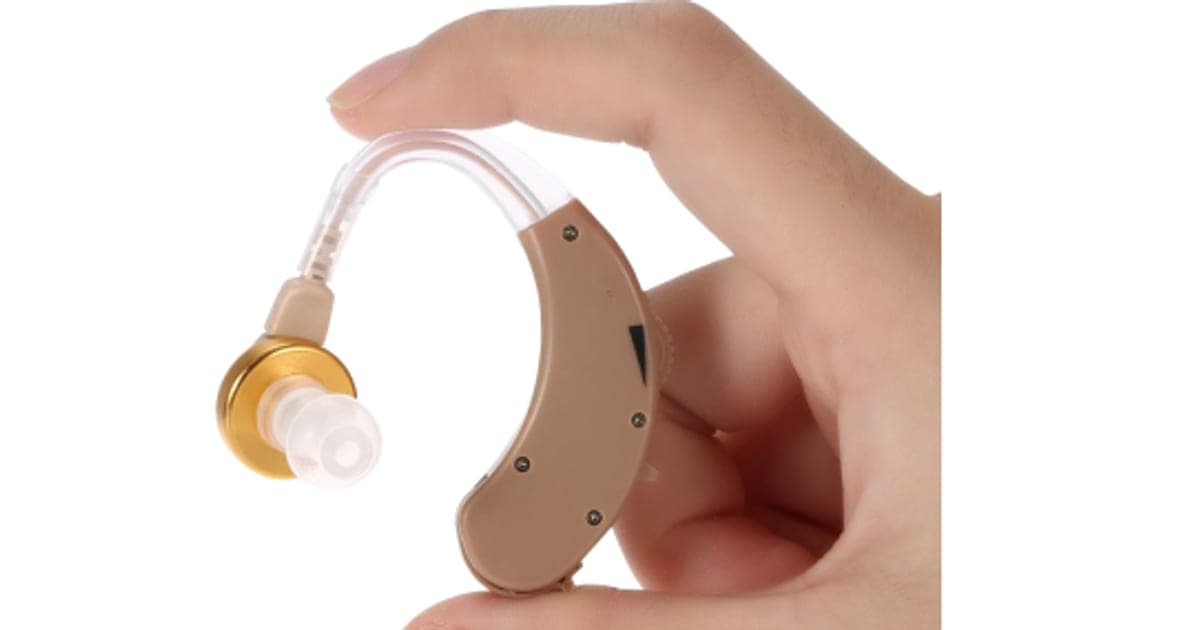
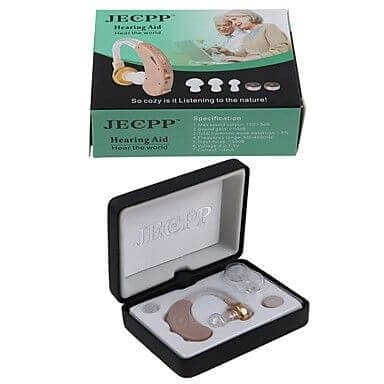
The main image shows a small beige behind-the-ear device balanced on a fingertip next to a smiling woman. The hard case add-on image shows a box labelled "Jecpp Hearing Aid, hear the world" with a black case holding a beige behind-the-ear unit, ear tips and a button battery. The HearingAid Max page does not mention Jecpp.
One device, one ear
The prices are per device. Most age-related hearing loss affects both ears. Wearing an amplifier in one ear can make sounds seem to come from one side.
Who it's for
HearingAid Max suits few people: an adult without hearing loss who wants a temporary boost for TV or quiet conversation, or someone who wants a cheap stopgap while they arrange a hearing test. Anyone with hearing loss is better served by an OTC hearing aid, and anyone with red-flag symptoms needs a doctor.
- Adults without diagnosed hearing loss who want a little extra volume for TV or quiet chats
- People wanting a cheap, temporary amplifier while they arrange a hearing test
- Not people with hearing loss, who should look at OTC or prescription hearing aids
People who struggle with TV volume
If you need the TV louder than others in the room like, an amplifier helps. So does turning on subtitles, a TV speaker near your chair or a wireless TV headset, which are often cheaper.
Older adults with gradual hearing loss
Gradual hearing loss in both ears is common with age. OTC hearing aids were created for adults with perceived mild to moderate loss. They are designed and regulated for that job, which an amplifier is not.
Carers and family members
Buying a hearing gadget for a parent is common. A hearing test first, then an OTC or prescription aid, gives them a device that actually suits their hearing.
Who should skip it
Skip HearingAid Max if you have known or suspected hearing loss, any red-flag symptom, are under 18 or need help hearing in noisy places.
- Anyone with known or suspected hearing loss in both ears
- People with sudden hearing changes, ear pain, discharge, dizziness or one-sided ringing
- Anyone under 18
- People who need help hearing speech in noisy places
Is HearingAid Max a hearing aid or a sound amplifier?
By its own title, a sound amplifier, and we found no sign of FDA hearing aid status. Since the FDA's 2022 rule, OTC hearing aids are regulated medical devices for adults with perceived mild to moderate hearing loss. The FDA's guidance says personal sound amplification products are not intended to compensate for hearing impairment and are for people without hearing loss in certain listening situations.
What the FDA says about OTC hearing aids
The FDA's page OTC hearing aids: what you should know says they are for adults 18 and older with perceived mild to moderate hearing loss, such as trouble in noisy places, following group conversations or needing to turn up the volume. It says they are not for severe or profound hearing loss.
What the FDA says about amplifiers
The FDA's guidance on hearing aids and personal sound amplification products distinguishes the two by intended use and labelling: amplifiers are for generally amplifying sound for non-hearing-impaired listeners, while hearing aids are intended to compensate for hearing loss. That is why a product's name and claims matter.
What this means for you: a product named "HearingAid Max" that calls itself an amplifier, with no FDA status shown, is not the same as an OTC hearing aid. If you have hearing loss, choose a device labelled and registered as an OTC hearing aid.
Why tuning matters
Hearing loss is rarely flat. Most people lose high-pitched sounds first, which carry consonants and make speech clear. Hearing aids boost the frequencies you need. A simple amplifier boosts everything, including low rumble and background noise, which can make speech no clearer and noise more tiring.
Feedback and noise
Cheap amplifiers can whistle when the tip does not seal well or the volume is high. They usually have no noise reduction. The page lists neither feedback control nor noise reduction.
Safety of loud amplification
Over-amplification can damage hearing further. OTC hearing aids have output limits set by the FDA. The page gives no maximum output for HearingAid Max.
When should you see a doctor instead?
The FDA lists red flags that need a medical check before using any hearing device. They include sudden hearing changes in the past six months, hearing loss worse in one ear, ear pain or discharge, a suspected object in the ear, dizziness or vertigo, and ringing or buzzing in one ear. Some causes, such as earwax or infection, are easy to treat.
Sudden hearing loss
Sudden hearing loss, especially in one ear, can be a medical emergency where early treatment matters. Do not wait or use an amplifier; see a doctor promptly.
Earwax
Blocked ears from earwax can muffle hearing. A pharmacist or doctor can advise on safe removal. Pushing a tip into a waxy ear can make it worse.
Hearing tests
Many audiologists, pharmacies and online services offer hearing tests. Knowing the type and level of your loss helps you choose the right device.
How much does HearingAid Max cost, and what do the add-ons add?
On 6 October 2026, one HearingAid Max cost $79, with the five-pack at $197 flagged as the best seller. The checkout offered two AG13 batteries for $3, a hard case for $7, a USB car adapter for $4 and a 3-year warranty for $14. For both ears, two units cost $119.
HearingAid Max price and bundles
| Package | Total | Per unit |
|---|---|---|
| 1 HearingAid Max | $79 | $79.00 |
| 2 HearingAid Max | $119 | $59.50 |
| 3 (buy 2, get 1 free) | $137 | $45.67 |
| 4 HearingAid Max | $179 | $44.75 |
| 5 (buy 3, get 2 free), best seller | $197 | $39.40 |
Prices are in US dollars as listed on 6 October 2026. If you are considering two, compare with OTC hearing aid pairs first. The offer is on the HearingAid Max order page (opens G Com Pte Ltd in a new tab).
Batteries
AG13 button batteries, also sold as LR44, are cheap and widely available. The page says one battery operates the device. Button batteries are dangerous if swallowed, so keep spares away from children and pets.
The hard case
For $7, a hard case "to easily and safely carry". The image shows a Jecpp-branded box and a black case with the amplifier, tips and a battery.
Car adapter and warranty
The $4 car adapter is irrelevant to a battery device. The 3-year warranty costs $14. The seller's terms already cover defective goods for two years once you have a returns number.
The "regular price"
Add-ons are shown against crossed-out prices, with a countdown timer on the page. We found no evidence that HearingAid Max sells at a higher regular price. Beige behind-the-ear amplifiers of this design are sold widely.
Who sells it
The order page names G Com Pte Ltd at 137 Market Street in Singapore, with the email support@g63com.com and a phone number. The footer gives the country as Hong Kong. The page code says charges appear on your card statement as panameedia.

HearingAid MaxScore 3.3/10
Best for: Adults without diagnosed hearing loss who want a little extra volume for TV or quiet chats
$79.00 at G Com Pte Ltd · Price checked October 6, 2026
Check price at G Com Pte Ltd (opens G Com Pte Ltd in a new tab)We may earn a commission if you buy through our links.
Is HearingAid Max better than an OTC hearing aid?
No. OTC hearing aids are regulated devices built for mild to moderate hearing loss, and some cost less per pair than two HearingAid Max units. Audien's Atom One costs $98 for a rechargeable pair in our review, against $119 for two HearingAid Max amplifiers. Lab tests of OTC aids vary, but they are in the right category.
| Device | Category | Ears | Price |
|---|---|---|---|
| HearingAid Max | Sound amplifier, no FDA hearing aid status shown | One per unit | $79 each, $119 for two |
| Audien Atom One | OTC hearing aid | Pair, rechargeable | $98 in our review |
| Audien Atom Air | OTC hearing aid | Pair, rechargeable | $149 in our review |
| Prescription hearing aids | Fitted by a professional | Pair | Higher |
HearingAid Max vs Audien Atom One
Our Audien Atom One review covers Audien's cheapest OTC hearing aid, a rechargeable pair at $98. We found the closest lab-tested Audien model gave limited help with speech in noise, but it is a hearing aid sold for hearing loss. That is the clearest case where a rival wins.
HearingAid Max vs Audien Atom Air
Our Audien Atom Air review covers a tiny rechargeable OTC pair at $149. It is a more discreet option.
HearingAid Max vs earplugs
If loud places are your issue rather than quiet ones, our Hears review covers high-fidelity earplugs that protect hearing. Browse our hearing reviews for more.
HearingAid Max vs a TV headset
For TV alone, a wireless TV headset or subtitles can be simpler and cheaper.
If you only want a cheap amplifier and do not have hearing loss, the offer is on the HearingAid Max offer page (opens G Com Pte Ltd in a new tab).
HearingAid MaxScore 3.3/10
Why people buy it: Small behind-the-ear unit with a simple volume control
$79.00 at G Com Pte Ltd · Price checked October 6, 2026
Check price at G Com Pte Ltd (opens G Com Pte Ltd in a new tab)We may earn a commission if you buy through our links.
Is HearingAid Max legit, and what should you check before buying?
HearingAid Max is a real product from a named seller, and an amplifier should arrive if you order. Before buying, decide whether you need a hearing aid, check for red flags, compare with OTC hearing aids, switch from the five-pack and note the card statement name.
Get a hearing test
What to do: have a hearing test before buying any hearing device. It tells you whether you have hearing loss and what kind.
Check the red flags
What to do: if you have sudden changes, one-sided loss, ear pain, discharge, dizziness or one-sided ringing, see a doctor first.
Check the selected bundle
The five-pack for $197 is flagged as the best seller in the page code. What to do: change the order to one unit, or consider an OTC hearing aid pair instead.
Card statement name and memberships
The charge appears as panameedia. Pages on this checkout have also carried text for a "Gadget Discount Club" membership that is free for 30 days and then billed. What to do: read every checkbox and post-payment page.
Refunds and returns
The page code offers a 30-day guarantee for a full refund or replacement, less shipping and handling. The terms we recorded on 4 October 2026 focus on defective goods, which can be returned within two years once you have a returns number, with return postage at your cost. A used in-ear device may be hard to return for hygiene reasons.
How to buy HearingAid Max the smart way
- Get a hearing test and check for red flags.
- Compare with OTC hearing aids.
- Open the HearingAid Max order page (opens G Com Pte Ltd in a new tab) and select your country.
- Change the five-pack to one unit.
- Skip the car adapter.
- Note the card statement name, panameedia.
How did we score HearingAid Max?
HearingAid Max scores 3.3 out of 10: claim accuracy 0.4, build durability 0.8, price competitiveness 0.6, usability 1.0 and owner satisfaction 0.5, each out of 2. It is a simple amplifier that runs on cheap batteries. The score falls on a hearing aid name for a device that calls itself an amplifier, no FDA hearing aid status shown, no tuning or output limits stated, one ear per unit and another brand's box in the add-on image.
How the score breaks down
We use the five criteria on our how we test page, each out of 2.
| Criterion | Score | Why |
|---|---|---|
| Claim accuracy | 0.4 / 2 | Hearing aid name on an amplifier; no output limits or status |
| Build durability | 0.8 / 2 | Basic plastic behind-the-ear unit |
| Price competitiveness | 0.6 / 2 | $119 for two, more than an OTC pair in our reviews |
| Usability | 1.0 / 2 | Simple volume dial; amplifies noise too |
| Owner satisfaction | 0.5 / 2 | No independent ratings for this listing |
| Total | 3.3 / 10 |
What owners say
We found no Trustpilot profile for the gadgetxaura.com store and no retailer reviews for HearingAid Max by that name. Owners of similar cheap behind-the-ear amplifiers on large retail sites report that they make things louder in quiet rooms, whistle at higher volume, amplify background noise and feel uncomfortable over long periods.
What we did, and did not, do
Nobody on our team has used HearingAid Max. We read the offer page our link opens and its page code on 6 October 2026, along with the FDA's OTC hearing aid page, the FDA's guidance on hearing aids and amplifiers and the pages that rank for HearingAid Max. The refund and returns terms are as we recorded them from the site's terms page on 4 October 2026.
How to use HearingAid Max safely if you buy it
Start at a low volume, fit the tip snugly to stop whistling, use it in quiet settings and keep it out of noisy places. Clean the tip regularly, keep batteries away from children, and stop using it if your ear hurts or your hearing changes. Book a hearing test if you find you rely on it.
- Start low. Increase the volume slowly until speech is comfortable.
- Fit the tip well. A loose tip causes whistling.
- Use it in quiet settings. It amplifies noise too.
- Take breaks. Long use at high volume can be tiring and harmful.
- Clean the tip. Wipe it daily and replace worn tips.
- Store batteries safely. Away from children and pets.
- Book a hearing test. If you find you need it every day.
Changing the battery
Open the battery door, insert the AG13 with the flat side as marked, and close it gently. Remove the battery overnight to save power.
If it whistles
Lower the volume, push the tip in more snugly or try a different tip size.
Hygiene
Do not share in-ear devices. Clean tips with a dry cloth or as the instructions say, and keep it out of water.
HearingAid MaxScore 3.3/10
Before you buy: Check the final price, shipping and return terms at checkout.
$79.00 at G Com Pte Ltd · Price checked October 6, 2026
Check price at G Com Pte Ltd (opens G Com Pte Ltd in a new tab)We may earn a commission if you buy through our links.
What else do people ask about cheap hearing aids?
Most questions are about whether cheap amplifiers can harm hearing, whether OTC aids need a prescription and how to tell them apart. Over-amplification can harm hearing, OTC hearing aids need no prescription, and the label and FDA status tell them apart. A hearing test is the best first step.
Do I need a prescription for an OTC hearing aid?
No. Adults with perceived mild to moderate hearing loss can buy OTC hearing aids without a prescription or exam.
Can amplifiers damage hearing?
Turning sound up too loud for long periods can. Hearing aids have output limits; cheap amplifiers may not state any.
How do I tell an OTC hearing aid from an amplifier?
Look for "OTC hearing aid" on the label and in the listing. Amplifiers are usually called personal sound amplifiers or hearing amplifiers.
Are hearing aids covered by insurance?
Coverage varies by plan and country. Check with your insurer or health service.
Frequently asked questions
Is HearingAid Max a real hearing aid?
Its own title calls it a 'hearing amplifier device' and 'hear aid amplifier'. We found no sign that it is an FDA-registered OTC hearing aid. The FDA says sound amplifiers are for people without hearing loss to amplify sounds in some settings, while OTC hearing aids are regulated devices for mild to moderate hearing loss.
What is the difference between a hearing aid and an amplifier?
The FDA treats OTC hearing aids as medical devices for adults with perceived mild to moderate hearing loss, with requirements on output and labelling. Personal sound amplification products are not intended to compensate for hearing impairment. Amplifiers usually just turn everything up.
How much does HearingAid Max cost?
On 6 October 2026, the offer page listed one HearingAid Max for $79, two for $119, three (two plus one free) for $137, four for $179 and five (three plus two free) for $197, with the five-pack flagged as the best seller. Two batteries cost $3, a hard case $7 and a 3-year warranty $14.
Is it for one ear or two?
The price is for one device, for one ear. Most people with age-related hearing loss have it in both ears. A pair costs $119 on the page, more than Audien's OTC Atom One pair at $98 in our review.
When should I see a doctor instead?
The FDA lists red flags: sudden hearing changes in the last six months, hearing loss worse in one ear, ear pain or discharge, dizziness or vertigo, and ringing in one ear. Any of these need a medical check before using any hearing device.
What batteries does HearingAid Max use?
AG13 button batteries, also sold as LR44. The page says one is needed to operate it and sells two as a $3 add-on. They are widely available. Keep button batteries away from children, as swallowing one is dangerous.
Is HearingAid Max legit?
It is a real product sold by G Com Pte Ltd, which lists a Singapore address, email and phone number. The concerns are the hearing aid name on an amplifier, no FDA hearing aid status shown, one ear per unit, another brand's box in the add-on image and return postage at your cost.
We may earn a commission if you buy through our links.
This content is for informational purposes and is not medical advice. Talk to a qualified professional before using any product that affects your health.
Prices accurate as of October 6, 2026. Check the seller's checkout for current pricing, promotions and terms.
What we checked: No hands-on use. Claims, product title, feature bullets, photos, US dollar prices, bundles, add-ons and their images, warranty price, seller details and card statement name from the HearingAid Max offer page our link opens (gadgetxaura.com) and the data in the page's own code on 2026-10-06. The 30-day guarantee text was read in the same page code that day; the fuller refund and returns terms are as recorded from the site's terms page on 2026-10-04. The FDA's page on OTC hearing aids, the FDA's guidance on hearing aids and personal sound amplification products and the top-ranking HearingAid Max pages were read on 2026-10-06.

About the author
James Wilson, Consumer Tech Writer
James Wilson covers health and wellness technology for Top10Gadgets: breathing devices, massagers, hearing aids, dental and weight-loss products, and the other gadgets sold with a promise to make life easier. James write…
- Health and wellness gadgets
- Over-the-counter hearing aids
- Breathing and massage devices
- FDA clearance and registration
- Tech for beginners
Writing for Top10Gadgets since 2026Full profile