Hearing / OTC hearing aids
Audien Atom Air Review: What the $149 OTC Hearing Aid Can Do, What the Sales Page Gets Wrong and How to Buy
A tiny rechargeable over-the-counter hearing aid launched in May 2026 at $149 a pair. It is a cheap way to try hearing aids, but tests of other Atom models found limited speech clarity.

By James Wilson, Consumer Tech Writer at Top10Gadgets
Updated 29 min readHow we test
Quick answer
Yes, if you are an adult with mild to moderate hearing loss who wants the cheapest reasonable first try at hearing aids, and you will use the 45-day trial properly. The Atom Air is a small, rechargeable in-ear OTC hearing aid at $149 a pair.
Score 6.1/10$149.00 at Audien Hearing
Check price at Audien Hearing (opens Audien Hearing in a new tab)We may earn a commission if you buy through our links.
- Best for
- Adults with perceived mild to moderate hearing loss who want a low-cost first try at hearing aids
- Not for
- Anyone with sudden, one-sided or fluctuating hearing loss, ear pain, discharge or dizziness; see a doctor first
$149.00 at Audien Hearing
Check price at Audien Hearing (opens Audien Hearing in a new tab)We may earn a commission if you buy through our links.
On this page · 14 sections
- 01Our verdict
- 02The short version
- 03Pros & cons
- 04How it works
- 05Who it's for
- 06How much does the Audien Atom Air cost, and what's in the box?
- 07Are the Atom Air's claims true?
- 08Will the Atom Air work for your hearing?
- 09Is the Atom Air better than the Atom One or mid-range OTC aids?
- 10Is the Atom Air legit, and what should you check before buying?
- 11What do owners say, and how did we score the Atom Air?
- 12How to use the Atom Air for the best results
- 13What else do people ask about OTC hearing aids?
- 14Frequently asked questions
Our verdict
Yes, if you are an adult with mild to moderate hearing loss who wants the cheapest reasonable first try at hearing aids, and you will use the 45-day trial properly. The Atom Air is a small, rechargeable in-ear OTC hearing aid at $149 a pair. Lab tests of Audien's other Atom models found weak speech clarity, especially in noise, and the offer page's "A2 chip, 4 modes" specs do not match Audien's own launch announcement. It scores 6.1 out of 10, held back by those mismatched claims, likely limited performance in noise and a return process that needs a consultation.
The short version
- An over-the-counter, rechargeable in-ear hearing aid from Audien Hearing, launched on 28 May 2026.
- $149 a pair on the offer page on 3 October 2026, or $223.50 for two pairs and $298 for three, with free US shipping and a 45-day trial.
- Audien's launch announcement describes an A1 MAX chip, one adjustable mode, 24-hour battery and a charging case; the offer page claims an A2 chip and four modes.
- Best trait: a genuinely low-cost, simple way to find out whether amplification helps you.
- Biggest drawback: Audien's Atom models have tested poorly for speech clarity in noise, where many people need help most.
- Our score: 6.1 out of 10, with the lowest mark for claim accuracy.
Pros & cons
The Atom Air makes sense as a low-risk first step, not as a replacement for well-fitted hearing aids. At $149 it costs a fraction of most alternatives. The trade-off is basic sound processing with little room to tune it, and a sales page that promises more than the evidence and Audien's own launch details support.
What we like
- $149 a pair, among the lowest prices for an OTC hearing aid
- Small, light in-ear design that sits mostly inside the ear
- Rechargeable, with a charging case and up to 24 hours per charge
- No app, appointment or hearing test needed to start
- 45-day trial, 1-year warranty and a large, mostly positive brand-wide owner record
What we don't
- The offer page's 'A2 chip' and '4 listening modes' do not match Audien's launch announcement, which describes an A1 MAX chip and one adjustable mode
- Independent lab tests of Audien's other Atom models found speech clarity well below average, especially in noise
- No app, Bluetooth streaming or detailed self-fitting
- Returns need a phone or video consultation first, and you pay return shipping
- Only for adults with mild to moderate hearing loss; some hearing problems need a doctor first
Sold by Audien Hearing
Audien Atom Air$149.00
How it works
Every hearing aid does the same three basic things: picks up sound, amplifies it, and delivers it into your ear. The difference between a $149 aid and a $3,000 one lies in how cleverly it amplifies different pitches, handles noise, and fits your particular hearing.
Microphones pick up sound
Step 1: A small microphone in each earpiece picks up sound around you, including speech, which is the main thing hearing aids are meant to help with.
A chip amplifies it
Step 2: A sound-processing chip boosts the sound, more in the pitches you set, and sends it to a tiny speaker that sits in your ear canal behind a soft silicone tip.
You adjust volume and tone
Step 3: You choose the volume, and according to Audien's launch announcement, adjust the frequency balance within one hearing mode; there is no app or audiologist fitting.
Without an audiologist fitting or an app, the Atom Air relies on you to choose a volume and tone that sound right. That is fine for mild loss and quiet rooms. It is harder when your hearing loss is uneven across pitches, which is common, or when there is background noise.
Who it's for
The Atom Air suits adults who think their hearing has started to slip, who ask people to repeat themselves or turn the TV up, and who want to try amplification without spending thousands or booking appointments. It also suits people who already own prescription aids and want a cheap backup pair for travel, the gym or the night their main pair is being repaired.
It is not for people with red-flag symptoms that need a doctor, for severe or profound loss, for under-18s, or for anyone who mainly struggles in noisy places. For those, a hearing test and either a better OTC aid or prescription aids fitted by a professional are the better route.
- Adults with perceived mild to moderate hearing loss who want a low-cost first try at hearing aids
- People who mainly struggle with conversation in quiet rooms or with the TV
- Anyone wanting a cheap spare or travel pair alongside better hearing aids
Who should skip it
- Anyone with sudden, one-sided or fluctuating hearing loss, ear pain, discharge or dizziness; see a doctor first
- People with severe hearing loss, or under 18, who need prescription hearing aids
- Anyone whose main problem is hearing in noisy restaurants and groups; lab tests of similar Audien models were weak in noise
- People who want an app, phone streaming or fine-tuning
How much does the Audien Atom Air cost, and what's in the box?
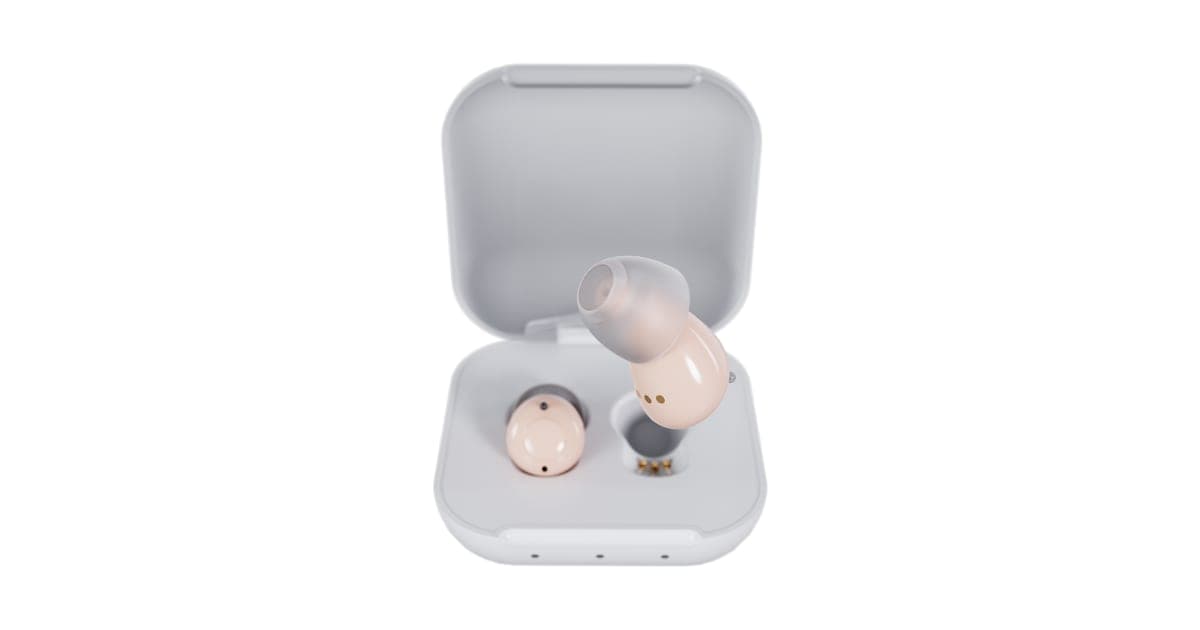
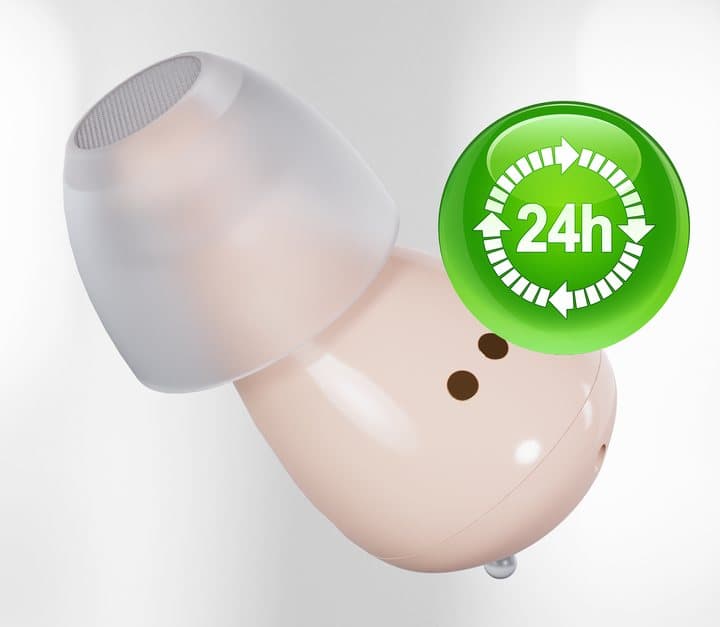
The Audien Atom Air costs $149 a pair on the offer page on 3 October 2026. You get two small, skin-coloured in-ear hearing aids, silicone tips in small, medium and large, a charging case and a cable, with up to 24 hours of battery. The offer page lists an "A2 chip" and four listening modes, while Audien's own May 2026 launch announcement describes an A1 MAX chip and one adjustable mode.
The Atom Air comes as a pair of small, skin-coloured in-ear hearing aids with silicone tips in small, medium and large sizes, a charging case and a charging cable, according to the offer page and Audien's materials.
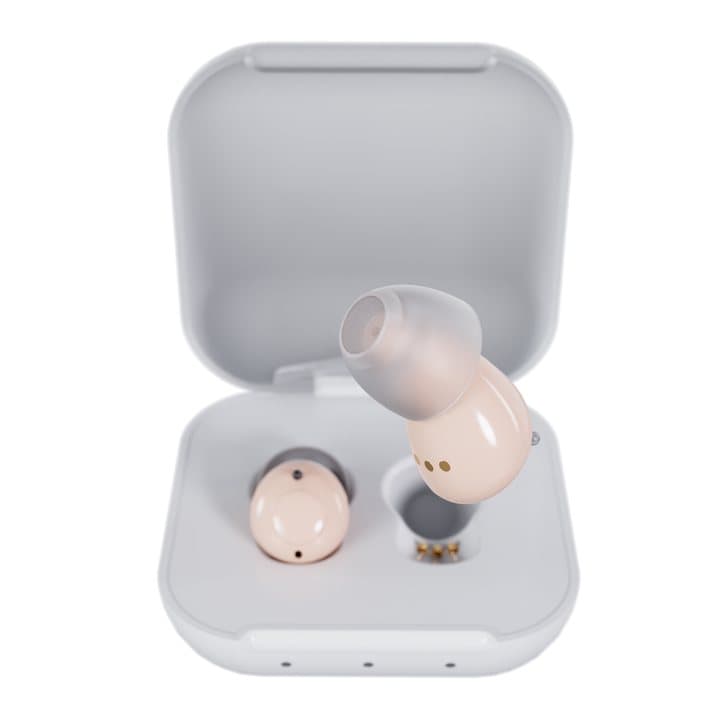
Hearing aids in the charging case, from the offer page
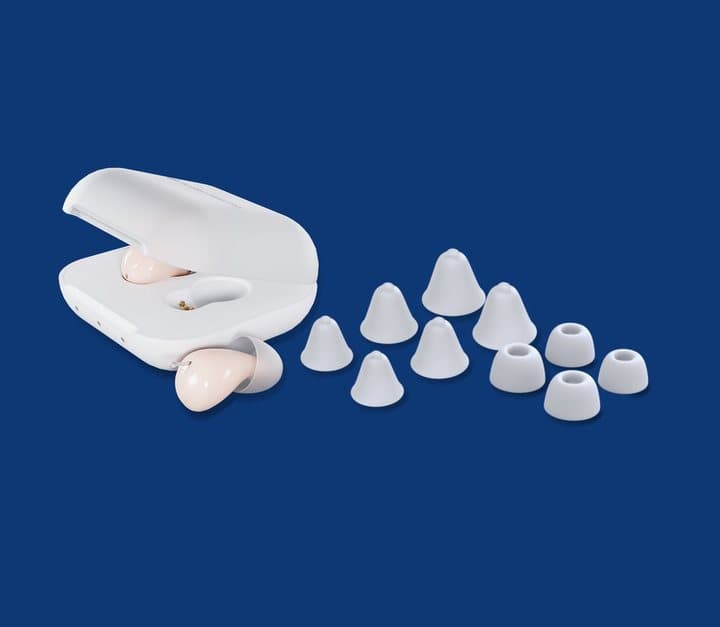
Ear tips in small, medium and large sizes
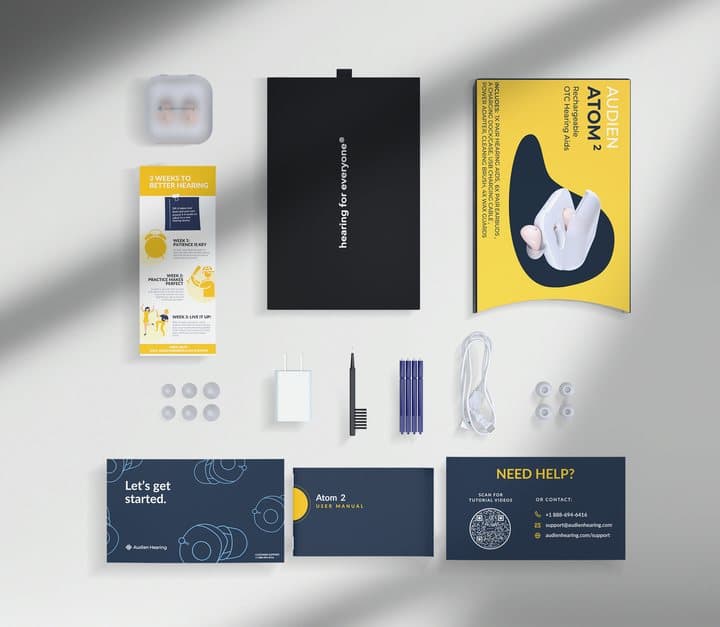
Box contents shown on the Atom Air offer page; the manual is labelled Atom 2
Specifications: two different stories
The offer page our link opens and Audien's own launch announcement describe the Atom Air differently:
| Spec | Offer page | Audien launch, May 2026 (Hearing Review) |
|---|---|---|
| Chip | A2 chip | A1 MAX chip |
| Listening modes | 4 (conversation, restaurant, TV, outdoor) | 1 adjustable mode with frequency control |
| Battery | 24 hours | 24 hours |
| Charging case | Yes | Yes |
| Noise | "Advanced background noise cancellation" | "Advanced sound isolation" |
| App or Bluetooth | No | No |
| Price | $149 a pair | $149 a pair |
The offer page's box-contents photo also shows a manual labelled "Atom 2", Audien's earlier model with an A2 chip and four modes. Our reading is that the offer page reuses copy and images from the Atom 2. We cannot be sure which description matches what ships.
What this means for you: check the product name on the order confirmation and the manual in the box. If the four modes matter to you and your pair has one, that is a fair reason to return it within the trial.
Why the mismatch matters
Listening modes are presets for different situations: conversation, restaurant, TV and outdoors. With four modes, you can switch to a setting that cuts more low-frequency rumble in a restaurant, for example. With one adjustable mode, you set one sound and live with it everywhere, adjusting volume and tone as you go. For someone who spends most of the day at home, one mode may be fine. For someone moving between quiet rooms and busy places, modes help.
The chip matters less than the page suggests. HearingTracker's tests of the A2-based Atom Pro 2 did not find better speech clarity than the basic Atom. What matters is whether the aid you receive helps your hearing in your situations, which only the trial will tell you.
Audien's range, for context
Audien's own site listed these models on 3 October 2026:
| Model | Price per pair | Notes |
|---|---|---|
| Atom One | $98 | Most basic in-ear model |
| Atom Air | $149 | Newest, lightest in-ear model |
| Atom Pro 2 | $289 | 4 modes, UV cleaning case |
| Atom X (2nd gen) | $389 | Touchscreen case control |
| Ion Air | $489 | Behind-the-ear |
| Ion Pro 2 | $689 | Behind-the-ear, Bluetooth, app |
Atom Air price and bundles
On 3 October 2026 the offer page our link opens showed:
| Package | Total | Per pair | Shown as |
|---|---|---|---|
| 1 pair | $149 | $149 | free shipping |
| 2 pairs (second 50% off) | $223.50 | $111.75 | Retail $298 |
| 3 pairs (buy 2, get 1 free) | $298 | $99.33 | Retail $447 |
Most people need one pair. Extra pairs make sense only for a spouse with similar hearing needs or as a backup, and it is worth trying one pair first.
Who Audien Hearing is
Audien Hearing is a US direct-to-consumer hearing aid company based in Arizona, founded by Dylan Garber, whose sales page tells the story of his grandmother's expensive hearing aids. It sells online, through retail partners and through offer pages like the one our link opens. Audien's site lists a range from the $98 Atom One to the $689 Ion Pro 2, along with accessories, a hearing supplement and a protection plan.
Warranty and support
The offer page promises lifetime hearing support and a one-year warranty. NCOA's review of Audien notes the standard warranty covers manufacturing defects, not loss or damage, and that Audien sells an optional protection plan. Trustpilot reviewers mention paying shipping for warranty repairs.

Audien Atom AirScore 6.1/10
Best for: Adults with perceived mild to moderate hearing loss who want a low-cost first try at hearing aids
$149.00 at Audien Hearing · Price checked October 3, 2026
Check price at Audien Hearing (opens Audien Hearing in a new tab)We may earn a commission if you buy through our links.
Are the Atom Air's claims true?
Several Atom Air claims are not supported. "Crystal clear sound" and hearing "everything you want to" overstate any hearing aid. Independent lab testing by HearAdvisor, reported by HearingTracker, found Audien's original Atom well below average for speech in quiet and in noise, and we found no test showing the Atom Air breaks that pattern. The chip and mode specs also contradict Audien's own launch announcement.
The sales page leans on price comparisons and big statements about sound quality. Here is how they hold up.
"Crystal clear sound" and "hear everything you want to (and nothing you don't)"
No hearing aid does this, and cheap ones least of all. Independent lab testing by HearAdvisor, reported by HearingTracker, found the original Audien Atom gave speech-in-quiet results a full point below average on a five-point scale and speech-in-noise results also well below average, with limited amplification of high pitches, where many speech sounds live. The Atom Pro 2 scored even lower for speech clarity, though it controlled feedback well.
The Atom Air is a newer model and has not been tested in the same way, as far as we could find. It may perform differently. But there is no evidence it breaks from the pattern of Audien's other Atom models.
"Advanced background noise cancellation"
Hearing in noise is the hardest job for any hearing aid. Premium aids use directional microphones and sophisticated processing; even they cannot remove noise. Audien's Atom models have tested poorly in noise, and the launch announcement for the Atom Air mentions "sound isolation", which usually refers to the physical seal of the tip, not processing.
"Reduces ringing"
The page says the chip reduces "ringing". If that means tinnitus, hearing aids can make it less noticeable for some people by bringing back outside sounds that mask it. They do not cure it. If it means feedback whistling, that is a fit and processing issue all hearing aids manage to some degree.
"$149 vs $2,500+" and "only cost around $100 to make"
Prescription hearing aids do typically cost thousands per pair in the US, but that price usually includes a hearing test, professional fitting, follow-up adjustments and sometimes years of service. Comparing a $149 device to a $2,500 package of device plus care is not like for like. The claim that hearing aids cost about $100 to make is from the founder's story on the sales page; we could not verify it.
"1 million+ units sold" and "patented design"
Audien is a well-established direct-to-consumer brand, and its Trustpilot profile has over 2,000 reviews, consistent with large sales. We could not verify the specific figures or the patent.
"No doctor approval needed"
This is true for OTC hearing aids for adults with perceived mild to moderate loss. It does not mean a doctor or audiologist is never needed. The FDA lists warning signs that call for a medical check first (see "What to know before you buy").
"Hearing aids slow cognitive decline"
The page cites research on hearing aids and cognitive decline. The Achieve trial, published in The Lancet in 2023, found that a hearing intervention slowed cognitive decline over three years in older adults at higher risk, but not in the overall group. It involved audiologist-fitted hearing aids and counselling, not cheap OTC devices. Treating hearing loss is good for quality of life; claims about protecting the brain should be read with that context.
Claims scorecard
| Claim | What the evidence shows | Our view |
|---|---|---|
| OTC hearing aid, no prescription needed | True for adults with perceived mild to moderate loss | Supported |
| 24-hour battery, charging case | Matches launch announcement | Supported |
| A2 chip and 4 listening modes | Launch announcement says A1 MAX and 1 mode | Contradicted |
| Crystal-clear sound, noise cancellation | Audien Atom models tested weak, especially in noise | Not supported |
| Reduces ringing | Hearing aids may ease tinnitus for some; no cure | Overstated |
| $149 vs $2,500+ | Real price gap, but prescription price includes care | Misleading comparison |
| Slows cognitive decline | Lancet trial showed benefit only in a higher-risk group with professional care | Overstated |
Will the Atom Air work for your hearing?
It depends mostly on your hearing. OTC hearing aids like the Atom Air are for adults with perceived mild to moderate loss: soft speech and whispers are hard to catch, and you ask people to repeat themselves or turn the TV up. It is most likely to help in quiet rooms. In restaurants and other noisy places, budget aids help far less, and a hearing test gives you a clear starting point.
Whether a $149 hearing aid helps depends mostly on your hearing, not the device. This section helps you judge that before you buy.
What "mild to moderate" means
Hearing loss is measured in decibels: how loud a sound must be before you hear it. Mild loss (roughly 26 to 40 dB) makes soft speech and whispers hard to catch, especially in noise. Moderate loss (roughly 41 to 55 or 70 dB, depending on the scale) makes normal conversation hard without amplification. OTC aids are designed for this range. Severe and profound loss needs prescription aids.
Signs you may have mild to moderate loss
- You often ask people to repeat themselves, especially in groups.
- You turn the TV up louder than others like.
- Speech sounds mumbled, particularly women's and children's voices.
- You struggle in restaurants and on the phone.
- People tell you that you are not hearing them.
Why a hearing test still helps
You do not need a test to buy OTC aids, but a test tells you a lot: how much loss you have, at which pitches, and whether both ears are similar. If your loss is mainly in high pitches, as is common with age, a basic aid with limited high-frequency boost, like Audien's tested models, may not help much with speech clarity. Free hearing checks are available from many pharmacies, hearing centres, and online or app-based tests.
Protecting the hearing you have
Whatever you decide about hearing aids, protecting your remaining hearing matters. Noise exposure from power tools, concerts, motorbikes and loud headphones adds to age-related loss. Earplugs or ear defenders for loud activities, and keeping headphone volume moderate, help slow further damage. Hearing aids amplify sound, so never wear them turned up in already loud places.
How often to retest
Hearing usually changes slowly. If you start using OTC aids, consider a hearing check every year or two, or sooner if you notice a change. A sudden drop, or a change in one ear, needs a doctor promptly.
Quiet rooms vs noisy places
Simple aids help most in quiet: one-to-one conversation at home, the TV, a quiet office. They help least in restaurants, family gatherings and busy streets, where many people feel their hearing loss most. If noise is your main problem, look at aids with directional microphones and better processing, or see an audiologist.
Both ears or one?
The Atom Air comes as a pair and is designed for similar loss in both ears. If one ear is much worse than the other, or you only notice loss on one side, that is a reason to see a doctor before buying anything.
A realistic first month
Week one is about getting used to wearing them: a few hours a day at home, adjusting volume, finding the right tip. Week two is about real situations: TV, phone, a shop, a family meal. By weeks three and four, you should know whether you are hearing conversations more easily than before, or just hearing louder noise. Keep brief notes each week; they make the keep-or-return decision much clearer, and they help if you speak to support or an audiologist.
Involving family
People close to you often notice hearing loss before you do, and they will notice improvement too. Ask a partner or friend to tell you honestly whether you are asking them to repeat themselves less, and whether the TV volume has come down. That outside view is useful evidence when deciding whether to keep the aids.
Is the Atom Air better than the Atom One or mid-range OTC aids?
The Atom Air costs $49 more than Audien's basic Atom One, which uses tiny dials, and is newer, smaller and lighter, according to Audien. Mid-range OTC hearing aids cost more but usually add apps, self-fitting, Bluetooth streaming and better noise handling, which matter if you struggle in noise. Prescription aids fitted by an audiologist cost the most and suit more than mild loss.
The OTC hearing aid market has grown quickly since 2022. Here is how the Atom Air sits among the options.
| Option | Typical price per pair | Fitting | App or streaming | Best for |
|---|---|---|---|---|
| Audien Atom Air | $149 | Volume and tone, no app | No | Lowest-cost first try |
| Audien Atom One | $98 | Basic dials | No | Absolute minimum budget |
| Audien Atom Pro 2 | $289 | 4 modes | No | Audien with more modes |
| Mid-range OTC aids from established hearing brands | $300 to $1,000 | App-based self-fitting with a hearing test | Usually | Better tuning and noise handling |
| AirPods Pro 2 with hearing aid feature | About $249 | Hearing test in the iPhone | Yes | iPhone users with mild to moderate loss |
| Prescription aids from an audiologist | $2,000 to $6,000+ | Professional fitting and follow-up | Usually | Complex, severe or noise-heavy needs |
Atom Air vs Atom One
The Atom One costs $49 less and is Audien's most basic model, with small dials to set volume and tone. The Atom Air is newer, smaller and lighter according to Audien. If budget is everything, the Atom One is the cheapest way in; we cover it in our Audien Atom One review.
Atom Air vs mid-range OTC aids
Aids from established hearing brands sold over the counter, often with an app that runs a hearing test and fits the aid to your results, generally perform better in independent tests. They cost two to six times as much. If you know you have hearing loss and plan to wear aids every day, the extra spend often pays off in clarity.
Atom Air vs AirPods Pro 2
In September 2024 the FDA authorised a hearing aid feature for Apple's AirPods Pro 2, which uses a hearing test on an iPhone to tune amplification for mild to moderate loss. HearingTracker's review of the Atom Pro 2 suggests AirPods Pro 2 as a stronger alternative at a similar price to Audien's mid models. They are bulkier, need an iPhone and have shorter battery life, but they also stream music and calls.
Atom Air vs prescription hearing aids
Prescription aids cost far more but come with a hearing test, professional fitting, adjustments over time and better processing. If you have significant or uneven loss, or struggle in noise, they are the most likely to help. Many audiologists now also support people who start with OTC aids.
What an audiologist can add
Even if you buy OTC aids, an audiologist can be useful: a full hearing test, a check for wax or medical problems, advice on whether your loss suits OTC aids, and in some clinics help adjusting OTC devices for a fee. Some people start with a cheap OTC pair, find hearing aids help, and then move to better aids with professional support. That is a perfectly sensible path.
If you have decided a low-cost OTC aid is the right first step, the Atom Air order page (opens Audien Hearing in a new tab) lists the single and multi-pair offers. Our hearing section and wider health and wellness reviews cover more devices, including the AirPhysio breathing device and Akusoli insoles, where we checked claims in the same way.
For the full side-by-side on controls, battery, specs and returns, see our Audien Atom Air vs Atom One comparison.
Audien Atom AirScore 6.1/10
Why people buy it: $149 a pair, among the lowest prices for an OTC hearing aid
$149.00 at Audien Hearing · Price checked October 3, 2026
Check price at Audien Hearing (opens Audien Hearing in a new tab)We may earn a commission if you buy through our links.
Is the Atom Air legit, and what should you check before buying?
Audien is a real, established OTC hearing aid brand with a 4.6 Trustpilot score across its products, and the Atom Air comes with a 45-day trial. Before buying, see a doctor first if you have ear pain, discharge, sudden or one-sided hearing loss or ringing in one ear, as the FDA advises. Note that returns need a phone or video consultation first, and you pay return shipping.
Most problems with budget hearing aids come from buying them when a medical check was needed, expecting too much, or missing the return rules. Here is what to check.
See a doctor first if you have red flags
The FDA says to see a doctor, ideally an ear specialist, before using OTC hearing aids if you have:
- A visible ear deformity, from birth or injury.
- Fluid, pus or blood coming from the ear in the past six months.
- Ear pain or discomfort.
- A history of excessive earwax or a feeling something is in the ear canal.
- Sudden hearing loss, or hearing loss that has got worse quickly.
- Hearing that comes and goes.
- Hearing loss or ringing in only one ear, or much worse in one ear.
- Dizziness or vertigo.
What to do: if any apply, see a doctor before buying. Sudden hearing loss in particular is an emergency that should be seen within days.
The return process
Audien's refund policy, which we read on 3 October 2026, sets out a 45-day risk-free trial from delivery, with conditions:
- You must contact Audien by phone, text or email and complete a phone call or video appointment with its team before the return is authorised.
- You pay return shipping; once approved, a USPS label is emailed to you.
- The return must be in transit by day 45 after delivery.
- Everything must come back in the original packaging, undamaged, with all accessories.
- No refund for damage from drops, water, wax build-up or modifications.
- Audien's policy says it does not accept returns for purchases made through retail partners or third-party sellers.
What to do: keep all packaging and accessories, start the return by about day 30 if you are unsure, and confirm with support at the start which seller you bought from and where to send returns.
Expect an adjustment period
New hearing aid users often find sounds too loud, tinny or strange at first, including their own voice. The brain needs a few weeks to adapt.
What to do: wear them a few hours a day at first, in quiet places, and build up. Judge them after two to three weeks of regular wear, not on day one.
Earwax and fit
In-ear aids sit in the ear canal, where wax collects. Wax can block the speaker and cause poor sound or whistling. A poor tip fit causes feedback too.
What to do: clean the tips and wax guards regularly, try all tip sizes, and see a doctor or nurse if you think you have a wax build-up.
Paying for it
Original Medicare does not cover hearing aids. Some Medicare Advantage plans do, and OTC hearing aids are often eligible for HSA or FSA funds.
What to do: check your plan and keep the receipt.
Buying for a parent
Many OTC hearing aids are bought by adult children for a parent. Talk with them first: hearing aids only help if they are worn, and people resist aids they did not choose. Check the red-flag list together, consider a hearing test first, and plan to help with set-up, charging and the first weeks of wear. Small in-ear aids can be fiddly for people with arthritis or poor eyesight.
What to do: involve them in the decision, and be ready to help during the trial.
How to buy the Atom Air the smart way
- Check the red-flag list above; if none apply, take a free hearing test if you can. Then open the Atom Air offer page (opens Audien Hearing in a new tab).
- Order one pair first, not a multi-pack, so you can judge them before committing.
- Check the product name on the order confirmation and the manual in the box, given the mismatched specs.
- Note the delivery date and set a reminder for day 30.
- Wear them daily for at least two weeks, in quiet and in noise, trying each tip size.
- If they do not help, call support well before day 45 to start the return.
What do owners say, and how did we score the Atom Air?
The Atom Air scores 6.1 out of 10: claim accuracy 0.7, build durability 1.1, price competitiveness 1.5, usability 1.4 and owner satisfaction 1.4, each out of 2. Audien's Trustpilot profile showed 4.6 from 2,023 reviews across all its products, with 75% five-star and 14% one-star. Owners praise patient support and low prices; complaints describe feedback, lack of clarity and consultation-first returns.
The Atom Air is new, so most owner feedback is about Audien as a brand and its other Atom models.
Trustpilot
On 3 October 2026 the Trustpilot profile for audienhearing.com showed a TrustScore of 4.6 out of 5 from 2,023 reviews: 75% five-star, 5% four-star, 3% three-star, 3% two-star and 14% one-star. These cover all Audien products, not the Atom Air alone.
Positive reviews praise friendly, patient support staff, quick fixes and low prices. Negative reviews describe noise, feedback and lack of clarity, hearing aids that screech, returns that need a consultation before a refund, and paying shipping for warranty repairs.
Independent lab results
HearingTracker publishes results from HearAdvisor's lab. The original Audien Atom scored 2.6 out of 5 for speech in quiet and 1.0 for speech in noise, with limited high-frequency amplification. The Atom Pro 2 scored 0.7 for speech in quiet and 0.5 in noise, placing it in the bottom tenth of OTC devices tested, though it scored 5 out of 5 for feedback handling. The Atom Air has not been tested as far as we found.
The testimonials on the page
The offer page's testimonials mention the Atom Pro 2 and Audien Pro 2 by name, not the Atom Air, and describe conversation and TV becoming easier, a husband with severe loss preferring them to expensive aids, and families being glad they can hear again. They are positive stories, but they are about other models.
What the one-star reviews say
The 14% of one-star reviews cluster around three issues: aids that whistle or sound noisy and unclear, frustration with having to book a call or video appointment before a refund, and costs for repairs or shipping. Few say the aids did nothing at all; more say they did not help enough. That matches the lab picture of aids that make sound louder without always making speech clearer.
Third-party reviews in search
Pages ranking for Audien reviews include HearingTracker's lab-based reviews, NCOA's review, comparison sites and press releases. HearingTracker's are the most useful because they include lab measurements.
How we scored the Atom Air
Every score on the site follows the five criteria on our how we test page.
| Criterion | Score | Why |
|---|---|---|
| Claim accuracy | 0.7 / 2 | Chip and mode claims contradict the launch spec; sound and noise claims unsupported; misleading price comparison |
| Build durability | 1.1 / 2 | Simple rechargeable aid with a one-year warranty; mixed reliability reports for Audien models |
| Price competitiveness | 1.5 / 2 | $149 a pair is among the cheapest OTC aids; poor value if it does not help your hearing |
| Usability | 1.4 / 2 | Simple and rechargeable; no app; returns need a consultation |
| Owner satisfaction | 1.4 / 2 | Brand-wide 4.6 from 2,023 reviews; lab results for sibling models weak |
| Total | 6.1 / 10 |
The score would rise with an independent lab test of the Atom Air and an offer page that matches the real specifications.
What we did, and did not, do
Nobody on our team has worn the Atom Air, and this review does not claim otherwise. We read the offer page our link opens, Audien's launch announcement as reported by Hearing Review, Audien's refund policy and model prices, HearingTracker's lab reviews of the Atom and Atom Pro 2, NCOA's Audien review, the FDA's OTC hearing aid guidance and Audien's Trustpilot profile, all on 3 October 2026. Nothing here is medical advice.
How to use the Atom Air for the best results
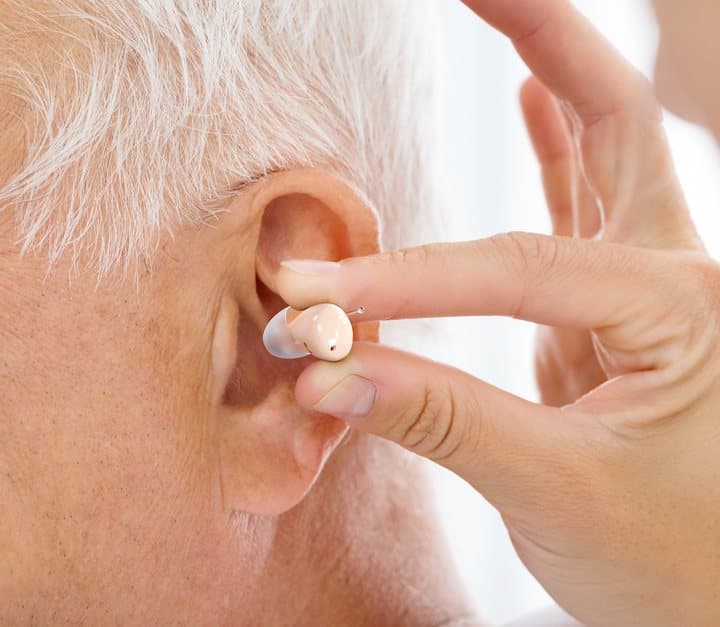
Charge the aids fully in the case, then try the medium tips first so each aid sits snugly without hurting. Start at a low volume in a quiet room and raise it until speech is comfortable, not loud. Wear them for two to four hours a day in the first week, then build up. If they whistle, try a larger tip, push the aid in fully and check for wax.
- Charge the aids fully in the case before first use.
- Try the medium tips first; the aid should sit snugly without hurting, with no gaps.
- Start at a low volume in a quiet room and raise it until speech is comfortable, not loud.
- Wear them for two to four hours a day in the first week, then build up to all day.
- Practise in different places: at home, with the TV, in a shop, then in a busier setting.
- Clean the tips daily with the brush or a dry cloth, and check for wax.
- Put them back in the case each night to charge and keep them safe and dry.
Dealing with whistling
Whistling (feedback) happens when amplified sound leaks out and is picked up again by the microphone. Try a larger tip for a better seal, push the aid in fully, lower the volume slightly, and check for wax. Hugs, hats and phones near the ear can cause brief whistling, which is normal.
Your own voice sounds odd
With the ear canal blocked, your own voice can sound boomy or hollow, called occlusion. It usually becomes less noticeable over a few weeks. If it stays bothersome, a different tip size may help.
Using them with the TV
Sit closer to the TV than usual, reduce background noise, and turn on subtitles as a back-up. If TV is your main problem, a TV streamer or a wireless TV headphone set may help more than basic hearing aids.
Using the phone
Hold the phone near the microphone on the aid rather than directly over the ear canal, and try speakerphone. Basic aids without Bluetooth can make phone calls tricky; this is one area where aids with streaming help.
Keeping them safe
Keep them away from water, showers and swimming, since no water-resistance rating is stated. Sweat during exercise can also get into small aids, so wipe them down afterwards and let them dry in the open case before charging. Do not leave them where pets can reach them; dogs are notorious for eating hearing aids. Store them in the case whenever they are out of your ears.
Replacing tips and wax guards
Silicone tips harden and lose their seal over time, and wax guards clog. Audien sells a maintenance kit with replacement domes and wax guards. Replacing tips every few months, or sooner if they look discoloured or feel loose, keeps sound clear and reduces whistling.
Travelling with hearing aids
Take the charging case and cable in your hand luggage, not checked bags. You can keep hearing aids in through airport security; tell the officer if you are asked to remove anything. Pack a small cleaning brush and spare tips for longer trips.
Audien Atom AirScore 6.1/10
Before you buy: Check the final price, shipping and return terms at checkout.
$149.00 at Audien Hearing · Price checked October 3, 2026
Check price at Audien Hearing (opens Audien Hearing in a new tab)We may earn a commission if you buy through our links.
What else do people ask about OTC hearing aids?
Most questions are about what OTC hearing aids are and whether cheap ones are worth it. They are FDA-regulated hearing aids you can buy without a prescription, for adults 18 and over with perceived mild to moderate loss, a category created in October 2022. Budget models can be a reasonable first step for mild loss in quiet settings, but noisy places need better aids.
What is an OTC hearing aid?
A hearing aid you can buy without a prescription, exam or fitting, for adults 18 and over with perceived mild to moderate hearing loss. The FDA created the category in October 2022 to make hearing aids cheaper and easier to get.
What is the difference between an OTC hearing aid and a sound amplifier?
OTC hearing aids are FDA-regulated medical devices intended to treat hearing loss, with rules on output limits and labelling. Personal sound amplification products (PSAPs) are not intended for hearing loss; they are for people with normal hearing who want to hear better in certain situations.
Are cheap hearing aids worth it?
They can be a reasonable first step for mild loss in quiet settings, and a good way to find out whether amplification helps. If you struggle in noise or have more than mild loss, spending more on a better OTC aid or a professional fitting usually brings much better results.
How long do rechargeable hearing aid batteries last?
Rechargeable lithium-ion batteries typically last several years before holding noticeably less charge. Daily charging is normal. If an aid stops lasting the day within the warranty period, contact support.
Can I wear OTC hearing aids to bed?
It is best not to. Sleeping in them can be uncomfortable, can push wax deeper, and means they do not charge. Take them out at night and put them in the case.
When should I see an audiologist instead?
If you have any red-flag symptoms, if OTC aids do not help after a fair trial, if you struggle mainly in noise, or if your loss is more than moderate. An audiologist can test your hearing properly, fit aids to it and adjust them over time.
Do hearing aids work straight away?
They make sound louder straight away, but understanding speech better takes time. The brain has to relearn how to process sounds it has not heard clearly for years. Most people need two to four weeks of daily wear before deciding whether aids help, which is why a 45-day trial is useful only if you start wearing them as soon as they arrive.
Frequently asked questions
Is the Audien Atom Air a real hearing aid?
Audien sells the Atom Air as an over-the-counter (OTC) hearing aid. Since October 2022, the FDA has allowed adults 18 and over with perceived mild to moderate hearing loss to buy OTC hearing aids without an exam or prescription. NCOA's review of Audien describes its current models as FDA-registered OTC hearing aids.
How much does the Audien Atom Air cost?
On 3 October 2026 the offer page showed $149 for one pair, $223.50 for two pairs and $298 for three pairs, with free US shipping. Audien's own site listed the Atom Air at $149 a pair the same day.
How good are Audien hearing aids?
They are basic and cheap. In independent HearAdvisor lab tests reported by HearingTracker, the original Audien Atom and the Atom Pro 2 gave speech clarity well below average, particularly in noise, though the Pro 2 handled feedback well. We found no published lab test of the Atom Air itself.
Does the Atom Air have 4 listening modes?
The offer page says it has an A2 chip and four listening modes. Audien's May 2026 launch announcement, reported by Hearing Review, describes an A1 MAX chip and one adjustable hearing mode with frequency control. Check the product listing at checkout and the manual on arrival to see which you have.
Do I need a hearing test before buying?
No test is required for OTC hearing aids. A test is still a good idea: it tells you whether your loss is mild to moderate, and whether it is the same in both ears. Many audiologists, some pharmacies and several free online and app-based tests can help.
How do I return Audien hearing aids?
Within 45 days of delivery, you contact Audien by phone, text or email and complete a phone call or video appointment before the return is authorised. You pay return shipping, everything must come back in the original packaging, and the parcel must be in transit by day 45.
Does Medicare cover Audien hearing aids?
Original Medicare does not cover hearing aids. Some Medicare Advantage plans include a hearing aid benefit, and OTC hearing aids are often eligible for HSA or FSA spending. Check your plan. Keep your receipt for any claim or reimbursement.
Can the Atom Air stop tinnitus?
The offer page says it reduces ringing. Hearing aids can make tinnitus less noticeable for some people by making outside sounds easier to hear, but they do not cure it. Ringing in one ear only, or with sudden hearing loss, needs a doctor.
We may earn a commission if you buy through our links.
This content is for informational purposes and is not medical advice. Talk to a qualified professional before using any product that affects your health.
Prices accurate as of October 3, 2026. Check the seller's checkout for current pricing, promotions and terms.
What we checked: No hands-on use. Claims, bundles, testimonials, guarantee and product images from the Atom Air offer page our link opens (getaudienatom2.com) on 2026-10-03. Audien's May 2026 Atom Air launch announcement as reported by Hearing Review, Audien's refund policy and model prices on its own site, HearingTracker's HearAdvisor lab results for the Audien Atom and Atom Pro 2, NCOA's Audien review, the FDA's OTC hearing aid guidance and the Trustpilot profile for audienhearing.com were read the same day. No lab test of the Atom Air itself was found.
Compare Audien Atom Air

About the author
James Wilson, Consumer Tech Writer
James Wilson covers health and wellness technology for Top10Gadgets: breathing devices, massagers, hearing aids, dental and weight-loss products, and the other gadgets sold with a promise to make life easier. James write…
- Health and wellness gadgets
- Over-the-counter hearing aids
- Breathing and massage devices
- FDA clearance and registration
- Tech for beginners
Writing for Top10Gadgets since 2026Full profile