Supplements / Alcohol support
Cloud9 Daily Restore Review: What's in the Supplement for Drinkers, What It Can't Undo and Who Should Avoid It
A daily capsule for drinkers with B vitamins, NAC, milk thistle, DHM and more. Some ingredients fill real gaps; no supplement reverses alcohol's harm, and two ingredients carry interaction and liver cautions.

By Daniel Brooks, Technology & Buying Guide Editor at Top10Gadgets
Updated 30 min readHow we test
Quick answer
Only if you drink regularly, are cutting down, take no interacting medicines and have no liver disease, and you want one labelled product to cover likely B-vitamin gaps. Cloud9 Daily Restore has fully disclosed doses, a strong form of vitamin B1 and sensible B12 and folate.
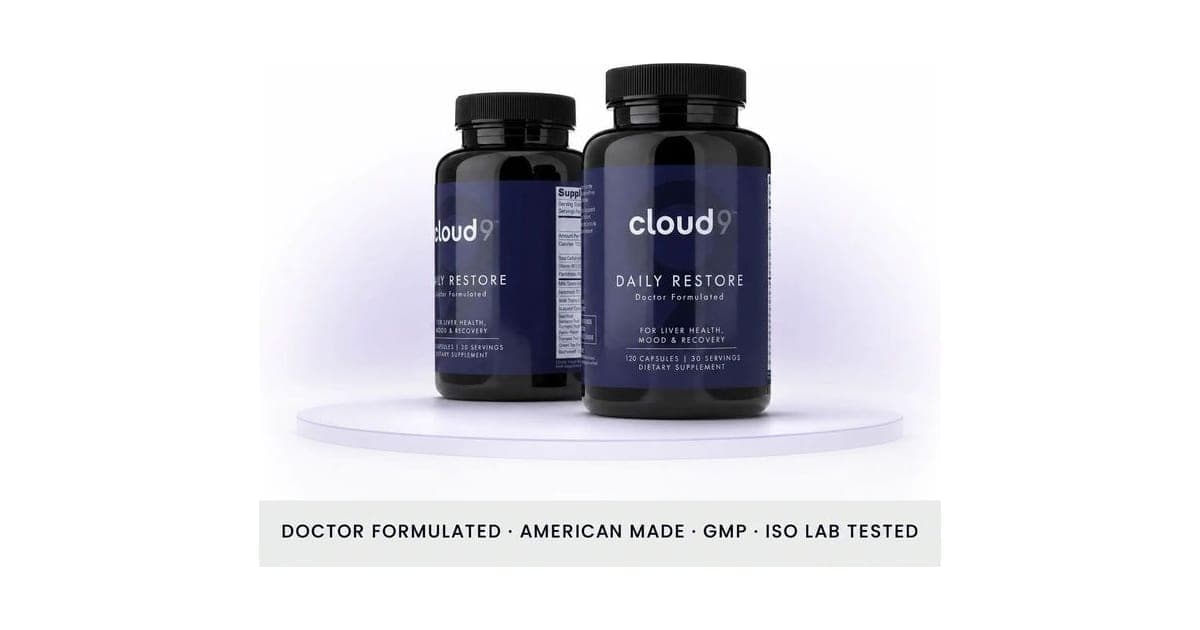
Score 5.0/10$59.00 at Cloud9
Check price at Cloud9 (opens Cloud9 in a new tab)We may earn a commission if you buy through our links.
- Best for
- Regular drinkers who are cutting down and want to correct likely B-vitamin shortfalls alongside medical advice
- Not for
- Anyone taking antidepressants, MAOIs, triptans, tramadol or other serotonergic medicines, because of the 5-HTP
$59.00 at Cloud9
Check price at Cloud9 (opens Cloud9 in a new tab)We may earn a commission if you buy through our links.
On this page · 14 sections
- 01Our verdict
- 02The short version
- 03Pros & cons
- 04How it works
- 05Who it's for
- 06How much does Cloud9 Daily Restore cost, and what's in it?
- 07Does Cloud9 Daily Restore work, and what does the evidence say?
- 08Are Daily Restore's claims true?
- 09Is Daily Restore better than a B-complex or simply drinking less?
- 10Is Cloud9 Daily Restore safe, and what should you check before buying?
- 11What do owners say, and how did we score Cloud9 Daily Restore?
- 12How to use Cloud9 Daily Restore for the best results
- 13What else do people ask about supplements for drinkers?
- 14Frequently asked questions
Our verdict
Only if you drink regularly, are cutting down, take no interacting medicines and have no liver disease, and you want one labelled product to cover likely B-vitamin gaps. Cloud9 Daily Restore has fully disclosed doses, a strong form of vitamin B1 and sensible B12 and folate. But it is sold as a way to feel better "without quitting alcohol", and no supplement undoes alcohol's harm. It also contains 5-HTP and ashwagandha, which carry real medication and liver cautions. It scores 5.0 out of 10, at $59 a month.
The short version
- A daily capsule supplement for drinkers with three blends: replenish (B1, B12, folate, electrolytes), liver (NAC, milk thistle, DHM) and mood (5-HTP, L-tyrosine, L-theanine, ashwagandha).
- Developed by clinicians who work in nutrition and alcohol, according to the brand.
- $59 for one month on 3 October 2026, $110 for two, $156 for three and $264 for six, with a 60-day guarantee.
- Best trait: transparent doses, including nutrients drinkers often lack.
- Biggest drawback: framed as letting you keep drinking, with ingredients that need caution in exactly the people most likely to buy it.
- Our score: 5.0 out of 10, with the lowest marks for claim accuracy and owner record.
Pros & cons
Daily Restore is better formulated than many offer-page supplements, with real doses and a clear label. The problem is less what is in it than how it is sold: as a way to keep drinking while protecting your health, which no supplement can do.
What we like
- Fully disclosed doses for every ingredient, including a strong 300 mg dose of a well-absorbed form of vitamin B1
- Thiamine, B12 and folate address deficiencies that are genuinely common in regular drinkers
- Developed with clinicians who specialise in nutrition and alcohol, including nutritionist Dr. Brooke Scheller
- One product instead of several separate supplements
- 60-day money-back guarantee
What we don't
- Marketed to help you feel better 'without quitting alcohol', but no supplement undoes alcohol's harm, including its cancer risk
- Contains 5-HTP, which should not be combined with antidepressants and other serotonergic medicines without medical advice
- Contains ashwagandha, which has been linked to rare cases of liver injury, an odd fit for a 'liver defense' formula
- 'Every ingredient backed by human clinical studies' does not mean the formula itself has been tested
- No independent owner reviews found; the brand's Trustpilot profile has none
Sold by Cloud9
Cloud9 Daily Restore$59.00
How it works
Daily Restore groups its ingredients into three blends, each aimed at a different effect of alcohol.
Replaces nutrients alcohol depletes
Step 1: Regular drinking reduces absorption and stores of B vitamins, especially thiamine (B1), B12 and folate; the 'replenish blend' supplies these, plus a little sodium and potassium.
Supports antioxidant defences
Step 2: NAC is a building block of glutathione, a major antioxidant in the liver; milk thistle and DHM are plant compounds studied for liver protection, mostly in lab and animal research.
Targets mood and stress
Step 3: 5-HTP is a serotonin precursor, L-tyrosine a dopamine precursor, L-theanine a calming amino acid and ashwagandha an adaptogen herb; together they are aimed at the low mood and anxiety some people feel after drinking.
Some of this is grounded in well-established nutrition science, especially the B vitamins. The liver and mood blends rely more on early, mixed or indirect evidence. The sections below go through each.
Who it's for
Daily Restore makes most sense for regular drinkers who are actively cutting down, whose diet may be short of B vitamins, and who want a single daily product with clearly stated doses. It is most appropriate alongside a conversation with a doctor, ideally with blood tests, which Cloud9 itself offers through an at-home blood test.
It is not appropriate for anyone taking antidepressants or other serotonergic medicines without medical advice, for people with liver disease, or for pregnant or breastfeeding women. And it is not a substitute for drinking less. If you are worried about your drinking, the most useful step is talking to a doctor or a free helpline, not buying a supplement.
Why Daily Restore appeals
Many people drink more than they would like, feel the effects the next day, and do not want to give up alcohol entirely. A supplement that promises to "restore" what alcohol takes, without asking you to quit, speaks directly to that. It feels like taking responsibility without giving anything up.
It also appeals because it looks more serious than a hangover remedy: doctor-formulated, full doses on the label, and a focus on long-term health rather than morning-after relief. For people who like to cover their bases with supplements, one product that does several jobs is attractive.
Who gets the most value
The people most likely to benefit are regular drinkers with poor diets, who are likely to be short of thiamine and folate, and who are cutting down. Occasional drinkers with a balanced diet are unlikely to notice much, and heavy daily drinkers need medical care more than a supplement.
Harm reduction, honestly
There is a reasonable harm-reduction case for nutritional support in people who drink: correcting a thiamine shortfall, for example, prevents real harm. That is different from the idea that a supplement lets you keep drinking at the same level without consequences. Daily Restore is most defensible as a support while someone drinks less, and least defensible as permission to carry on.
- Regular drinkers who are cutting down and want to correct likely B-vitamin shortfalls alongside medical advice
- People who would otherwise buy several separate supplements and prefer one labelled formula
- Adults not taking antidepressants or other interacting medicines, with no liver disease
Who should skip it
- Anyone taking antidepressants, MAOIs, triptans, tramadol or other serotonergic medicines, because of the 5-HTP
- People with liver disease or cirrhosis, or abnormal liver tests
- Pregnant or breastfeeding women, and anyone with thyroid disease or on immunosuppressants, without medical advice
- Anyone using it as a reason to keep drinking heavily; if you think you drink too much, talk to a doctor
How much does Cloud9 Daily Restore cost, and what's in it?
Cloud9 Daily Restore cost $59 for one month on 3 October 2026, $110 for two, $156 for three and $264 for six, with extra savings on subscriptions and free shipping over $100. Every dose is disclosed: milk thistle, NAC and DHM for the liver, L-tyrosine, 5-HTP, L-theanine and ashwagandha for mood, plus B vitamins, including 300 mg of the thiamine form TTFD, and electrolytes.
The page our link opens and the brand's store list the full formula. The bottle is labelled for liver health, mood and recovery.
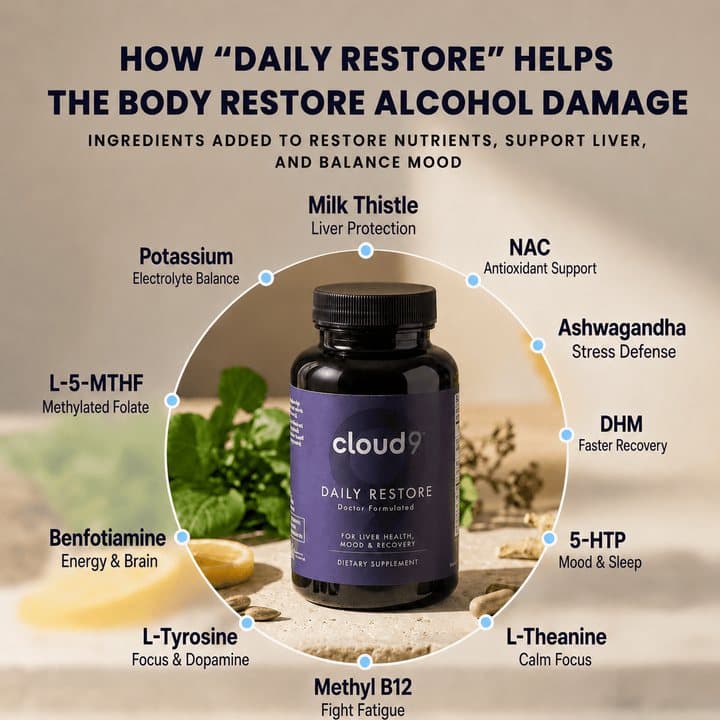
The full formula
| Blend | Ingredient | Dose (brand) |
|---|---|---|
| Liver | Milk thistle | 350 mg |
| Liver | NAC (N-acetyl cysteine) | 350 mg |
| Liver | Dihydromyricetin (DHM) | 200 mg |
| Mood | L-Tyrosine | 300 mg |
| Mood | 5-HTP | 50 mg |
| Mood | L-Theanine | 50 mg |
| Mood | Ashwagandha | 300 mg |
| Replenish | Vitamin B1 (thiamine tetrahydrofurfuryl disulfide, TTFD) | 300 mg |
| Replenish | Vitamin B12 (methylcobalamin) | 500 mcg |
| Replenish | Methylfolate | 250 mcg |
| Replenish | Sodium | 75 mg |
| Replenish | Potassium | 55 mg |
The brand does not say on the page we read how many capsules make up a serving. Check the label for the serving size and how to take it.
Cloud9 Daily Restore price
On 3 October 2026 the page our link opens showed prices in Indian rupees because of our location. Requested in US dollars, the same page showed:
| Supply | One-time price | Per month |
|---|---|---|
| 1 month | $59 | $59 |
| 2 months | $110 | $55 |
| 3 months | $156 | $52 |
| 6 months | $264 | $44 |
The page also offers subscriptions with larger savings, from 8% on one month to 34% on six months, and free shipping on orders over $100. Cloud9's store sells related products, including an at-home blood test at $139 and other supplement bundles.
Is $59 a month good value?
Bought separately, the main ingredients would cost less in total, particularly B vitamins, NAC and milk thistle, which are inexpensive. What you pay for is the convenience of one product, the specific B1 form, and the brand's clinical positioning. If you only need B vitamins, a B-complex or thiamine supplement costs a fraction of the price.
Who makes it
Cloud9 describes itself as making doctor-developed products to support the liver, nutrients, mood, sleep and recovery. It lists a mailing address in Sheridan, Wyoming, offices in Scottsdale, Arizona, a phone line and an email address on its site. Its range includes other supplement bundles for bloating, sleep and metabolism, a podcast and a blog. The brand's Trustpilot profile names founder Mike Hardenbrook and co-owners Dr. Robin Terranella and Dr. Brooke Scheller.
The at-home blood test
Cloud9 also sells an at-home blood test for $139. Testing before supplementing is a sensible idea in principle, since it shows which nutrients you are actually low in. Your own doctor can often order the same tests, and in many cases insurance covers them.
Useful tests for regular drinkers usually include a full blood count, liver function tests, and levels of B12 and folate. Thiamine is harder to measure, which is one reason doctors often give it routinely to heavy drinkers.
The guarantee and subscriptions
The page promises a 60-day money-back guarantee if you do not feel a difference. Subscriptions renew automatically.
What this means for you: if you subscribe for the discount, note your renewal date, and check the guarantee terms before buying a six-month supply.

Cloud9 Daily RestoreScore 5.0/10
Best for: Regular drinkers who are cutting down and want to correct likely B-vitamin shortfalls alongside medical advice
$59.00 at Cloud9 · Price checked October 3, 2026
Check price at Cloud9 (opens Cloud9 in a new tab)We may earn a commission if you buy through our links.
Does Cloud9 Daily Restore work, and what does the evidence say?
Its strongest case is thiamine, vitamin B1: alcohol reduces its absorption and storage, deficiency is common in heavy drinkers, and doctors routinely give it to people treated for alcohol dependence. B12 and folate are sensible too. Evidence for the liver and mood ingredients is weaker, DHM's alcohol research is mostly in animals, and we found no published trial of Daily Restore itself.
The page says every ingredient is backed by human clinical studies and shows study counts. Individual ingredients being studied is not the same as the formula being tested; we found no published trial of Daily Restore itself.
Thiamine (vitamin B1): the strongest case
Thiamine deficiency is common in people who drink heavily, because alcohol reduces its absorption and storage. Severe deficiency can cause serious brain disorders, which is why doctors routinely give thiamine to people being treated for alcohol dependence. Daily Restore uses 300 mg of TTFD, a fat-soluble form designed to be better absorbed than standard thiamine. For a regular drinker, this is the most defensible ingredient.
Anyone who drinks heavily and has confusion, unsteadiness or vision problems needs urgent medical care, not a supplement.
For moderate drinkers with a good diet, thiamine deficiency is much less likely. The case for 300 mg a day is strongest in people who drink heavily or eat poorly; for others, it is a generous dose with little downside but probably little noticeable effect.
Vitamin B12 and folate
Heavy drinking is associated with low folate and sometimes B12. Both are needed for healthy blood cells and nerves. The doses here are reasonable. A blood test can show whether you are actually low.
NAC (N-acetyl cysteine)
NAC helps the body make glutathione, an antioxidant central to the liver's defences, and it is used in hospitals at high doses to treat paracetamol (acetaminophen) overdose. Evidence that everyday NAC supplements protect the liver from alcohol is limited, and small studies of NAC for reducing drinking have shown mixed results.
Milk thistle
Milk thistle is the best-known liver herb. Clinical trials in liver disease have been conflicting or too limited to draw conclusions, and NIH-funded trials did not find benefits in hepatitis C or a progressive form of fatty liver disease. It is generally well tolerated.
DHM (dihydromyricetin)
DHM, from the oriental raisin tree, reduced alcohol intoxication and withdrawal-like effects in rats in widely reported research. Good-quality human evidence that it prevents hangovers or protects the liver is lacking.
5-HTP and L-tyrosine
5-HTP is converted into serotonin; L-tyrosine into dopamine and noradrenaline. Small studies have looked at both for mood, with mixed results. The 5-HTP dose here, 50 mg, is low compared with doses used in depression research. Its main relevance is the interaction risk with serotonergic medicines.
Alcohol itself affects serotonin and dopamine signalling, which is one reason mood can dip the day after drinking. Whether small doses of precursors make a noticeable difference to that has not been tested in drinkers.
L-theanine
L-theanine, found in tea, has some evidence for promoting relaxation without drowsiness at doses of around 100 to 200 mg. The 50 mg here is on the low side.
Ashwagandha
Ashwagandha has a growing body of small trials suggesting it can reduce perceived stress and anxiety. The NIH's LiverTox database entry on ashwagandha also describes rare cases of clinically apparent liver injury, usually mild but occasionally severe, and advises avoiding it in people with cirrhosis or advanced chronic liver disease. In a product sold for "liver defense" to people who drink, that is a notable tension.
Electrolytes
Alcohol increases urine output and can lower sodium and potassium. The small amounts here are similar to a light electrolyte drink. Water with food does much of the same job.
How the doses compare
| Ingredient | Daily Restore | Typical supplement or study doses |
|---|---|---|
| Thiamine | 300 mg (TTFD) | 50 to 300 mg in supplements; higher in medical treatment |
| B12 | 500 mcg | 250 to 1,000 mcg in supplements |
| Methylfolate | 250 mcg | 400 to 1,000 mcg in many supplements |
| NAC | 350 mg | 600 to 1,800 mg in many studies |
| Milk thistle | 350 mg | 140 to 800 mg silymarin in studies |
| 5-HTP | 50 mg | 100 to 300 mg in mood studies |
| L-theanine | 50 mg | 100 to 400 mg in relaxation studies |
| Ashwagandha | 300 mg | 250 to 600 mg extract in stress studies |
Several ingredients are at or below the lower end of studied doses. That reduces side-effect risk, and also reduces the chance of a noticeable effect from those ingredients. The B vitamins are where the doses are most substantial.
Ingredient evidence summary
| Ingredient | Evidence for its intended role | Key caution |
|---|---|---|
| Thiamine (TTFD) | Strong rationale in drinkers | Severe symptoms need urgent care |
| B12, methylfolate | Good rationale | Test levels if possible |
| NAC | Limited for alcohol-related liver protection | Interacts with some heart medicines |
| Milk thistle | Conflicting trials | Ragweed allergy |
| DHM | Mostly animal studies | Little human data |
| 5-HTP | Mixed, small studies | Serotonergic interactions |
| L-tyrosine | Limited | MAOIs, thyroid medicines |
| L-theanine | Some evidence at higher doses | Low dose here |
| Ashwagandha | Small trials for stress | Rare liver injury; thyroid, pregnancy |
Are Daily Restore's claims true?
Its central pitch is not supported. Feeling better "without quitting alcohol" ignores that alcohol raises the risk of at least seven cancers, according to the US Surgeon General's 2025 advisory, and no supplement cancels that. "Restore the damage done by alcohol" has no evidence in people. "Every ingredient backed by human clinical studies" is partly true, but the studies are often small, unrelated to alcohol or at different doses.
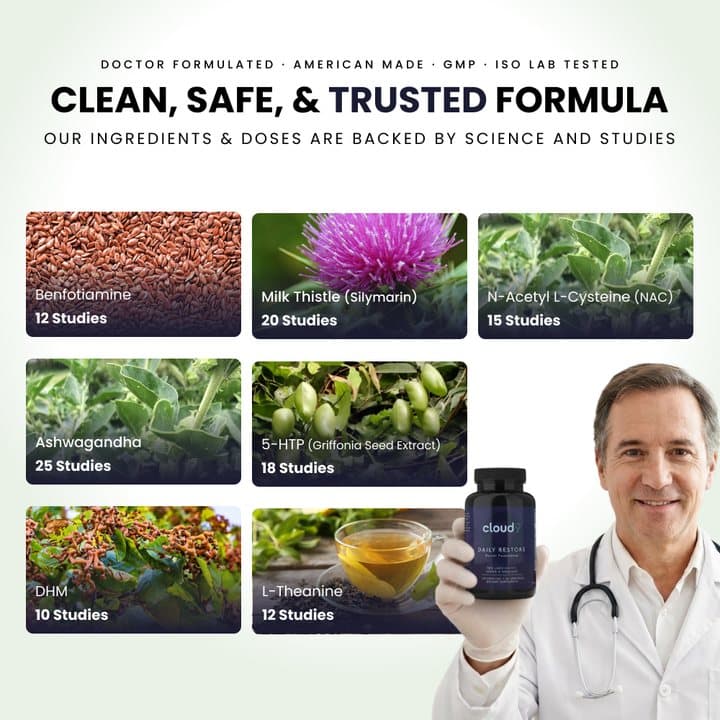
The brand's study counts per ingredient
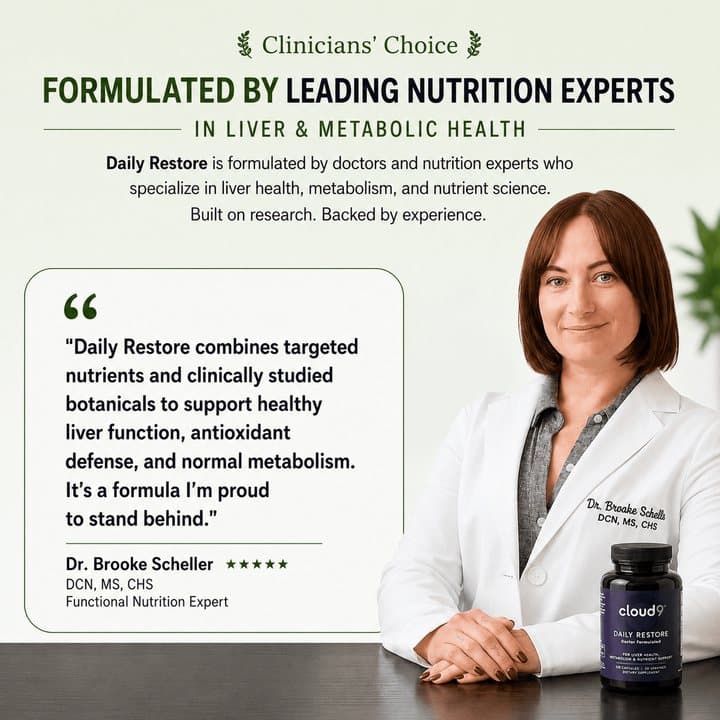
Nutritionist Dr. Brooke Scheller, who the brand says helped formulate it
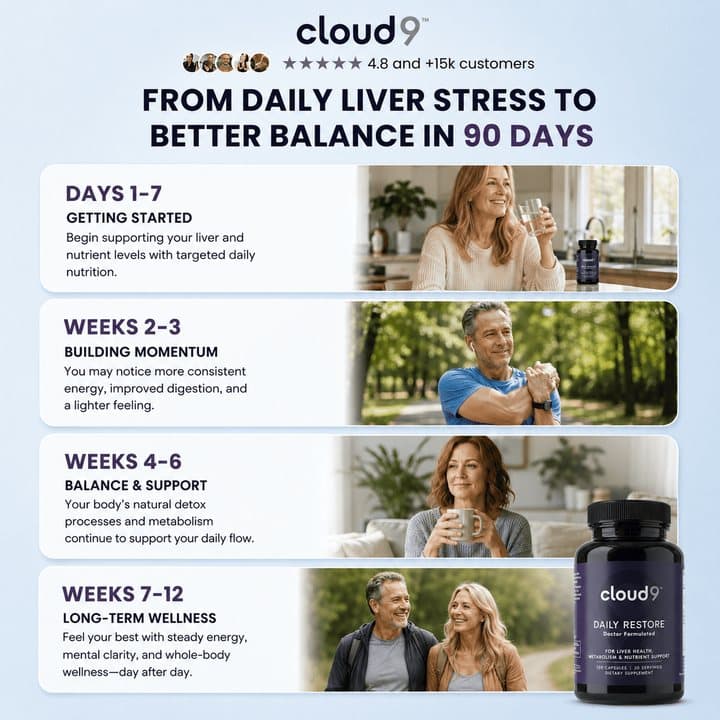
The brand's 90-day timeline
"Bounce back, feel clear, take control, without quitting alcohol"
This is the core pitch, and the most problematic. The US Surgeon General's 2025 advisory on alcohol and cancer stated that alcohol increases the risk of at least seven types of cancer, and there is no supplement that cancels that risk. Liver disease, heart disease, high blood pressure, poor sleep and mental health effects also follow from drinking itself. Replacing nutrients is useful; it is not protection.
"Restore the damage done by alcohol and protect your health"
The brand's own images use this line. No ingredient in the formula has been shown to reverse alcohol-related damage in people. Some may support recovery when combined with drinking less.
"Every ingredient is backed by human clinical studies"
Most ingredients have been studied in people for something. Many studies are small, not about alcohol, or at different doses. DHM's alcohol research is mostly in animals. The formula itself has no published trial.
"Supports liver detox and cellular defence"
NAC supports glutathione production, and milk thistle has been studied for the liver. "Detox" is not a defined effect, and the evidence that these supplements protect drinkers' livers is weak. Ashwagandha's rare liver risks cut the other way.
"Clears brain fog and improves energy" and "eases stress and mood swings"
If brain fog and fatigue come from thiamine or B12 shortfall, correcting it can help. Alcohol's effects on sleep and mood are often the bigger cause, and they improve most when people drink less. The mood ingredients have small, mixed evidence.
"Made in an FDA-approved facility"
The FDA does not approve supplement facilities. Facilities can be FDA-registered and follow good manufacturing practice, which the brand also mentions elsewhere. "FDA-approved" is inaccurate wording.
"Doctor-formulated" and "clinicians' choice"
Cloud9 says its products are developed by doctors and nutrition experts. Its Trustpilot profile names co-owners Dr. Robin Terranella and Dr. Brooke Scheller, a nutritionist known for work on alcohol and nutrition. That is a meaningful credential compared with many supplements. It does not replace testing of the product itself.
"Over 150,000 bottles sold" and "4.8 out of 5"
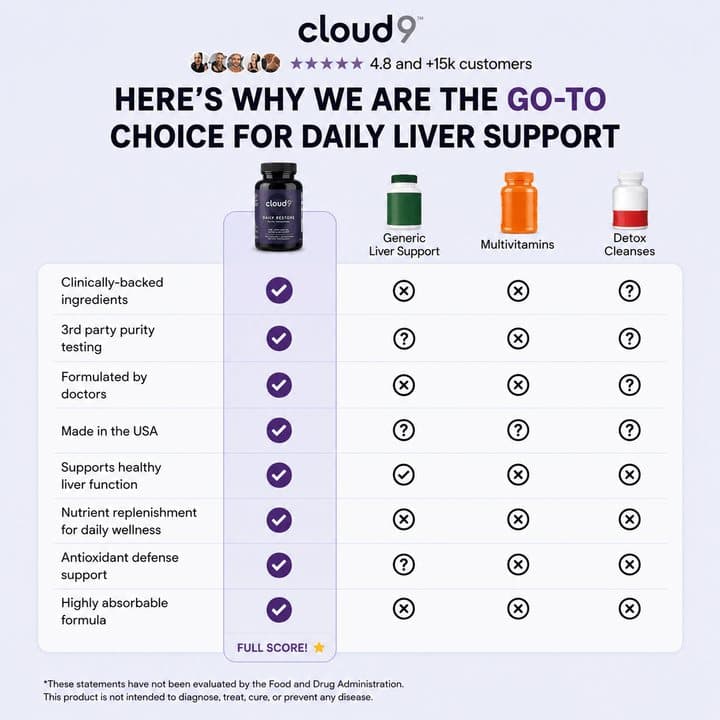
We could not verify these figures, and found no independent reviews to compare them with. The page's images also show a "Clinicians' Choice" badge and media logos; we could not confirm what each refers to.
"Fast-acting formula"
Correcting a nutrient deficiency usually takes weeks. The brand's own 90-day timeline image suggests gradual change, which is more realistic than "fast-acting".
Claims scorecard
| Claim | What we found | Our view |
|---|---|---|
| Replenishes nutrients alcohol depletes | B1, B12, folate in useful doses | Supported |
| Supports liver detox and protection | Weak evidence; ashwagandha liver cautions | Overstated |
| Restores alcohol damage, protects health while drinking | No supplement does this | Misleading |
| Every ingredient backed by human studies | Mixed; formula untested | Overstated |
| Eases stress and mood | Small, mixed evidence; low doses for some | Unproven |
| Made in an FDA-approved facility | FDA does not approve facilities | Inaccurate |
| Doctor-formulated | Clinician co-owners named | Supported |
Is Daily Restore better than a B-complex or simply drinking less?
If your goal is replacing B vitamins, a B-complex or thiamine supplement costs a few dollars a month, a fraction of Daily Restore's price. Liver supplements with milk thistle have no strong evidence of protecting the liver from alcohol. The most effective option is drinking less, with alcohol-free days and low- or no-alcohol drinks, and medical treatment for anyone worried about dependence.
| Option | Cost | What it addresses | Evidence |
|---|---|---|---|
| Cloud9 Daily Restore | $44 to $59 a month | B vitamins, plus liver and mood ingredients | Mixed; strongest for B vitamins |
| B-complex or thiamine supplement | A few dollars a month | B-vitamin shortfalls | Good rationale in drinkers |
| Blood tests with a doctor | Varies; often covered | Actual nutrient levels and liver health | Essential for heavy drinkers |
| Drinking less | Saves money | The cause of the harm | Strongest of all |
| Medication for alcohol use disorder | Prescribed | Cravings and relapse | Good evidence |
| Support programmes and helplines | Often free | Changing drinking habits | Good evidence |
Daily Restore vs a simple B-complex
If your goal is replacing B vitamins, a B-complex or thiamine supplement costs a fraction of the price. It will not include the liver and mood ingredients, which have weaker evidence and some cautions anyway.
Daily Restore vs a liver supplement
Liver supplements with milk thistle and similar herbs are widely sold. Our Akka review looks at one in detail. None has strong evidence that it protects the liver from alcohol.
Daily Restore vs drinking less
Cutting down is the only approach that reliably reduces alcohol's harm. Even moderate reductions lower risk. Tools that help include tracking drinks, alcohol-free days, low- and no-alcohol drinks, and support programmes.
Daily Restore vs alcohol-free drinks
The market for alcohol-free beers, wines and spirits has grown quickly, and many people use them to cut down without giving up the social ritual of drinking. Swapping some drinks for alcohol-free versions reduces alcohol intake directly, which no supplement can do. Combined with a few alcohol-free days a week, it can make a big difference over time.
Daily Restore vs medical treatment
For people who find it hard to cut down, doctors can prescribe medicines that reduce cravings or help prevent relapse, and refer to counselling. These have far stronger evidence than any supplement.
Daily Restore vs electrolyte and hydration drinks
Electrolyte drinks help with dehydration after drinking and are cheap. They do not replace B vitamins, but for the morning after, water, food and rest do more than any capsule.
Daily Restore vs a multivitamin
A standard multivitamin provides B vitamins at lower doses, plus other nutrients, for a fraction of the cost. For someone with a reasonable diet who drinks moderately, a multivitamin or simply better meals may be enough.
If you have decided a supplement for nutrient support is right for you, and none of the cautions apply, the Cloud9 Daily Restore order page (opens Cloud9 in a new tab) lists the supply options. Our supplements section and wider health and wellness reviews cover other products, including Primal Sleep and the Capnos Legura for people cutting down on vaping. For a digestive supplement checked the same way, see our Emma Relief review.
Cloud9 Daily RestoreScore 5.0/10
Why people buy it: Fully disclosed doses for every ingredient, including a strong 300 mg dose of a well-absorbed form of vitamin B1
$59.00 at Cloud9 · Price checked October 3, 2026
Check price at Cloud9 (opens Cloud9 in a new tab)We may earn a commission if you buy through our links.
Is Cloud9 Daily Restore safe, and what should you check before buying?
Daily Restore has real cautions. Check with a pharmacist first if you take antidepressants, triptans, tramadol, lithium, thyroid medicine, sedatives, immunosuppressants or diabetes or blood pressure medicines, because 5-HTP, tyrosine and ashwagandha can interact. Ashwagandha has rare links to liver injury, so avoid it with liver disease, and skip it in pregnancy. If you are worried about your drinking, talk to a doctor.
Medication interactions
The most important cautions in this review.
What to do: check with a pharmacist before taking Daily Restore if you take antidepressants (SSRIs, SNRIs, MAOIs), triptans for migraine, tramadol, lithium, thyroid medication, sedatives, immunosuppressants, diabetes medicines, blood pressure medicines or nitroglycerin. 5-HTP, tyrosine, ashwagandha and NAC each have known interactions with some of these.
Liver disease
Ashwagandha has rare links to liver injury and should be avoided in people with cirrhosis or advanced liver disease.
What to do: if you drink heavily or have had abnormal liver tests, see a doctor before taking any supplement, and get your liver checked. Stop and seek care if you notice yellow skin or eyes, dark urine or pain under the right ribs.
Pregnancy and breastfeeding
Several ingredients, including ashwagandha and 5-HTP, are not recommended in pregnancy.
What to do: avoid Daily Restore if pregnant or breastfeeding unless a doctor advises otherwise. Alcohol in pregnancy is not safe at any level.
Alcohol and sedation
Ashwagandha, theanine and 5-HTP can add to drowsiness, and alcohol is a sedative.
What to do: do not drive or operate machinery if you feel drowsy, and avoid combining with sleeping tablets without advice.
Thyroid conditions
Ashwagandha may affect thyroid hormone levels, and L-tyrosine is a building block of thyroid hormones.
What to do: if you have a thyroid condition or take thyroid medication, check with your doctor before taking Daily Restore.
Older adults
Older adults are more sensitive to alcohol and more likely to take medicines that interact with supplements.
What to do: review all supplements and medicines with a pharmacist at least once a year, and mention alcohol use honestly.
Autoimmune conditions and immunosuppressants
Ashwagandha may stimulate the immune system.
What to do: if you have an autoimmune condition or take immunosuppressant medicines, ask your doctor first.
If you are worried about your drinking
Signs of a problem include drinking more than you intend, cravings, needing more to feel the effect, drinking affecting work or relationships, or feeling unwell when you stop.
What to do: talk to a doctor. In the US, the federal National Helpline (1-800-662-4357) is free and confidential, and the National Institute on Alcohol Abuse and Alcoholism's Rethinking Drinking site has practical tools. Do not stop suddenly if you drink heavily every day; alcohol withdrawal can be dangerous and should be medically supervised.
How to buy Cloud9 Daily Restore the smart way
- Check the medication and health cautions above with a pharmacist, then open the Cloud9 Daily Restore page (opens Cloud9 in a new tab).
- Start with one month rather than six, so you can stop if it does not suit you.
- Decide whether to subscribe; if you do, note the renewal date.
- Check the label for the serving size and directions when it arrives.
- Keep your order confirmation; the 60-day guarantee depends on it.
- Pair it with a plan to drink less, and ideally a blood test to see what you actually need.
Supplement quality
Supplements are not approved by the FDA before sale, and quality varies across the industry. Look for third-party testing seals from independent organisations when choosing any supplement.
What to do: ask the brand whether its products are independently tested for contents and contaminants, and keep the batch number in case of problems.
What do owners say, and how did we score Cloud9 Daily Restore?
Cloud9 Daily Restore scores 5.0 out of 10: claim accuracy 0.6, formulation and labelling 1.2, price competitiveness 1.0, usability 1.4 and owner satisfaction 0.8, each out of 2. The page shows testimonials and claims 150,000 bottles sold and a 4.8 rating, but the brand's claimed Trustpilot profile had no reviews on 3 October 2026, and we found no other independent rating.
Testimonials on the page
The page shows testimonials from people who wanted to keep drinking but feel better, from a 46-year-old weekend drinker who feels more balanced, and from a user who says their doctor recommended it while they cut back and that they think about wine less. It claims over 150,000 bottles sold and a 4.8 out of 5 average rating from more than 15,000 customers.
Independent ratings
The Trustpilot profile for trycloud9.com had no reviews on 3 October 2026, although the company had claimed it. We found no other independent rating, so we cannot check the page's rating claims.
Reading supplement testimonials
Testimonials for supplements aimed at drinkers often describe better mornings, more energy and less guilt. These can be real, but they often coincide with drinking less, eating better or simply paying more attention to health. When reading them, look for whether the person also changed their drinking. One testimonial on this page, from someone cutting back on doctor's advice, is a good example of using a supplement as part of a wider change.
What we would look for in a trial
A useful study would compare Daily Restore with a placebo in regular drinkers, measuring blood levels of B vitamins, liver tests, mood and sleep over at least three months, while recording how much people drink. Until then, the evidence is at the level of individual ingredients.
How we scored Cloud9 Daily Restore
Every score on the site follows the five criteria on our how we test page. For a supplement, "build durability" covers formulation and labelling quality.
| Criterion | Score | Why |
|---|---|---|
| Claim accuracy | 0.6 / 2 | Nutrient claims fair; "restore the damage", "without quitting" and "FDA-approved facility" misleading |
| Formulation and labelling | 1.2 / 2 | Every dose disclosed; strong B1; low doses of some mood ingredients; ashwagandha caution |
| Price competitiveness | 1.0 / 2 | $44 to $59 a month; simple B vitamins cost far less |
| Usability | 1.4 / 2 | Daily capsules; interaction checks needed |
| Owner satisfaction | 0.8 / 2 | Seller testimonials only; no independent reviews |
| Total | 5.0 / 10 |
The score would rise with a published trial of the formula, marketing that encourages drinking less, and clear interaction warnings on the sales page.
What we did, and did not, do
Nobody on our team has taken Daily Restore, and this review does not claim otherwise. We read the page our link opens, the brand's store data, LiverTox, interaction guidance for 5-HTP, research summaries on DHM and the Trustpilot profile, all on 3 October 2026. Nothing here is medical advice.
How to use Cloud9 Daily Restore for the best results
Check for interactions with a pharmacist first, then read the label for the serving size and whether to take it with food. Take it at the same time each day, such as with breakfast, rather than tying it to drinking sessions, and do not take more than the label says. The best results come from pairing it with drinking less: set a weekly limit and plan alcohol-free days.
- Check for interactions with any medicines you take, with a pharmacist.
- Read the label for the serving size and whether to take it with food.
- Take it at the same time each day, for example with breakfast, so it becomes a habit and is not tied to drinking sessions.
- Do not take more than the label says, even after a heavy night; extra doses will not undo it.
- Track your drinking alongside it, in a notes app or a free drink-tracking app, so you can see what is actually changing.
- Give it a few weeks before judging, and stop if you notice side effects.
- Get blood tests if you drink regularly, to see which nutrients you are actually low in.
Combining it with cutting down
The best results will come from pairing any supplement with drinking less. Set a weekly limit, plan alcohol-free days, try low- or no-alcohol drinks, and notice which situations lead to drinking more. Many people find their energy, sleep and mood improve noticeably within a few weeks of cutting down.
A four-week plan for drinking less
- Week 1: write down every drink for a week without changing anything. Most people are surprised by the total.
- Week 2: pick two or three alcohol-free days, and swap one drink on other days for an alcohol-free alternative.
- Week 3: set a weekly limit and plan which days you will drink. Eat before drinking and alternate with water.
- Week 4: review what helped and what triggered extra drinking, and decide on your limit going forward.
If you take Daily Restore during this time, you will not know whether it or the changes helped. That is fine: the changes are what matter.
Sleep and alcohol
Alcohol can help people fall asleep but disrupts sleep later in the night, reducing deep and dream sleep. Much of the fatigue and brain fog people attribute to "depletion" is poor sleep. A few weeks of drinking less is often the fastest way to feel clearer.
Side effects to watch for
Stomach upset, headache, drowsiness or feeling restless can occur with some of these ingredients. Stop and seek medical help for confusion, agitation, fast heartbeat, high temperature, muscle twitching or stiffness, which can be signs of serotonin syndrome if combined with other serotonergic medicines. Stop for any signs of liver problems.
High doses of B vitamins can turn urine bright yellow, which is harmless. B12 and folate at these doses are generally well tolerated.
Storage
Keep it in a cool, dry place out of reach of children, with the lid closed.
When to stop
Stop taking it if you start a new medicine that might interact, become pregnant, notice side effects, or develop signs of liver problems. Tell your doctor which supplements you take at every appointment, including this one.
Taking it with food
The page does not say whether to take it with food. Fat-soluble thiamine forms like TTFD are generally better absorbed with a meal, and taking supplements with food reduces stomach upset. Follow the label if it gives directions.
Cloud9 Daily RestoreScore 5.0/10
Before you buy: Check the final price, shipping and return terms at checkout.
$59.00 at Cloud9 · Price checked October 3, 2026
Check price at Cloud9 (opens Cloud9 in a new tab)We may earn a commission if you buy through our links.
What else do people ask about supplements for drinkers?
Most questions are about whether supplements can offset alcohol. There is little good evidence that any supplement prevents hangovers or protects the liver from alcohol; the only reliable protection is drinking less. Replacing nutrients lost through regular drinking, especially thiamine, is the most sensible role for supplements, because alcohol reduces thiamine absorption and deficiency can damage the brain and nerves.
Do "hangover" or "alcohol support" supplements work?
There is little good evidence that any supplement prevents hangovers or protects against alcohol's effects. Replacing nutrients lost through regular drinking, especially thiamine, is the most sensible role for supplements.
Can supplements protect your liver from alcohol?
No supplement has been shown to protect people's livers from alcohol. The only reliable protection is drinking less. Some supplements, including ashwagandha, can rarely harm the liver.
Why do heavy drinkers need thiamine?
Alcohol reduces thiamine absorption and storage. Deficiency can damage the brain and nerves, and severe deficiency causes a medical emergency. Doctors routinely give thiamine to people with alcohol dependence.
How much alcohol is safe?
Health authorities increasingly say there is no completely safe level. US dietary guidelines advise that adults who drink limit themselves to two drinks or fewer a day for men and one or fewer for women, and that drinking less is better for health than drinking more.
Can 5-HTP help with low mood after drinking?
Evidence for 5-HTP in mood is limited and mixed. Low mood after drinking often reflects alcohol's effects on the brain and sleep, which improve with drinking less. Persistent low mood should be discussed with a doctor.
What is the best way to cut down on drinking?
Set clear goals, track your drinks, plan alcohol-free days, swap to alcohol-free alternatives, avoid situations that trigger heavy drinking, and get support. Doctors and helplines can help, and medicines are available for people who find it hard.
Does alcohol really deplete B vitamins?
Yes, particularly with regular or heavy drinking. Alcohol reduces absorption of thiamine and folate from the gut, impairs their storage and use, and heavy drinkers often eat less nutritious food. That is why B-vitamin replacement is standard in medical care for alcohol dependence.
Is it better to take one combined supplement or separate ones?
Combined products are convenient, but you cannot adjust individual doses or drop an ingredient that does not suit you. Separate supplements let you take only what you need, often for less money. If a blood test shows you only need B vitamins, separate is usually better.
Can I take Daily Restore on the same day I drink?
The brand designed it for people who drink. Some ingredients, such as ashwagandha and theanine, can add to drowsiness with alcohol, so be careful with driving, and never use supplements to justify drinking more than you otherwise would.
How long until I notice anything?
If you are low in thiamine or B12, energy can improve over a few weeks of supplementing. The brand's own timeline describes changes over 90 days. If you notice nothing after two months, it is probably not addressing what you need, and a blood test and a conversation about drinking will tell you more.
Can I take it if I have stopped drinking?
Many people who stop drinking benefit from B-vitamin support in the first months, especially after heavy drinking, and doctors often prescribe thiamine. The mood and liver ingredients are less important. Ask your doctor what is appropriate for your recovery.
Frequently asked questions
Does Cloud9 Daily Restore work?
Parts of it address real needs: regular drinkers are often low in thiamine, B12 and folate, and this formula supplies them in useful amounts. The liver and mood claims rely on studies of individual ingredients, many in animals or small groups, and the finished formula has not been tested in a published trial. It cannot undo the damage alcohol causes.
Can you drink alcohol and stay healthy if you take Daily Restore?
No. The US Surgeon General's 2025 advisory highlighted that alcohol increases the risk of at least seven types of cancer, and no supplement removes that risk. The most effective way to protect your health is to drink less. A supplement may help with nutrient gaps while you do.
How much does Cloud9 Daily Restore cost?
On 3 October 2026 the page our link opens showed $59 for one month, $110 for two months, $156 for three and $264 for six, with extra savings on subscriptions and free shipping on orders over $100. Check subscription terms.
Is Daily Restore safe with antidepressants?
Ask your doctor or pharmacist first. Daily Restore contains 50 mg of 5-HTP, a serotonin precursor. Combined with SSRIs, SNRIs, MAOIs and some other medicines, extra serotonin can contribute to serotonin syndrome. The dose is modest, but the interaction is a known caution.
Is ashwagandha safe for the liver?
For most people it is well tolerated, but the NIH's LiverTox database describes rare cases of liver injury linked to ashwagandha, some serious, and advises avoiding it in people with cirrhosis or advanced liver disease. That is a reason for heavy drinkers, whose livers may already be affected, to be cautious.
What is in Cloud9 Daily Restore?
Per the brand: milk thistle 350 mg, NAC 350 mg, DHM 200 mg, L-tyrosine 300 mg, 5-HTP 50 mg, L-theanine 50 mg, ashwagandha 300 mg, vitamin B1 (as TTFD) 300 mg, vitamin B12 500 mcg, methylfolate 250 mcg, sodium 75 mg and potassium 55 mg.
Does DHM prevent hangovers?
DHM reduced intoxication and hangover-like effects in rats, but there is little good evidence in humans. Drinking less, alternating with water and eating beforehand remain the reliable ways to reduce hangovers. Its human evidence for hangovers is thin, so do not rely on it.
Who makes Cloud9?
Cloud9 is a US supplement company with a mailing address in Sheridan, Wyoming, and offices in Scottsdale, Arizona. Its Trustpilot profile lists founder Mike Hardenbrook and co-owners Dr. Robin Terranella and Dr. Brooke Scheller, who specialise in metabolic health and nutrition-based alcohol support.
We may earn a commission if you buy through our links.
This content is for informational purposes and is not medical advice. Talk to a qualified professional before using any product that affects your health.
Prices accurate as of October 3, 2026. Check the seller's checkout for current pricing, promotions and terms.
What we checked: No hands-on use. Claims, ingredient highlights, testimonials, guarantee and company address from the Cloud9 Daily Restore page our link opens (trycloud9.com) on 2026-10-03, which displayed rupee prices from our location; US dollar prices from the same page requested in US currency the same day. Full ingredient doses from the brand's store data. The NIH LiverTox entry for ashwagandha, interaction guidance for 5-HTP, research summaries on DHM and the Trustpilot profile for trycloud9.com were read the same day.

About the author
Daniel Brooks, Technology & Buying Guide Editor
Daniel Brooks edits the buying guides and comparisons at Top10Gadgets, and covers the sleep, supplement and travel categories where products are hardest to tell apart. Daniel approaches every purchase like a careful shop…
- Buying guides and product comparisons
- Budget and value-for-money products
- Sleep products
- Travel gear
- Subscriptions and return terms
Writing for Top10Gadgets since 2026Full profile