Kitchen Tech / Cutting boards
TIBO Titanium Cutting Board Review: Microplastics, Bacteria and Knife-Edge Claims Checked, Plus a Return Policy That Excludes Cutting Boards
A two-sided titanium and wheat straw cutting board with a knife sharpener and garlic grater. Metal boards are easy to clean, but they are hard on knives and the written policy allows no returns.

By Alex Carter, Senior Tech Reviewer at Top10Gadgets
Updated 26 min readHow we test
Quick answer
Only if you want a metal board for raw meat and accept faster knife wear and no real return option. The TIBO board pairs a non-porous metal side with a wheat straw side, and adds a sharpener and garlic grater.
Score 4.0/10$59.99 at TIBO
Check price at TIBO (opens TIBO in a new tab)We may earn a commission if you buy through our links.
- Best for
- Cooks worried about plastic board wear who accept extra knife sharpening
- Not for
- Owners of good Japanese or high-end knives who want to protect the edge
$59.99 at TIBO
Check price at TIBO (opens TIBO in a new tab)We may earn a commission if you buy through our links.
On this page · 13 sections
- 01Our verdict
- 02The short version
- 03Pros & cons
- 04How it works
- 05Who it's for
- 06Is a titanium board bad for your knives?
- 07Are TIBO's microplastics and hygiene claims true?
- 08How much does TIBO cost, and can you return it?
- 09Is TIBO better than a wood, plastic or stainless steel board?
- 10Is TIBO legit, and what should you check before buying?
- 11How did we score TIBO?
- 12How to use the TIBO board for the best results
- 13Frequently asked questions
Our verdict
Only if you want a metal board for raw meat and accept faster knife wear and no real return option. The TIBO board pairs a non-porous metal side with a wheat straw side, and adds a sharpener and garlic grater. The metal side is easy to clean and sheds no plastic. But metal is hard on knife edges, the "zero microplastics" promise ignores the wheat straw side, and the written policy says cutting boards cannot be returned despite the page's guarantees. The TIBO Titanium Cutting Board scores 4.0 out of 10, held back by contradictory return terms and overstated claims.
The short version
- What it is: a two-sided cutting board with a titanium side, a wheat straw side, a sharpener, a grater and a juice groove.
- Price: $59.99 plus shipping for one on 4 October 2026, or about $42 to $47 each in bundles.
- Best trait: a non-porous metal surface that is easy to wash and does not shed plastic.
- Biggest drawback: the written return policy excludes cutting boards, while the page promises a money-back guarantee.
- Our score: 4.0 out of 10.
Pros & cons
The pros come from the metal surface and the extras. The cons are about knife wear, contradictory guarantees and claims about microplastics and hygiene that go too far.
What we like
- Non-porous metal side is easy to wash and does not shed plastic particles
- Two surfaces let you keep raw meat and produce apart
- Juice groove, non-slip edge, sharpener and grater in one board
- Will not crack, warp or need oiling like wood
What we don't
- Metal surfaces dull knife edges much faster than wood or plastic
- Written policy says cutting boards cannot be returned, contradicting the 30 and 60-day guarantees on the page
- The wheat straw side is commonly a plastic composite, so 'zero microplastics' is doubtful
- Warranty shown as both 1 year and lifetime
- $59.99 plus shipping, with no independent owner ratings found
Sold by TIBO
TIBO Titanium Cutting Board$59.99
How it works
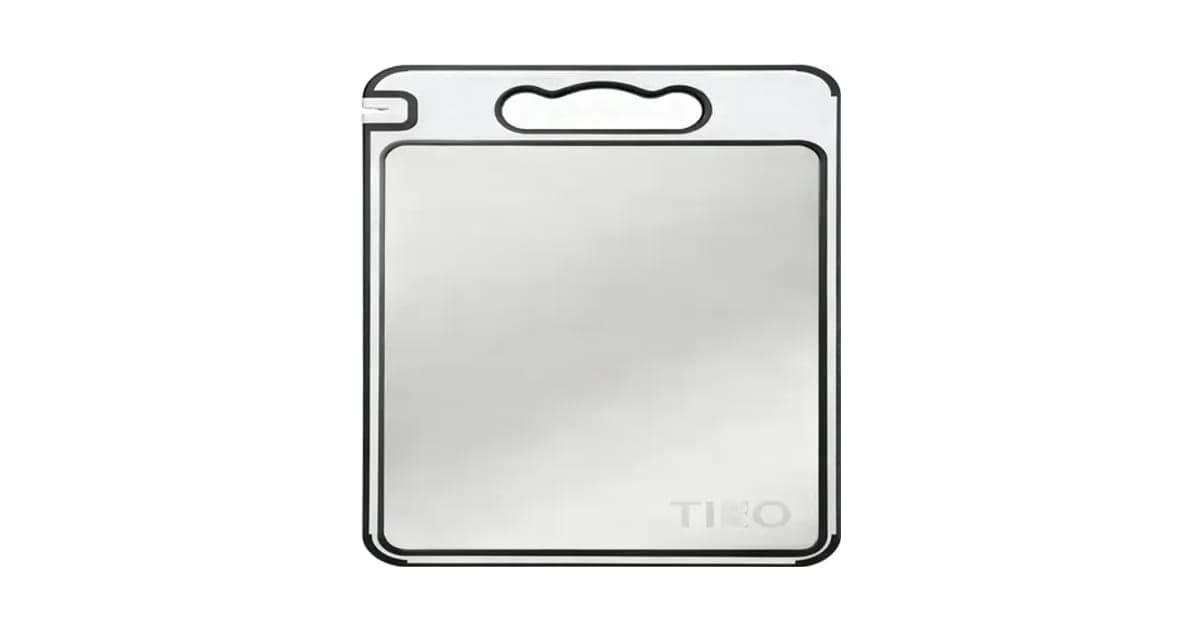
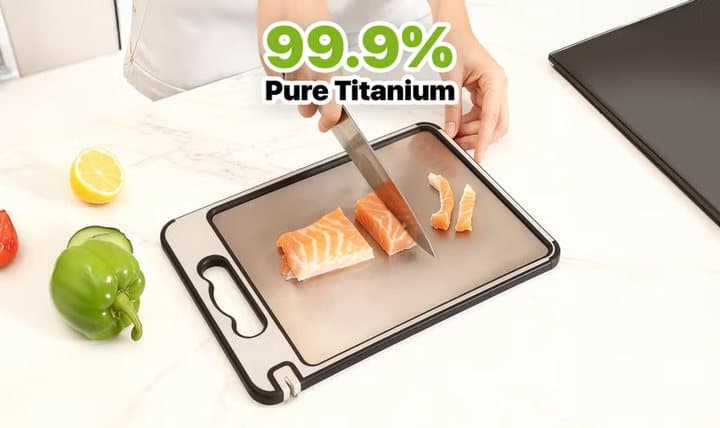
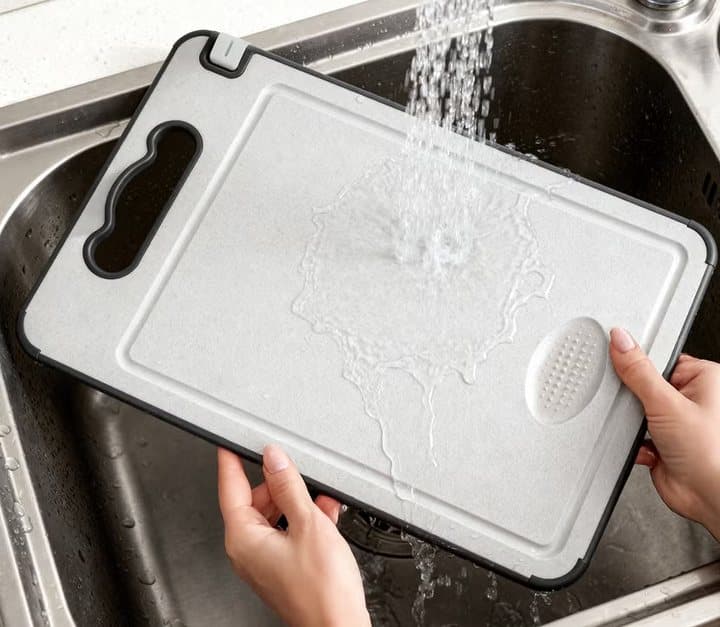
The TIBO board has a brushed metal surface on one side, which the maker says is 99.9% pure titanium, inside a black rim with a handle cut-out. The other side is a light-coloured wheat straw surface. A juice groove runs around the edge, and the corners hold a small ceramic knife sharpener and a textured grater for garlic and ginger.
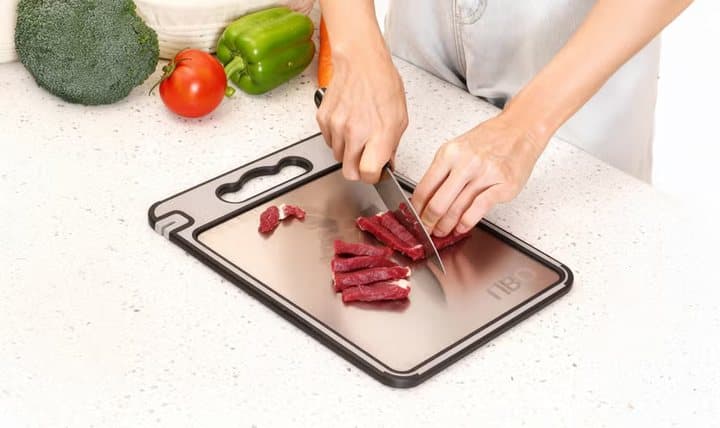
The idea is simple: metal is non-porous, so juices and bacteria cannot soak in, and it does not wear into plastic shavings. The maker suggests the metal side for meat and the wheat straw side for produce. Like the vacuum sealer in our SealPro review, it is sold as a food-safety upgrade for everyday kitchens.
Pick a side
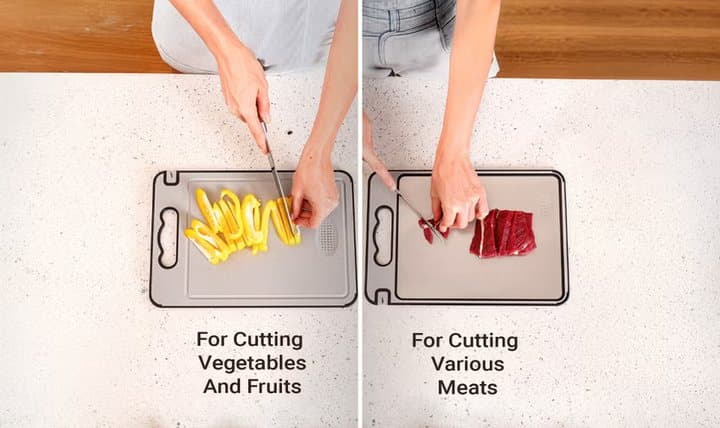
Step 1: Use the titanium side for raw meat and fish, and flip the board to the wheat straw side for vegetables, fruit and bread, as the maker suggests.
Chop, grate and sharpen
Step 2: Cut on the board as usual, use the built-in grater for garlic or ginger, and draw your knife through the ceramic sharpener a few times to touch up the edge.
Rinse and dry
Step 3: Wash the board with hot soapy water and dry it. The metal surface has no grooves to soak up juices, according to the maker.
Size and weight
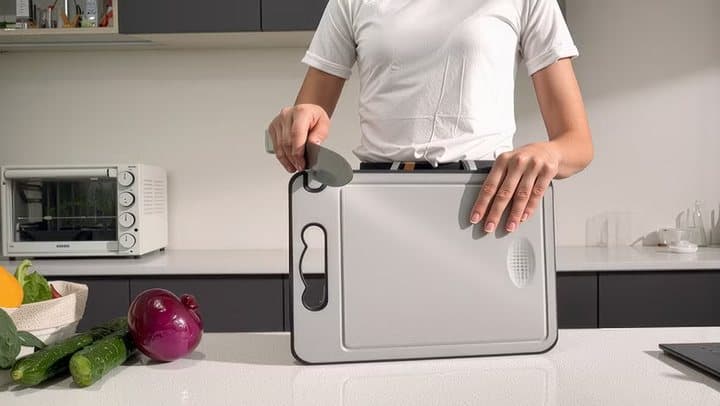
The page does not list dimensions or weight. The photos show a board roughly the size of a standard chopping board, with a handle cut-out at one end. A customer quote describes it as heavy enough to stay put but light enough to move.
Titanium as a material
Titanium is light, strong and resistant to corrosion, which is why it is used in medical implants and aircraft. "Medical grade" refers to grades of titanium used in implants. The page does not say which grade TIBO uses or how thick the metal layer is.
Solid titanium or a layer?
Most metal cutting boards sold online are thin metal sheets bonded to a plastic or composite core, rather than solid metal. The photos suggest a metal face set into a black rim, consistent with that design. The page does not say how thick the titanium is.
The wheat straw side
Wheat straw boards are commonly made from wheat straw fibre bound with a plastic such as polypropylene. The page does not say what TIBO's wheat straw side is made of. If it contains plastic, chopping on it will release some plastic particles, as with any plastic board.
Why two different surfaces
Pairing a hard metal side with a softer side lets the maker claim both hygiene and versatility. It also means the softer side probably takes most of the everyday vegetable chopping, which matters for both knife wear and microplastics.
Why metal boards became popular
Titanium and stainless steel boards spread through social media ads in the past couple of years, riding on concern about microplastics in plastic boards. Many look alike and make similar claims, with prices ranging widely.
The sharpener
A small slot with ceramic rods sits in one corner. Drawing a knife through three to five times touches up the edge, according to the page. Pull-through sharpeners are quick but remove more metal than careful honing, and they suit everyday knives better than fine ones.
The grater
A textured patch on the board grates garlic, ginger and similar foods. It saves pulling out a separate grater, though cleaning small pieces out of the texture takes a moment.
The juice groove
A channel around the metal surface catches juices from meat and fruit. That keeps counters cleaner, and it is a standard feature on good boards of any material.
The rim and handle
The black rim around the board and the handle cut-out are likely plastic or rubber, judging by the photos. They give grip and protect counters. They also touch food and juices, so they need the same washing as the cutting surfaces.
What it cannot do
It cannot protect your knives from a hard surface, make a wheat straw side plastic-free, or replace separate boards for strict raw meat and produce separation in a busy kitchen.
Who it's for
TIBO suits cooks worried about plastic shavings who will sharpen their knives more often, people who want a non-porous surface for raw meat, and anyone who likes an all-in-one board. It does not suit owners of fine knives, anyone who wants to be able to return a board after trying it, budget buyers, or cooks who dislike chopping on metal.
- Cooks worried about plastic board wear who accept extra knife sharpening
- People who want an easy-to-clean surface for raw meat and fish
- Anyone who likes an all-in-one board with a sharpener and grater
Why TIBO appeals
News about microplastics has made many people look at their plastic boards, which get scarred and fuzzy with use. A metal board that looks clean, never needs oiling and comes with a sharpener and grater is an attractive answer. The page's long customer quotes describe the relief of a board that is easy to keep clean.
People worried about microplastics
If you mostly cut on a heavily worn plastic board, a metal surface removes one source of plastic particles. That is a genuine benefit of the titanium side.
Gift buyers
An unusual metal board with built-in tools makes an eye-catching gift. Bear in mind that the recipient may not be able to return it, and that it may not suit their knives.
Raw fish and sushi
Raw fish benefits from a very clean surface. Metal is easy to clean, but sushi knives are thin and hard and chip easily on metal. A soft rubber or wooden board is the traditional choice for slicing raw fish.
People who prepare a lot of raw meat
Metal is easy to wash and sanitise after raw chicken or fish. Keeping the metal side for meat and using a separate board for produce is a sensible routine.
People with mould problems on wood
Wooden boards left wet can grow mould, especially in humid kitchens. A metal board does not, which is a real advantage for people who struggle to dry boards properly.
Families with young children
Parents preparing food for babies and toddlers often worry most about hygiene and plastic. A metal side for raw meat and an easy-clean surface appeal to them. Keep the sharpener corner out of reach of small hands.
Small kitchens
One board with two surfaces, a grater and a sharpener saves drawer space. For a small flat, that combination is handy.
Cooks who batch-prep
People who chop large amounts of vegetables at once need a board that is kind to knives and quiet to use for long sessions. A big wooden board suits that better. TIBO is more convenient for shorter jobs.
Campers and caravanners
A thin, rigid board that is easy to wipe clean suits outdoor cooking where water for washing is limited. The built-in sharpener and grater save packing extra tools.
Older cooks
A board that never needs oiling and stays put suits people who want less upkeep. Check the weight and whether the noise of metal is acceptable before committing, since returns are unlikely.
People who cook meat most days
Households that cut raw chicken or fish most days spend a lot of time washing boards. A metal side that cleans quickly and does not stain saves a little effort each time.
Who should skip it
Skip TIBO if you own good knives, especially thin Japanese blades, and want to keep their edges. Skip it if you want the option to return a board after use, because the written policy excludes cutting boards. Skip it if a good wooden or plastic board would do. And skip it if the clatter of a knife on metal bothers you.
- Owners of good Japanese or high-end knives who want to protect the edge
- Buyers who want the option of returning a board after trying it
- Anyone on a tight budget, since good wood and plastic boards cost less
- People who dislike the sound and feel of a knife on metal
Is a titanium board bad for your knives?
It is harder on knives than wood or plastic, though gentler than glass or stone. Commercially pure titanium is softer than hardened knife steel, which TIBO's FAQ points out. But a knife edge is extremely thin, and any hard surface rolls or chips it faster than wood or plastic, which give slightly under the blade. TIBO's built-in sharpener compensates, at the cost of removing metal from the blade more often.
Hardness in plain terms
Hardened kitchen knife steel is typically much harder than commercially pure titanium, which is why TIBO can say titanium is softer. But wood and food-safe plastics are far softer still. The edge meets much more resistance on metal than on the surfaces knives are designed to cut against.
What the page says
The FAQ says titanium is softer than knife steel, so it will not dull blades like glass, stone or bamboo. One customer quote, from someone described as an executive chef, says the titanium is softer than plastic boards. That last claim is wrong: titanium is far harder than the plastics used for boards.
Why edges dull on hard boards
A sharp edge is only a few microns thick. When it strikes a hard surface, the edge bends or flattens. On wood and plastic, the surface yields slightly and absorbs some of that impact. On metal, the edge takes it all.
Sharpening as a fix
Frequent sharpening keeps a knife working, but each pass removes steel. Over years, that shortens the blade and changes its shape. Honing with a steel or ceramic rod realigns the edge with less wear.
What chefs usually use
Professional kitchens mostly use plastic boards, often colour-coded by food type, for hygiene rules, and many chefs prefer wood at home. Metal boards are rare in professional kitchens, which contradicts the FAQ's suggestion that chefs are switching to titanium.
Serrated knives
Serrated bread knives and steak knives suffer less from hard boards, because the points do the cutting and the edge between them is protected. They also cannot be sharpened in a simple pull-through slot.
Which knives suffer most
Thin, hard Japanese knives are prone to chipping on hard surfaces. Softer Western knives tend to roll rather than chip. Cheap knives matter less, which suits a board with a pull-through sharpener.
Cutting technique
A rocking or slicing motion, where the edge glides rather than slams into the board, reduces edge damage on any surface. On metal it matters more. Heavy chopping straight down, such as cutting through bones, is best done on a thick wooden or plastic board.
Edge-friendly habits
Never scrape chopped food across the board with the knife edge; flip the knife and use the spine. Store knives in a block or on a magnetic strip, not loose in a drawer. These habits matter on any board and more on metal.
How often you will sharpen
On wood, a home cook might sharpen every few months and hone in between. On metal, expect to touch up the edge much more often, perhaps every few uses, to keep it cutting cleanly.
The noise
Cutting on metal is noisier than on wood or plastic. Some cooks will not mind. Others find it unpleasant every day.
What this means for you: if you care about your knives, keep a wood or plastic board for most cutting and use metal only where you value easy cleaning most.
Are TIBO's microplastics and hygiene claims true?
The metal side does avoid plastic wear and is easy to clean, but the page overstates both points. A 2023 study estimated that plastic boards could expose a person to up to 79.4 million plastic particles a year, which supports the concern. But TIBO's second side is wheat straw, commonly a plastic composite, and food safety guidance does not say wood is unsafe, as the FAQ suggests.
The concern behind TIBO is real and recent. The answer offered here, a metal board whose other side may be a composite, needs a closer look.
The microplastics study
The 2023 Environmental Science and Technology study measured particles released when chopping on polyethylene and polypropylene boards. It estimated 14.5 to 71.9 million polyethylene particles, or 79.4 million polypropylene particles, per person per year. A preliminary test found no harm to mouse cells over 72 hours.
What the study does and does not show
The study shows plastic boards release particles, especially with heavy chopping. It does not show how much of that is eaten, or whether those amounts harm health. A 2025 study in mice linked food prepared on polypropylene boards to gut inflammation, and on polyethylene boards to changes in gut bacteria, compared with wooden boards. Research in people is still limited.
Reducing microplastics without a new board
Replacing heavily scarred plastic boards, using wood for vegetables and avoiding hard chopping on plastic all reduce particles. A metal board is one option, not the only one.
"Zero microplastics in your food"
That is true only for what you cut on the metal side. If the wheat straw side contains plastic, produce cut on it may pick up particles too.
How much plastic a board sheds
The amount depends on the plastic, how hard you chop and what you cut. Carrots on polyethylene released more particles than chopping without food in the study. A lightly used board sheds less than a heavily scarred one.
"Wooden boards are a myth"
The FAQ calls wood's antibacterial reputation a myth and says the USDA recommends non-porous surfaces like titanium for raw meat. The USDA's food safety advice accepts both wood and non-porous boards, such as plastic, glass and marble, and recommends separate boards for raw meat and produce. It does not single out titanium.
What research says about wood
Studies by food microbiologists have found that bacteria applied to clean hardwood boards tend to decline, partly because wood draws moisture and bacteria below the surface where they cannot easily survive. Wood is not perfect, but calling its reputation a myth is unfair.
"Naturally antibacterial"
Titanium is not antibacterial in the way silver or copper can be. It is non-porous, so bacteria sit on the surface where washing removes them. That is useful but no different from glass, stainless steel or plastic when new.
Bacteria in knife grooves
Deep knife grooves in old plastic boards can hold bacteria that washing misses, which is why old plastic boards should be replaced. A metal board does not groove deeply. That is a fair point in its favour.
"Prevents cross-contamination"
Two sides help, but a single board flipped between raw meat and vegetables still risks juice on the rim, handles and counter. Separate boards and good washing do more.
"Odor-free"
Metal does not absorb smells, so garlic, onion and fish odours wash off. That is a genuine advantage over wood, which can hold strong smells.
"Easy to clean, zero maintenance"
The metal side is easy to clean. "Zero maintenance" is close, though metal shows scratches, and the wheat straw side and rim may stain. Compared with oiling a wooden board, it is genuinely low effort.
"Saves $100+ a year on sharpening"
The page says the sharpener saves on professional sharpening. Many home cooks never pay for sharpening, and pull-through sharpeners are cheap to buy separately. The saving is real only if you already pay a professional regularly.
"FDA-compliant pure medical-grade titanium"
FDA compliance for food-contact materials is a reasonable claim for titanium. The page gives no grade or test certificate, so "medical grade" and "99.9% pure" are unverified.
"The last cutting board you'll ever need"
Metal will outlast plastic. But the wheat straw side, rim and non-slip feet will wear, and a board you dislike using is not the last one you buy. The claim is an exaggeration.
"The magnet test"
The FAQ says real titanium is non-magnetic and fakes are stainless steel that a magnet sticks to. Common food-grade stainless steels, such as 304, are also largely non-magnetic, so the test does not prove a board is titanium.
How much does TIBO cost, and can you return it?
On 4 October 2026, one TIBO board cost $59.99 plus shipping, three cost $139.98 and five cost $209.97, with free shipping on bundles. The return terms conflict: the page shows a 30-day guarantee with free return shipping, the FAQ promises 60 days with "zero fine print", and the written policy says cutting boards cannot be returned for hygiene reasons.
TIBO prices
| Bundle | Price | Boards | Per board | Shipping |
|---|---|---|---|---|
| 1 board | $59.99 | 1 | $59.99 | Extra |
| Buy 2, get 1 free | $139.98 | 3 | About $46.66 | Free |
| Buy 3, get 2 free | $209.97 | 5 | About $41.99 | Free |
Compared with other boards
A good hardwood board of a similar size often costs less than $59.99 and lasts years with care. Plastic boards cost far less but need replacing more often. Stainless steel boards sold online are usually cheaper than TIBO. TIBO's price is near the top of the range.
Four versions of the guarantee
The page shows a "30-Day Money Back Guarantee" badge. A feature list says "30-Day Money-Back Guarantee & Free Return Shipping". The FAQ says "60-day money-back guarantee with zero fine print" and that the company pays return shipping. The written policy says cutting boards are not eligible for return at all.
Why this matters
A cutting board is something you must use to judge. If the policy excludes boards and requires items to be unused, the money-back guarantees on the page may not be honoured. That is the biggest risk of buying TIBO.
The written policy
For eligible items, returns must be requested within 30 days of delivery by emailing support@tibo-kitchen.com, items must be new and in original packaging, a $15 return and processing fee applies per order, and return shipping is the customer's responsibility. Refunds come within 15 business days after inspection. Cutting boards are listed as not eligible.
What to do: before buying, email support and ask them to confirm in writing which guarantee applies to the board.
Approval before sending
The policy says returns sent without prior approval will not be accepted, and approved returns must be posted within seven days. Missing either step could cost you the refund on any eligible item.
The warranty
The page shows a "1-Year Warranty" badge and also says "Lasts forever with lifetime warranty". The written terms we saw do not describe either.
Who runs the store
The policy names TIBO-Kitchen and a support email. The page does not give a company address, country or phone number that we could see. That makes resolving a dispute harder.
Delivery times
The FAQ says orders ship within 24 to 48 hours and arrive in three to five business days in the US on average. International times vary.
The "$114.95" figure
The FAQ says the only catch is a "$114.95 upfront cost", which matches none of the prices on the page. It suggests the FAQ was written for a different price or bundle.
Shipping on a single board
The single board adds shipping at checkout. Bundles include free shipping but commit you to three or five boards, which is a lot of boards with no returns.
The rating badge
The page shows 337 ratings and claims 97% positive reviews. Elsewhere, the FAQ says 96% of customers are thrilled and returns are under 4%. No source is given for any of these figures, and they do not all match.
Is it good value?
The FAQ argues TIBO saves money because cheap boards need replacing and you would also buy a sharpener and grater. A good wooden board can last many years with oiling, and a basic sharpener and grater cost little. At $59.99 plus shipping, TIBO is a premium board, not a saving.

TIBO Titanium Cutting BoardScore 4.0/10
Best for: Cooks worried about plastic board wear who accept extra knife sharpening
$59.99 at TIBO · Price checked October 4, 2026
Check price at TIBO (opens TIBO in a new tab)We may earn a commission if you buy through our links.
Is TIBO better than a wood, plastic or stainless steel board?
For knife care and value, a good wooden board usually wins; for easy cleaning of raw meat, metal or plastic works. Wood is kind to knives and holds up well hygienically when cleaned and dried. Plastic is cheap and dishwasher-safe but sheds particles as it wears. Stainless steel boards look and behave much like TIBO for less. TIBO's extras are its main difference.
| TIBO | Wooden board | Plastic board | Stainless steel board | |
|---|---|---|---|---|
| Kind to knives | Poor | Good | Good | Poor |
| Sheds plastic | Metal side no | No | Yes | No |
| Easy to sanitise | Yes | Hand wash, dry | Dishwasher | Yes |
| Maintenance | Rinse | Oil now and then | Replace when scarred | Rinse |
| Sharpener and grater | Yes | No | No | Sometimes |

TIBO vs a wooden board
Hardwood boards such as maple are gentle on knives and, when washed and dried, perform well in hygiene studies. They need occasional oiling and cannot go in the dishwasher. For most home cooks, a good wooden board plus a separate board for raw meat is the classic setup.
Hygiene compared
Any board is hygienic if washed promptly with hot soapy water and dried. Metal and new plastic are easiest to sanitise. Wood needs drying and occasional oiling. Old, deeply scarred boards of any material should be replaced.
TIBO vs a plastic board
Plastic boards are cheap, light and dishwasher-safe, which makes them popular for raw meat. They scar with use, shed particles and should be replaced when deeply grooved.
Owning more than one board
Food safety advice recommends separate boards for raw meat and produce. Many home cooks keep a plastic board for meat that goes in the dishwasher, and a wooden board for everything else. TIBO tries to be both in one board, which saves space but not risk.
Where wood loses
Wood cannot go in the dishwasher, needs oiling and can crack if left wet. People who want minimal care may prefer metal or plastic for that reason alone.
TIBO vs a glass board
Glass boards are non-porous and easy to clean, like metal, but even harder on knives and noisy. TIBO is kinder to knives than glass, which is the comparison the FAQ chooses.
TIBO vs a stainless steel board
Stainless steel boards look similar and share TIBO's pros and cons. The difference is the claimed titanium surface and TIBO's built-in tools. Without proof of the metal, compare on price and extras.
TIBO vs a composite board
Composite boards made from paper or wood fibre and resin are dishwasher-safe, gentle on knives and slow to scar. They cost about the same as a good wooden board. For many cooks, they balance hygiene and knife care better than metal.
Choose TIBO if
You want a non-porous metal surface for raw meat, like the built-in sharpener and grater, accept faster knife wear, and are comfortable with the return risk. Choose wood for knife care, plastic for budget and dishwasher use, or a composite board for a balance.
Where TIBO wins
TIBO wins for someone who wants one board with a non-porous metal side, a second surface, a sharpener and a grater, and is happy to sharpen knives often.
Kitchen gadgets we have looked at
Our Gourmax Pro review covers a countertop multi-cooker, and our Polygons review covers folding measuring spoons. Our Pacuzzi review looks at a silicone pan steamer.
TIBO Titanium Cutting BoardScore 4.0/10
Why people buy it: Non-porous metal side is easy to wash and does not shed plastic particles
$59.99 at TIBO · Price checked October 4, 2026
Check price at TIBO (opens TIBO in a new tab)We may earn a commission if you buy through our links.
Is TIBO legit, and what should you check before buying?
It is a real product sold by TIBO-Kitchen, but the conflicting guarantees are a serious problem. Check the return terms in writing, think about your knives, and remember that the wheat straw side may be a plastic composite. The long, polished customer quotes cannot be verified, and we found no independent rating for the store.
Where TIBO comes from
The page gives no manufacturer, country of origin or company address. Similar-looking boards are sold under many brands. Without more detail, it is hard to know who stands behind the product.
Customer quotes
The page shows a rating of 337 reviews and "97% positive". The quotes are long, polished and describe chefs and cooks with very specific stories. We could not verify any of them, and one makes a false claim about titanium being softer than plastic.
Watch the bundle pressure
The bundles are labelled with big savings, but five boards is more than most homes need. With returns uncertain, the single board is the safer purchase.
Get the return terms in writing
What to do: email support@tibo-kitchen.com before ordering, ask whether a used board can be returned for a refund, and keep the reply.
Check the materials
Ask support what the wheat straw side and rim are made of, and whether the titanium is a solid sheet or a layer. If they cannot answer, treat the "zero microplastics" claim with caution.
Protect your knives
Use the titanium side for tasks where cleaning matters most, and a wood or plastic board for heavy chopping. Hone knives regularly.
Test it gently
If you are unsure, try the board with an inexpensive knife first. That way, if the edge dulls quickly, you have not damaged your best blade.
Pay with protection
Pay by credit card or PayPal so you can dispute a charge if the promised guarantee is not honoured.
Read every guarantee carefully
When a page shows several guarantees, the written policy is what a company will usually rely on. Take a screenshot of the guarantee you are relying on, with the date, in case you need to dispute a charge.
How to buy TIBO the smart way
- Email support to confirm the return terms, then open the TIBO order page (opens TIBO in a new tab).
- Buy one board, not a bundle.
- Check the shipping cost on a single board.
- Keep the packaging and the support email.
- Try it carefully with everyday knives first.
How did we score TIBO?
The TIBO board scores 4.0 out of 10: claim accuracy 0.5, build durability 1.2, price competitiveness 0.8, usability 1.2 and owner satisfaction 0.3, each out of 2. A metal board is durable and easy to clean, which earns its points. It loses points for knife claims that conflict with how metal surfaces work, "zero microplastics" despite a wheat straw side, four versions of the guarantee with a policy that excludes boards, and no independent ratings.
How the score breaks down
We use the five criteria on our how we test page, each out of 2.
| Criterion | Score | Why |
|---|---|---|
| Claim accuracy | 0.5 / 2 | Knife, microplastics, wood and magnet claims overreach |
| Build durability | 1.2 / 2 | Metal will not crack or warp; warranty unclear |
| Price competitiveness | 0.8 / 2 | Premium price; extras add some value |
| Usability | 1.2 / 2 | Easy to clean; noisy and hard on edges |
| Owner satisfaction | 0.3 / 2 | No independent ratings; boards excluded from returns |
| Total | 4.0 / 10 |
What we did, and did not, do
Nobody on our team has used the TIBO board. We read the offer page, FAQ and return policy on 4 and 5 October 2026, and checked PubMed and Trustpilot on 5 October 2026. Our kitchen tech section lists other kitchen products we have reviewed, including The Wand review.
How to use the TIBO board for the best results
Use the metal side for raw meat and fish, the other side for produce, wash with hot soapy water after each use and dry it. Hone or sharpen knives more often than you would on wood, use the grater for small jobs, and keep a separate wood or plastic board if you chop a lot.
- Pick the right side. Metal for raw meat, wheat straw for produce.
- Use a rocking cut. Gentler on edges than chopping hard.
- Wash straight away. Hot soapy water, especially after raw meat.
- Dry it. Prevents water marks and keeps the rim clean.
- Touch up knives. A few passes through the sharpener when needed.
- Clean the grater. Use a brush for garlic bits.
- Keep a second board. For heavy chopping or strict separation.
Sanitising
After raw meat, wash with hot soapy water. For extra peace of mind, a diluted bleach solution, as food safety agencies suggest for boards, can be used on the metal side, then rinsed. Check the care instructions before using it on the wheat straw side.
Dishwasher
The page says just rinse. It does not say whether the board is dishwasher-safe. The rim and wheat straw side may not like high heat, so hand wash unless told otherwise.
Grating tips
Use the grater for small amounts of garlic, ginger or zest. Press lightly and keep fingers clear as the clove gets small. Rinse the texture straight away so bits do not dry on.
Stopping slips
The page mentions a non-slip base. If it slides, put a damp cloth underneath.
Cutting acidic foods
Lemons, tomatoes and vinegar-based marinades will not harm titanium, which resists corrosion well. Rinse the board after use so juices do not dry on the rim and wheat straw side.
Storing it
Store the board upright or flat once fully dry. Avoid stacking heavy pans on it, which can scratch the surface and press on the sharpener and grater.
Other questions about metal cutting boards
Can I cut bread on it? Yes, on either side.
Will it scratch? Metal shows fine scratches with use, which do not harm it.
Can I use it as a serving board? The FAQ suggests so.
TIBO Titanium Cutting BoardScore 4.0/10
Before you buy: Check the final price, shipping and return terms at checkout.
$59.99 at TIBO · Price checked October 4, 2026
Check price at TIBO (opens TIBO in a new tab)We may earn a commission if you buy through our links.
Frequently asked questions
Is a titanium cutting board good for knives?
Not especially. Titanium is softer than hardened knife steel but much harder than wood or plastic, so blades lose their edge faster on metal. TIBO includes a sharpener to compensate, but frequent sharpening wears the blade down over time.
How much does the TIBO board cost?
On 4 October 2026, one TIBO board cost $59.99 plus shipping, 'buy 2, get 1 free' cost $139.98 and 'buy 3, get 2 free' cost $209.97, with free shipping on bundles.
Can you return a TIBO cutting board?
The written policy says cutting boards cannot be returned for hygiene reasons, and other items need to be unused, with a $15 fee and return shipping at your cost. The page and FAQ promise 30 or 60-day money-back guarantees, so get the terms in writing before buying.
Do titanium cutting boards prevent microplastics?
The metal side does not shed plastic. A 2023 study estimated up to 79.4 million polypropylene particles a year from plastic boards. TIBO's other side is wheat straw, which is commonly a plastic composite, and the page does not say what it is made of.
Are titanium cutting boards more hygienic than wood?
Metal is non-porous and easy to clean. Food safety guidance accepts both wood and non-porous boards if cleaned properly, and recommends separate boards for raw meat. Research has found wood performs well hygienically too.
Is TIBO real titanium?
TIBO says it is 99.9% pure titanium and suggests a magnet test. Common food-grade stainless steels are also mostly non-magnetic, so a magnet test does not prove it is titanium. We could not verify the metal.
Is TIBO legit?
It is a product you can buy, sold by TIBO-Kitchen. The concerns are conflicting guarantees, a no-returns policy for boards, claims about knives that conflict with how metal surfaces work, and no independent ratings.
We may earn a commission if you buy through our links.
Prices accurate as of October 4, 2026. Check the seller's checkout for current pricing, promotions and terms.
What we checked: No hands-on use. Claims, photos, prices, FAQ answers and the return policy from the TIBO offer page our link opens on 2026-10-04 and 2026-10-05. The 2023 Environmental Science and Technology cutting board study on PubMed and Trustpilot were checked on 2026-10-05; no Trustpilot page was found.

About the author
Alex Carter, Senior Tech Reviewer
Alex Carter is the senior tech reviewer at Top10Gadgets, covering the everyday gadgets, home and kitchen devices, smart home products and accessories most people actually buy. Alex judges a product the way a normal buyer…
- Everyday gadgets and accessories
- Smart home devices
- Home and kitchen gadgets
- Value for money
- Long-term reliability
Writing for Top10Gadgets since 2026Full profile