Comparison
SleepZee vs Sleep Connection vs Hale: Mouthpiece, Wristband or Nasal Dilator for Snoring?
SleepZee vs Sleep Connection vs Hale compared: how each anti-snoring aid works, evidence, prices, refills, safety and returns. Which one fits your snoring?

By Daniel Brooks, Technology & Buying Guide Editor at Top10Gadgets
Updated 9 min readHow we test
Snoring from the throat
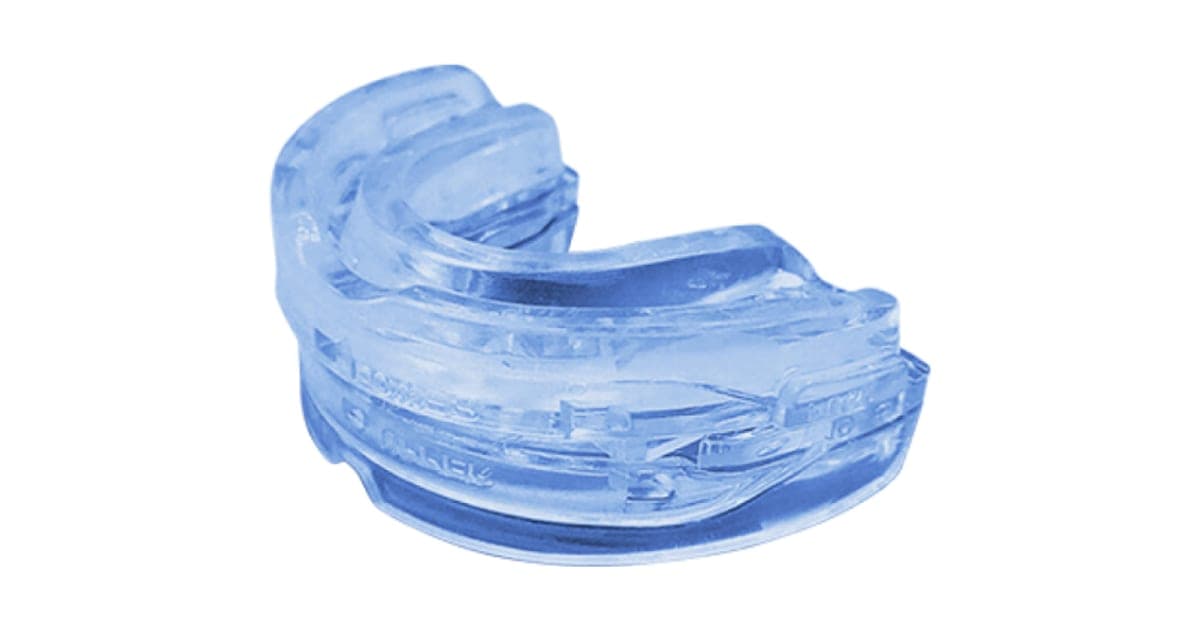 SleepZee Mouthpiece
A boil-and-bite mouthpiece that holds your lower jaw slightly forward to keep the airway at the back of the throat open.
4.7/10$49.95 plus $12.99 shipping
- Works on
- The airway behind the tongue, via the jaw
- Worn
- In the mouth, over both rows of teeth
- Returns
- Treat as final sale once moulded
Snoring mostly on your back
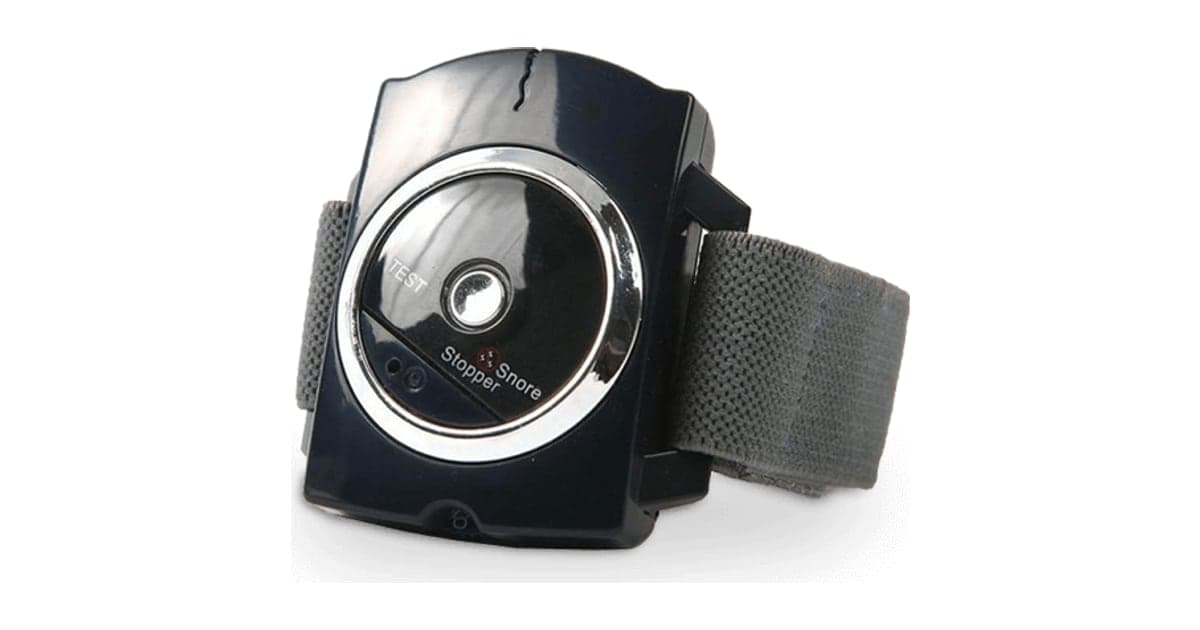 Sleep Connection Anti-Snore Wristband
A wristband that listens for snoring and sends a small electrical pulse to your wrist, so that you shift position without waking.
3.6/10$64.99 as reported at checkout, Aug 2026
- Works on
- Sleeping position
- Worn
- On the wrist, like a watch
- Returns
- Terms conflict; screenshot your checkout
Snoring from narrow nostrils
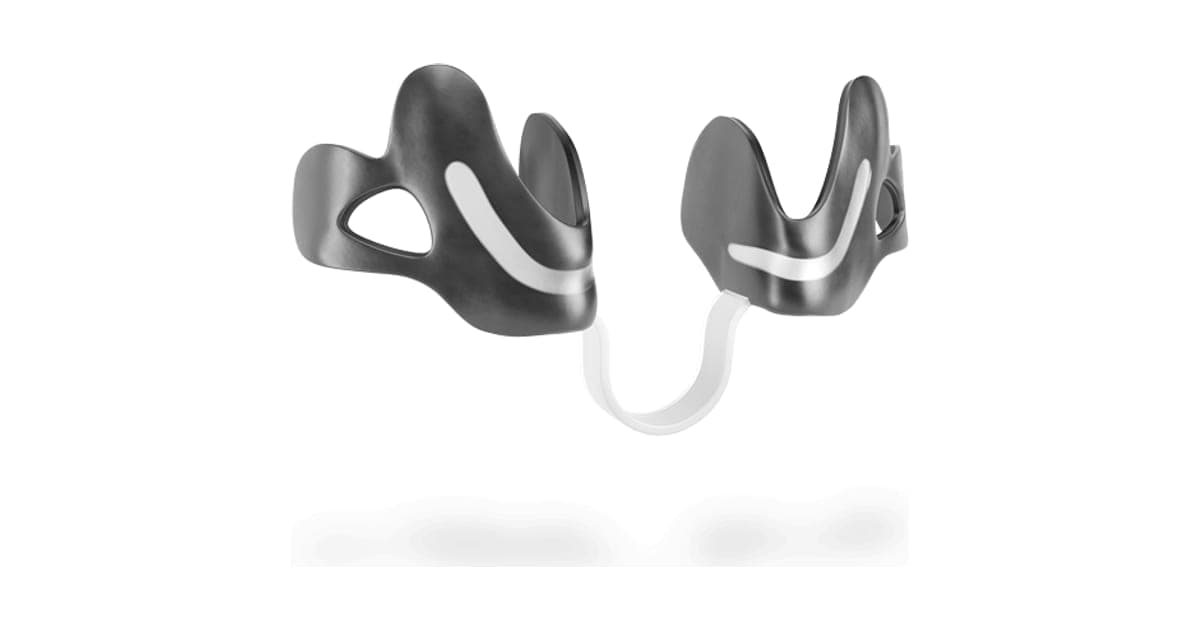 Hale Breathing Aid
A soft internal nasal dilator, two pieces joined by a clear band, that holds the nostrils open from inside. Three sizes in the kit.
5.6/10$29.99 per kit; refills extra
- Works on
- Nostrils that narrow when you breathe in
- Worn
- Just inside both nostrils
- Ongoing cost
- Refills $19.99 each, roughly monthly
01Key differences
- 01
Each one works on a different cause
SleepZee moves the jaw to open the throat, the Sleep Connection wristband tries to move you off your back, and Hale opens the nostrils. A device aimed at the wrong place does nothing, which is why owner reviews of all three are so split.
- 02
Only the mouthpiece type has strong evidence
Oral appliances that hold the jaw forward are an established snoring treatment, according to the American Academy of Sleep Medicine. Hale has one small study of an early version, and the wristband has none we could find.
- 03
Hale is cheapest to start and dearest to keep
A Hale kit is $29.99, but Hale sells refills at $19.99 and a $239.88 one-year supply, so a year costs about $250 or more. SleepZee is about $63 delivered and the wristband about $65, with no refills listed.
- 04
None of them is easy to return once used
SleepZee refunds change-of-mind returns only if unused, the wristband's checkout and written terms disagree, and Hale owners report returns being limited to unopened items. Plan on keeping whichever one you open.
- 05
Each has its own reason to skip it
SleepZee is not for loose teeth, gum disease, jaw pain or full dentures. The wristband sends an electrical pulse, so skip it with a pacemaker or other implant. Hale is not for recent nasal surgery or frequent nosebleeds.
02Compared side by side
| Feature | SleepZee | Sleep Connection | Hale |
|---|---|---|---|
| Price (one unit) | $49.95, plus $12.99 shipping | $64.99, as reported at checkout, Aug 2026 | $29.99, per kit; refills extra |
| Type | Mandibular advancement mouthpiece, boil-and-bite | Snore-triggered wristband | Internal nasal dilator |
| What it works on | The airway behind the tongue | Sleeping on your back | Nostrils that narrow or collapse |
| How it works | Holds the lower jaw slightly forward | Hears snoring, sends a mild pulse so you shift | Holds the nostril walls outward |
| Fitting | Moulded in hot water; re-boil to change it | Strap on; adjustable pulse and a test button | Pick from 3 sizes; optional insertion tools |
| Multipacks | 2 for $79.90, 3 for $105, 4 for $118 | 2 for $120, 3 for $162.99, 4 for $208 (reported) | 2 for $56.99, 3 for $75.98 |
| Ongoing cost | None listed | None listed | Refills $19.99; one-year supply $239.88 |
| Evidence | Device type is an established snoring treatment | No published study of this device | Early version matched a nasal strip in a 36-person study |
| FDA status | No 510(k) found under the SleepZee name | No clearance found | "FDA registered", which is not clearance |
| Returns | 30 days; change of mind only if unused | Conflicting: 60-day guarantee vs 30-day exchange | 30-day guarantee; owners report unopened-only |
| Skip it if you have | Loose teeth, gum disease, jaw pain, full dentures | A pacemaker or other implanted electronics | Recent nasal surgery, frequent nosebleeds |
| Independent ratings | Trustpilot 1.2 from 136 reviews; BBB F | No independent count; reports sharply split | Trustpilot 3.1 from 9 reviews |
| Our score | 4.7 / 10 | 3.6 / 10 | 5.6 / 10 |
Prices checked on 3 October 2026 on each brand's own order page. Scores follow the five criteria on our how we test page.
03Which one fits your snoring
Your partner says you snore in every position, often with your mouth open
Snoring that does not care which way you lie usually comes from the throat, which is what a jaw-forward mouthpiece targets.
You snore loudly on your back and much less on your side
Sleep Connection Anti-Snore Wristband
The wristband is the only positional option of the three, but it is unproven. A side-sleeping pillow or positional belt is a cheaper first test.
Nasal strips noticeably help you breathe at night
If strips help, narrow nostrils are part of the problem. Hale does the same job from inside the nose, without the adhesive.
You cannot tolerate anything in your mouth or nose
Sleep Connection Anti-Snore Wristband
It is the only one of the three that stays outside the body. Rule out sleep apnea first and keep your checkout screenshot.
Your nose is blocked by a cold, allergies or one side that never clears
None of the three
A dilator cannot shrink swollen lining or straighten a septum. Ask a pharmacist about allergies, and see a doctor about one-sided blockage.
You gasp, choke or stop breathing in your sleep, or feel exhausted by day
None of the three
Those are signs of sleep apnea. See a doctor and get a sleep test before trying any snoring gadget.
Pick the product that matches where your snoring comes from. Choose SleepZee for ordinary snoring from the throat, Hale if your nostrils narrow when you breathe in, and the Sleep Connection wristband only if you snore mainly on your back and cannot wear anything in your mouth or nose. They are three different kinds of device, not three versions of the same one. The cards and table above give you the short version. Below, we go through each product, the evidence, the real cost and the fine print.
Nobody on our team has used these three. This comparison draws on our full review of each, written from the official sales, checkout and returns pages, public records and owner reports, all checked on 3 October 2026. Nothing here is medical advice.
Why the cause of your snoring decides this
Snoring is the sound of soft tissue vibrating as air squeezes past it. Where that squeeze happens differs from person to person, and each of these products works on one place only.
- The throat. When you sleep, the tongue and soft palate relax and fall back. A mouthpiece that holds the jaw forward pulls the tongue base with it.
- Your position. On your back, gravity makes that collapse worse. Many people snore far less on their side.
- The nose. If the nostrils narrow as you breathe in, you work harder to pull air through and may switch to mouth breathing.
Two quick checks help. Ask your partner whether you snore in every position or mainly on your back. Then try a cheap pack of nasal strips for a few nights. If strips clearly help, your nose is involved. If nothing changes on your side, the throat is the likelier source.
SleepZee: a mouthpiece for snoring from the throat
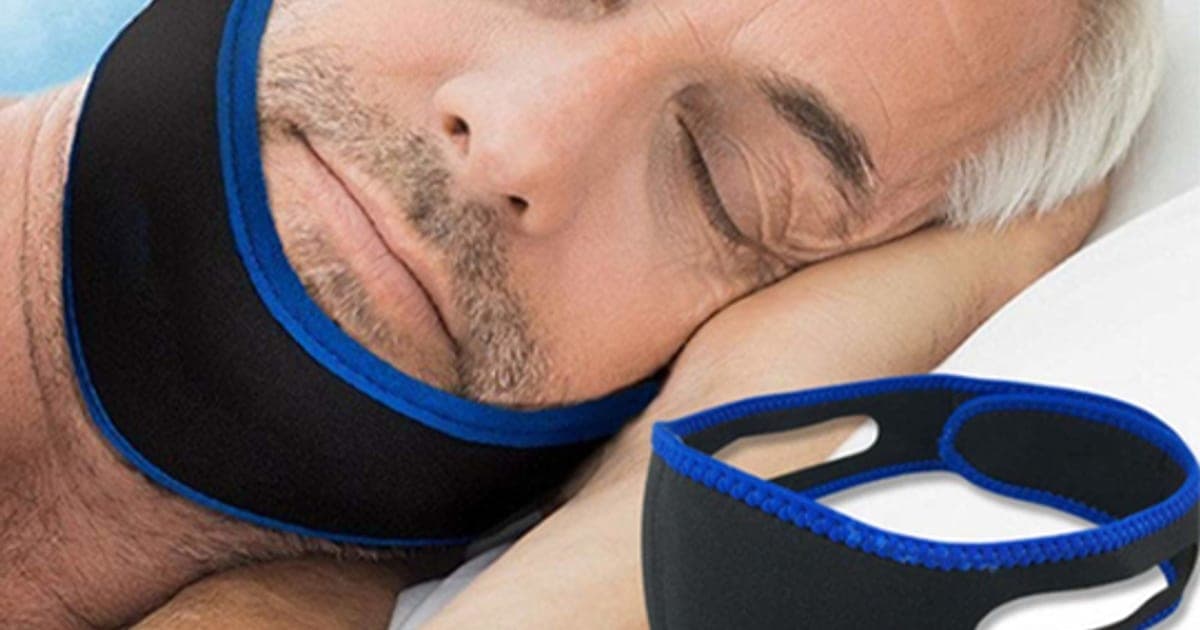
SleepZee is a one-piece, two-tray mouthpiece that you mould at home. You soften it in hot water, bite into it with your lower jaw slightly forward, and set it in cold water. The impression holds your jaw in that position every night. Front vents let you breathe through your mouth, and a hinged case comes in the box.
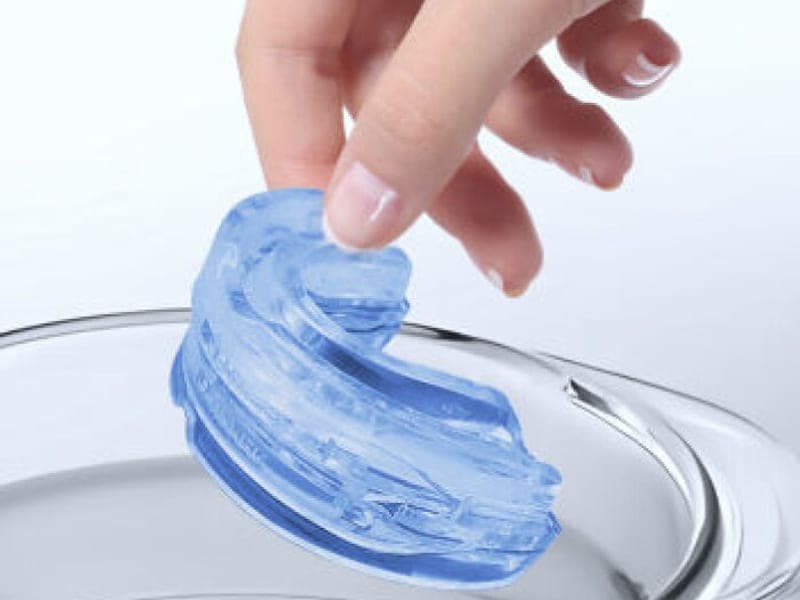
Step 1: soften in hot water before biting
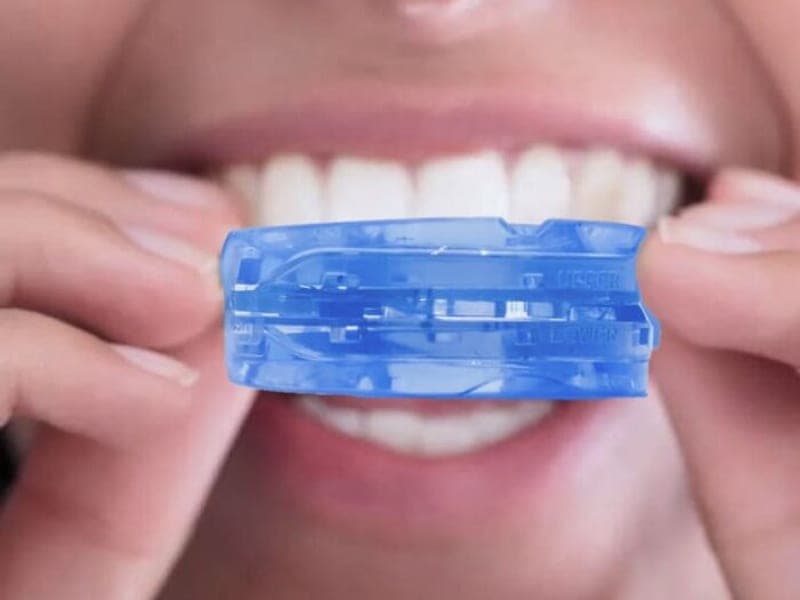
The fixed dual tray sits over both rows of teeth
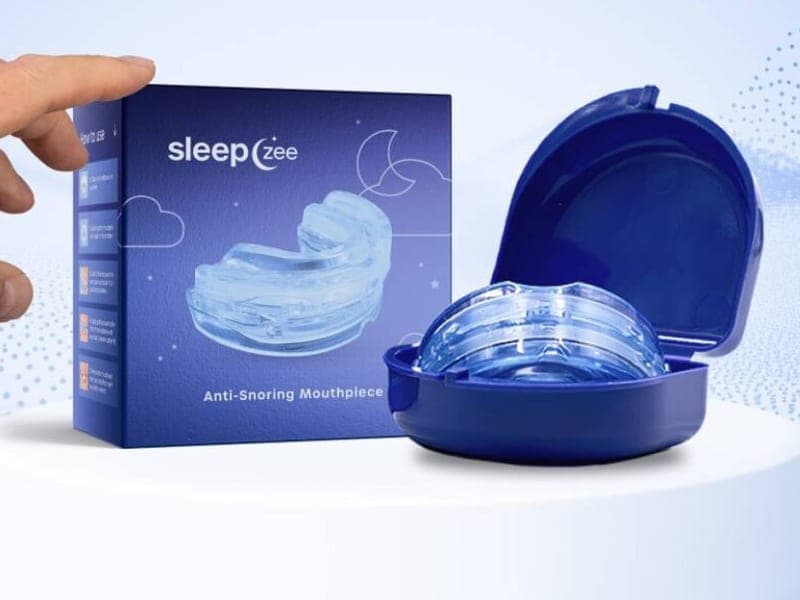
Retail box and the included storage case
- Our score
- 4.7/10
- Price
- $49.95plus $12.99 shipping
- Works on
- The airway behind the tongue, via the jaw
- Worn
- In the mouth, over both rows of teeth
The approach is the one dentists use, which is why this type of device has the best evidence of the three. The weaknesses are in the selling, not the idea. The sales page now promises a "fully-adjustable fit", but the photos show no hinge, screw or numbered steps: you change the position by re-boiling and re-biting. The checkout opens with a three-pack selected, a moulded mouthpiece is effectively a final sale, and the Better Business Bureau rates the company F. Fit decides whether it works, so the moulding steps in our SleepZee review matter more than anything else.
Sleep Connection: a wristband for back sleepers
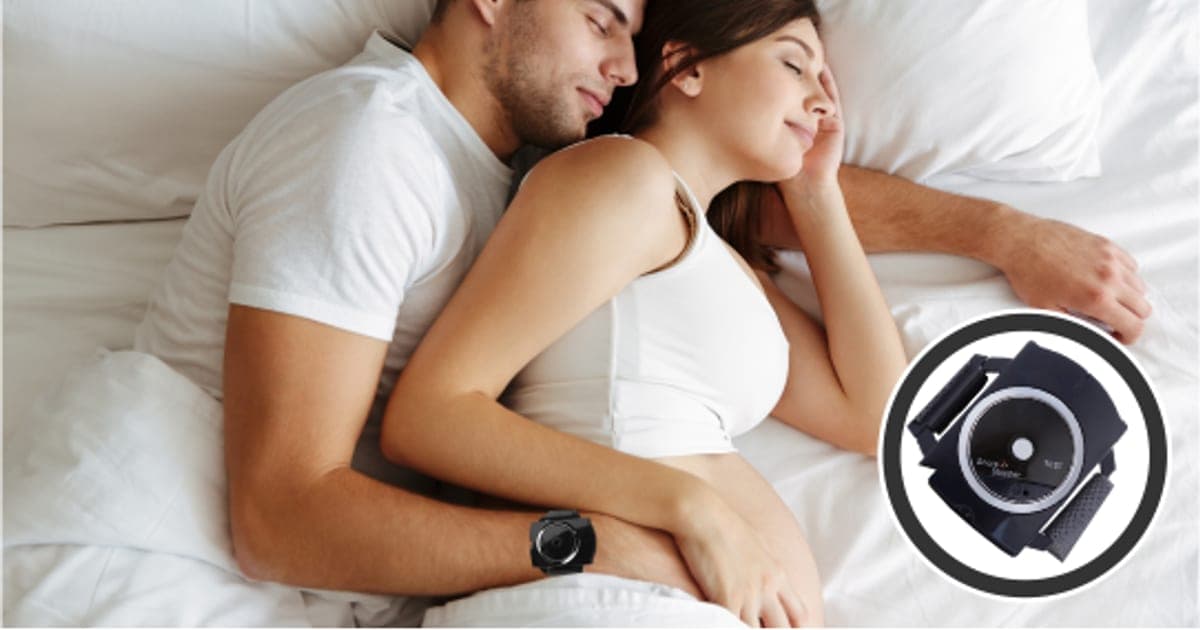
The Sleep Connection wristband has a sound sensor and a pulse. When it hears snoring, it sends a low-level electrical pulse to the skin of your wrist, at a strength you set, so that you shift position without fully waking. Several reviews say it switches itself off after about eight hours. There is no app and no subscription.
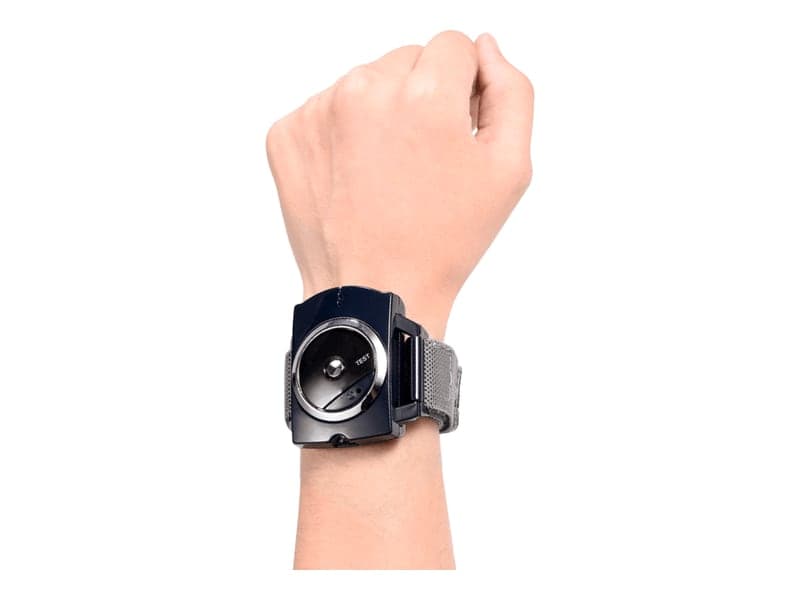
Worn like a watch, on either wrist
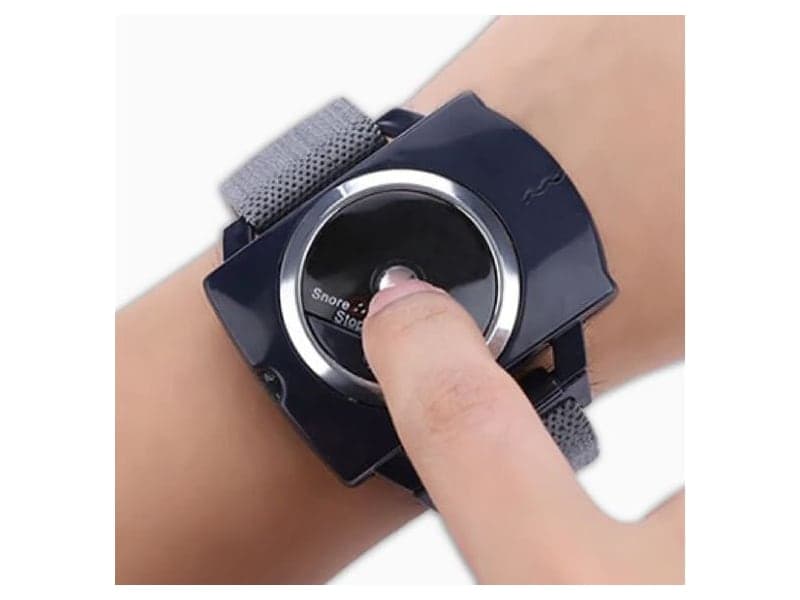
The central button and the test function
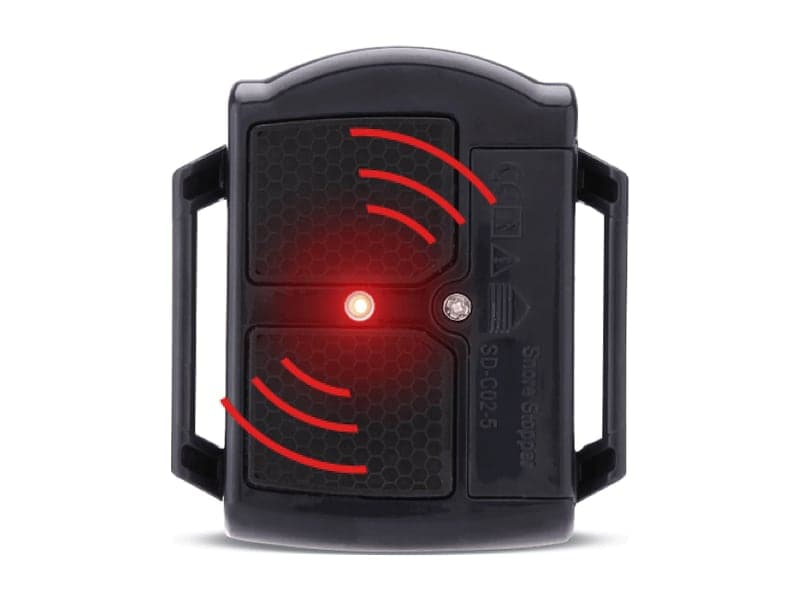
The underside, with Sleep Connection's pulse illustration
- Our score
- 3.6/10
- Price
- $64.99as reported at checkout, Aug 2026
- Works on
- Sleeping position
- Worn
- On the wrist, like a watch
The theory borrows from positional therapy, which helps people who snore mainly on their backs. But the device cannot tell which way you are lying, only that someone in the room is snoring, so a snoring partner can set it off. The unit in the brand's own photos is printed "Snore Stopper", model SD-C02-5, a name used by generic wristbands from other sellers. We found no published test and no FDA clearance, and we could not load the checkout ourselves, so the prices here come from an independent review that captured it in August 2026.
Hale: a nasal dilator for narrow nostrils
Hale is two soft, dark grey pieces that sit just inside each nostril, joined by a clear band under the nose. They hold the nostril walls outward to widen the narrowest part of the nasal airway, the nasal valve. The kit has small, medium and large sizes, a pocket case and optional insertion tools. It was designed by facial plastic surgeon Dr. Patrick Byrne.
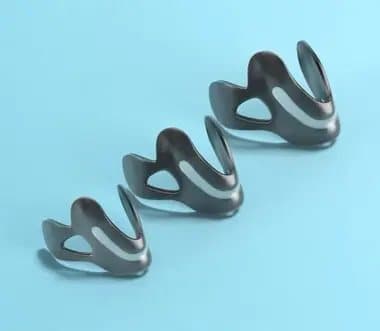
Three sizes
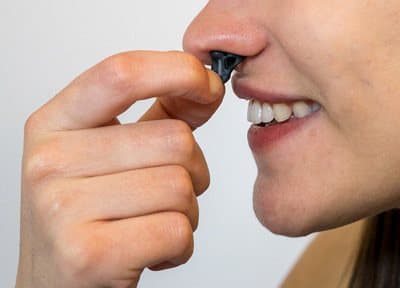
Inserting Hale
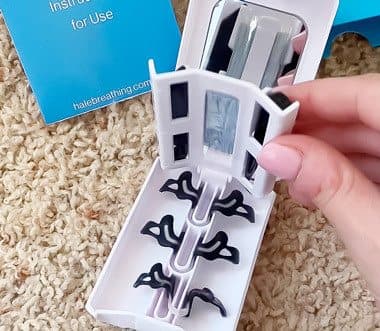
The kit with three sizes
- Our score
- 5.6/10
- Price
- $29.99per kit; refills extra
- Works on
- Nostrils that narrow when you breathe in
- Worn
- Just inside both nostrils
Hale is the most credible of the three on paper and the most overstated in its claims. A Johns Hopkins feasibility study (NCT03456115) tested what appears to be an early version in 36 people. It improved peak nasal airflow by an average of 29 litres per minute, against 28 for a Breathe Right strip, and participants preferred the strip. That does not support the offer page's "more effective than nasal strips" or "95% as effective as reconstructive surgery". It also helps only snoring that starts in the nose; our Hale review covers who that is.
What the evidence says for each
The three sit at very different points on the evidence scale.
SleepZee. The device type is well supported. The American Academy of Sleep Medicine describes oral appliance therapy as an established treatment for snoring. There is no study of SleepZee itself, and over-the-counter boil-and-bite devices depend heavily on the fit you get. The sales page's "92%" figure comes without a method.
Hale. One small, short study of an early design found it about as good as a nasal strip, measured over minutes during fitting. It did not measure snoring, sleep or comfort over weeks. A 2016 review of mechanical nasal dilators found the most support for external strips and clips, and only one supporting study for internal stents.
Sleep Connection. No published study of the device. Positional therapy is a recognised approach for snoring that happens mainly on the back, but a sound-triggered wristband is a loose version of it. Owner reports range from "silent from night one" to "did nothing", which fits a device that only helps one kind of snorer.
What each one really costs
The sticker prices are close. The cost over a year is not, because only Hale is designed to be replaced.
| Cost | SleepZee | Sleep Connection | Hale |
|---|---|---|---|
| One unit | $49.95 | $64.99 | $29.99 |
| Shipping | $12.99 | Not confirmed | Not confirmed |
| Refills | None listed | None listed | $19.99 each |
| First year, roughly | $62.94 | About $65 plus shipping | About $250 to $270 |
All three checkouts push multipacks. SleepZee's opens with three units selected, and Hale's bundles run to three kits. Buy one, find out whether it suits you, then decide. Hale's store prices refills on 30 or 45-day plans, which suggests replacing each dilator about once a month; check the instructions in the kit before you subscribe. If you have a health savings or flexible spending account, ask whether it covers breathing aids.
Safety: who should not use each one
Each device carries its own risks, and they do not overlap.
- SleepZee puts pressure on the teeth and jaw joint. Skip it with loose teeth, gum disease, jaw joint pain or full dentures. Expect extra saliva and mild jaw ache for the first week, and stop if your bite still feels different by mid-morning.
- Sleep Connection is electrical stimulation. Do not use it with a pacemaker, implanted defibrillator or other implanted electronics. Ask a doctor first if you are pregnant or have epilepsy, and do not wear it on broken or irritated skin.
- Hale sits against the nasal lining. Ask a doctor first after recent nasal surgery or a broken nose, with a nostril piercing, or if you take blood thinners or get frequent nosebleeds. Stop if it causes pain, sores or bleeding.
For all three: loud snoring with gasps, pauses in breathing or daytime exhaustion can signal obstructive sleep apnea. None of these products treats it, and quieter nights can hide it.
Returns and the fine print
With snoring aids you only learn whether one works by sleeping in it, so the return terms matter more than usual. None of the three is a safe experiment.
SleepZee's returns page refunds change-of-mind returns only for unused items in their original packaging, needs prior approval and leaves the postage to you. The Sleep Connection checkout promised a 60-day money-back guarantee in one independent capture, while the written terms described a 30-day, exchange-only policy for unused items. Hale's offer page shows a 30-day money-back guarantee, but Trustpilot reviewers report its store requiring unopened items. Whichever you buy, screenshot the terms at checkout and pay by credit card.
Strengths and limitations
Each product's three strongest points and three biggest drawbacks, taken from our full reviews.
SleepZee Mouthpiece
Strengths
- Uses mandibular advancement, the same jaw-forward approach dentists use for snoring
- Fits at home in a few minutes with boil-and-bite moulding, with no appointment or prescription
- At $49.95 it costs a fraction of a dentist-made device, and less each in multipacks
Limitations
- The 30-day guarantee covers change-of-mind returns only if the mouthpiece is unused, so treat it as a final sale once moulded
- No step-by-step adjustment: to change the jaw position you re-boil and re-bite it
- Not for sleep apnoea, whatever the sales page implies, and we found no FDA 510(k) listing under the SleepZee name
Sleep Connection Anti-Snore Wristband
Strengths
- Nothing in the mouth or on the face, unlike mouthpieces, strips or masks
- Pulse strength is adjustable, according to the brand
- Switches itself off after about eight hours, per several reviews
Limitations
- No published study of this wristband, and no FDA clearance we could find
- The sales page claims it stops snoring 'forever' with 'no side effects', which no device can promise
- The device in the brand's photos is printed 'Snore Stopper', a name used by generic wristbands from other sellers
Hale Breathing Aid
Strengths
- Designed by Dr. Patrick Byrne, a facial plastic surgeon with Johns Hopkins and Cleveland Clinic roles
- Discreet: sits inside the nostrils with a small clear band, unlike an external strip
- Three sizes in the kit, plus a case and optional insertion tools
Limitations
- A Johns Hopkins study of an early version found airflow gains similar to a Breathe Right strip, not better, and participants preferred the strip
- "95% as effective as reconstructive surgery" and "100% safe" are not supported by published data we found
- Hale's own store sells refills at $19.99 a month, an ongoing cost the offer page does not mention
Can you combine them?
Yes, where they target different causes, and that is sometimes the right answer. Someone who snores from the throat and has narrow nostrils could reasonably use a mouthpiece and a nasal dilator together. A back sleeper might pair any of them with a pillow that makes side sleeping comfortable, such as the adjustable Sleepgram on its firm setting.
Combining is also a signal. If you need two devices to sleep quietly, that is a good reason to see a doctor or a dentist who treats snoring. The sleep category and health gadgets section list everything else we have reviewed, and our best sleep products guide covers the wider picture.
Our verdict
There is no single winner, because these products do not compete for the same snorer. On our scores, Hale leads at 5.6, SleepZee follows at 4.7 and the Sleep Connection wristband trails at 3.6. For the most common case, snoring from the throat with no signs of apnea, a jaw-forward mouthpiece like SleepZee is the best-supported first try, as long as you buy one unit and treat it as a final sale. Choose Hale only after nasal strips have shown that your nose is the problem, and budget for refills. Try the wristband last, and only if you snore on your back and nothing can go in your mouth or nose.
Frequently asked questions
Which works best for snoring: a mouthpiece, a wristband or a nasal dilator?
It depends on where your snoring comes from. For ordinary snoring from the throat, a jaw-forward mouthpiece such as SleepZee has the strongest evidence. A nasal dilator such as Hale only helps if narrow nostrils are the cause. The Sleep Connection wristband aims at back-sleeping snoring, but nobody has published a test of it.
Can I use Hale and SleepZee together?
They work in different places, the nose and the jaw, so nothing in either product's instructions rules out wearing both. SleepZee has front breathing vents, so you are not forced to breathe through your nose. If you need both to stop snoring, that is worth mentioning to a doctor, because snoring from several places can point to sleep apnea.
Are SleepZee, Sleep Connection or Hale FDA cleared?
We found no FDA clearance for any of the three. We found no 510(k) record under the SleepZee name, no clearance for the Sleep Connection wristband, and Hale describes itself as FDA registered, which means the company and device are listed with the FDA, not that the FDA has reviewed how well it works.
Which one can I return if it does not work for me?
None of them reliably. SleepZee's returns page covers change-of-mind returns only for unused mouthpieces, and you pay postage. The Sleep Connection checkout and written terms gave conflicting policies in an independent review. Hale's offer page shows a 30-day guarantee, but owners report returns being limited to unopened items. Buy one unit and keep the box.
Which is cheapest over a year?
SleepZee or the wristband, if one unit lasts. SleepZee is about $62.94 delivered and the wristband about $64.99 as last reported. Hale starts lowest at $29.99 per kit, but Hale's store sells refills at $19.99 and a one-year supply at $239.88, so a year of nightly use costs roughly $250 to $270.
Do any of these treat sleep apnea?
No. None is a sleep apnea treatment, whatever the sales pages imply. Loud snoring with pauses, gasping or daytime exhaustion needs a doctor and a sleep test. Where an oral appliance is the right treatment for apnea, a dentist or clinic fits and follows it up. A gadget that quietens snoring can hide the symptom that would have led to a diagnosis.
More on SleepZee, Sleep Connection and Hale

About the author
Daniel Brooks, Technology & Buying Guide Editor
Daniel Brooks edits the buying guides and comparisons at Top10Gadgets, and covers the sleep, supplement and travel categories where products are hardest to tell apart. Daniel approaches every purchase like a careful shop…
- Buying guides and product comparisons
- Budget and value-for-money products
- Sleep products
- Travel gear
- Subscriptions and return terms
Writing for Top10Gadgets since 2026Full profile