Dental Care / Toothbrushes
Great Gums Review: How the Bioelectric Toothbrush Works, What the Studies Show and Who It Suits
A manual toothbrush with a chip that sends tiny microcurrents through wet bristles. Small studies suggest it may reduce gum inflammation, but 'reverses gum disease' goes well beyond the evidence.

By James Wilson, Consumer Tech Writer at Top10Gadgets
Updated 30 min readHow we test
Quick answer
Yes, if you have sensitive or mildly inflamed gums, dislike vibrating electric brushes, and want to try a gentle brush with some early evidence behind it, while still seeing your dentist. Great Gums is a real company with research partners, and small studies suggest its bioelectric brush may reduce gum inflammation more than ordinary brushes.
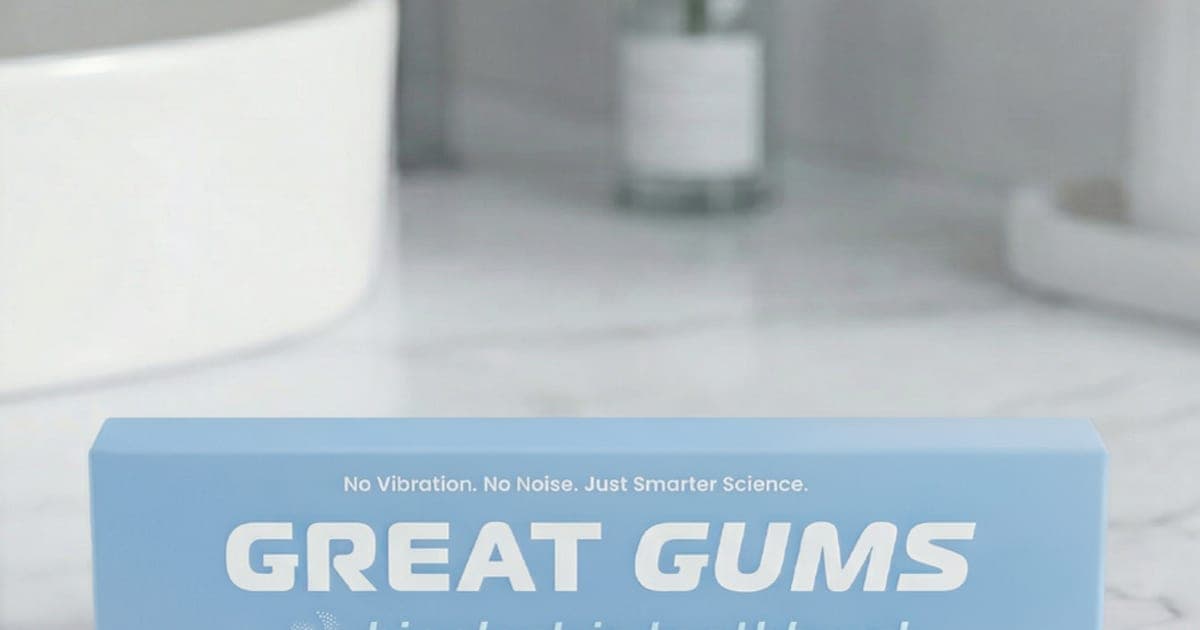
Score 6.2/10$29.99 at Great Gums
Check price at Great Gums (opens Great Gums in a new tab)We may earn a commission if you buy through our links.
- Best for
- People with sensitive teeth or gums who dislike vibrating electric brushes
- Not for
- Anyone with persistent bleeding, receding or painful gums, loose teeth or bad breath that will not go, until a dentist has checked them
$29.99 at Great Gums
Check price at Great Gums (opens Great Gums in a new tab)We may earn a commission if you buy through our links.
On this page · 14 sections
- 01Our verdict
- 02The short version
- 03Pros & cons
- 04How it works
- 05Who it's for
- 06How much does Great Gums cost, and what do you get?
- 07Does Great Gums work, and what does the evidence say?
- 08Are Great Gums' claims true?
- 09Is Great Gums better than a soft manual or electric toothbrush?
- 10Is Great Gums legit, and what should you check before buying?
- 11What do owners say, and how did we score Great Gums?
- 12How to use Great Gums for the best results
- 13What else do people ask about bleeding gums and toothbrushes?
- 14Frequently asked questions
Our verdict
Yes, if you have sensitive or mildly inflamed gums, dislike vibrating electric brushes, and want to try a gentle brush with some early evidence behind it, while still seeing your dentist. Great Gums is a real company with research partners, and small studies suggest its bioelectric brush may reduce gum inflammation more than ordinary brushes. But "heals your gums" and "reverses gum disease" go far beyond those studies, and at about $30 a brush every three months it costs much more than a manual brush. It scores 6.2 out of 10.
The short version
- A soft manual toothbrush with a chip that sends imperceptible microcurrents through wet bristles.
- No vibration, no charging, no replacement heads; replace the brush after about three months.
- $29.99 for one on 3 October 2026; $59.98 for three, $89.97 for five, $119.96 for eight. Same as the brand's store.
- Evidence: small trials, mostly short and company-linked, showing lower gum inflammation scores.
- Best trait: gentle, simple and pleasant for sensitive mouths.
- Biggest drawback: marketing that treats a toothbrush like a cure.
- Our score: 6.2 out of 10.
Pros & cons
Great Gums is better supported than most offer-page health gadgets: there is published research on microcurrent toothbrushes and a university partnership. The cons are about how far the marketing stretches that research, and about cost.
What we like
- Real company and real research: published and preprint trials involving Yonsei University and Columbia University College of Dental Medicine
- Small trials found lower gum inflammation scores than with ordinary brushes, especially between teeth
- Ultra-soft bristles and no vibration, which suits people with sensitive gums and teeth
- No charging and no replacement heads; you swap the whole brush every three months or so
- Offer price matches the brand's own store
What we don't
- "Heals your gums", "reverses gum disease" and "stop bleeding for good" go far beyond small, short, company-linked studies
- In the published 2021 study, the microcurrent brush removed no more plaque overall than a plain brush
- About $30 a brush, replaced every three months or so, versus a few dollars for a manual brush
- Bleeding gums need a dental check; a toothbrush is not treatment for gum disease
- "Five month battery life" on the offer page conflicts with the brand store's "3+ months" replacement guidance
Sold by Great Gums
Great Gums Lite$29.99
How it works
Great Gums is a manual toothbrush with a tiny electronic circuit. It does not scrub harder or vibrate; you still do the brushing.
Wet the bristles and switch on
Step 1: Wet the brush, press the button and a small light shows it is on. Water completes the circuit that lets the chip send tiny electrical currents through the bristles.
Brush normally for two minutes
Step 2: You brush as you would with any manual toothbrush. There is no vibration and you cannot feel the current, which the brand says runs at millions of pulses per second.
Replace the brush when it wears
Step 3: The brand's store says the Lite lasts three months or more. When it is time for a fresh brush, you replace the whole toothbrush; there are no heads to swap.
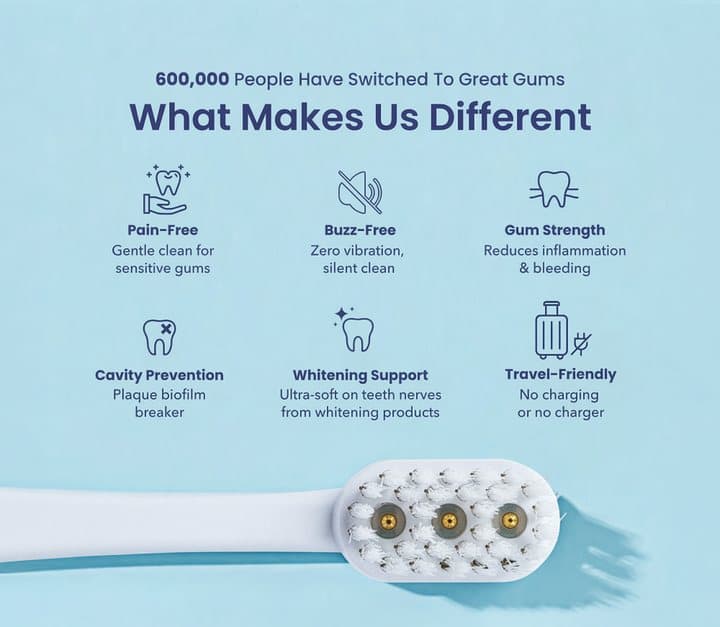
The theory, developed from university research on the "bioelectric effect", is that weak electrical currents can make bacterial biofilms like dental plaque easier to disrupt and remove. Water and saliva carry the current around the bristles, so the effect may reach a little beyond where the bristles touch, such as between teeth and at the gumline.
Where the idea comes from
The "bioelectric effect" was described in laboratory research showing that weak electric fields can make bacterial biofilms more vulnerable to removal or to antimicrobial agents. Dental plaque is a biofilm, so researchers explored whether toothbrushes could use the same principle. Young Wook Kim's doctoral work at the University of Maryland developed one such approach, which led to the brushes sold in South Korea and now by Great Gums.
Who it's for
Great Gums suits people with sensitive teeth or gums who find electric brushes too buzzy, people with mild gum inflammation who want a gentle brush alongside proper dental care, and travellers who want something light with no charger. It also suits people curious about a new approach who are happy to pay for it.
It does not replace a dentist, flossing or professional cleaning, and it is not a treatment for gum disease.
Why Great Gums appeals
Bleeding gums are common and worrying, and many people do not know whether to brush harder, softer or more often. A brush promising to "heal" gums gently, backed by a university and dentists, is reassuring. No vibration, no charging and soft bristles make it pleasant to use. The scientific story, the body's own electrical healing signals, is intriguing.
There is also the appeal of doing something proactive. Many people only think about their gums when the dentist mentions bleeding or pockets. A new kind of brush feels like a concrete step, and the 30-day guarantee lowers the risk of trying it.
Who gets the most value
People who are already brushing twice a day and cleaning between their teeth, and who want a gentler brush, may see the most benefit. One owner on the page reports that after two months their periodontist measured shallower gum pockets; that is an individual report, but it reflects the kind of person most likely to benefit: someone already under professional care.
What it will not do
It will not reverse established gum disease, regrow lost gum or bone, replace flossing or interdental brushes, or remove hardened tartar. It will not whiten teeth beyond removing surface stains with brushing.
A typical routine with Great Gums
Morning and night, you wet the brush, add toothpaste, press the button and watch for the blue light. You brush gently for two minutes, angling the soft bristles towards the gumline. There is no buzz, so it feels like a very soft manual brush. Once a day you clean between your teeth with floss or small interdental brushes. Every three months or so, when the bristles start to splay, you open a new brush.
That routine, done consistently, is what improves gum health for most people. Great Gums aims to add a small extra benefit on top.
- People with sensitive teeth or gums who dislike vibrating electric brushes
- Anyone with mild gum inflammation who is also seeing a dentist and wants to try a gentler brush
- Travellers who want a light brush that needs no charger
Who should skip it
- Anyone with persistent bleeding, receding or painful gums, loose teeth or bad breath that will not go, until a dentist has checked them
- People happy with a good electric brush, which has stronger long-term evidence
- Budget-conscious buyers; a manual brush and floss cost far less
- Anyone with an implanted electronic medical device, until they have checked with their doctor
How much does Great Gums cost, and what do you get?
Great Gums Lite cost $29.99 for one brush on the offer page on 3 October 2026, with three for $59.98, five for $89.97 and eight for $119.96, close to Great Gums' own store prices. You get a manual toothbrush with ultra-soft bristles, no vibration and a built-in bioelectric chip that works when the bristles are wet. Replacing it every three months means four brushes a year.
You get the Great Gums Lite toothbrush in a box. The brand's images show a white brush with teal accents and ultra-soft bristles, and a small light that glows when it is on.
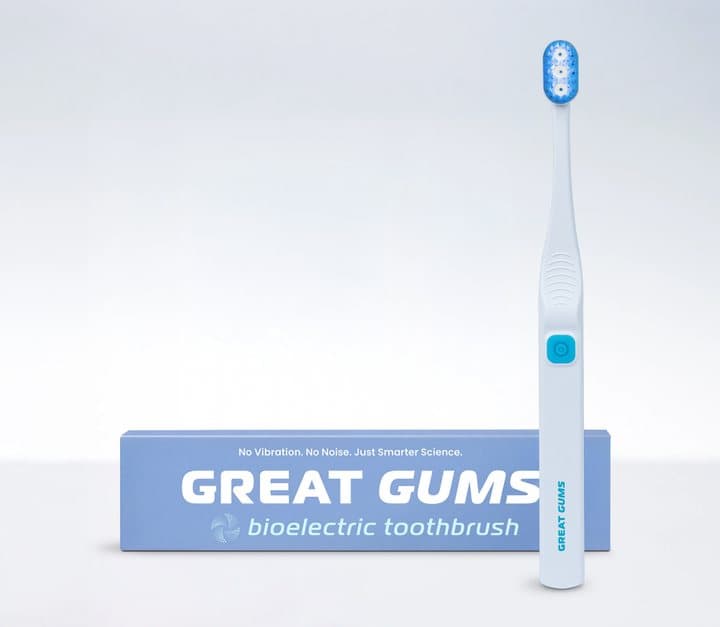
The brush and packaging
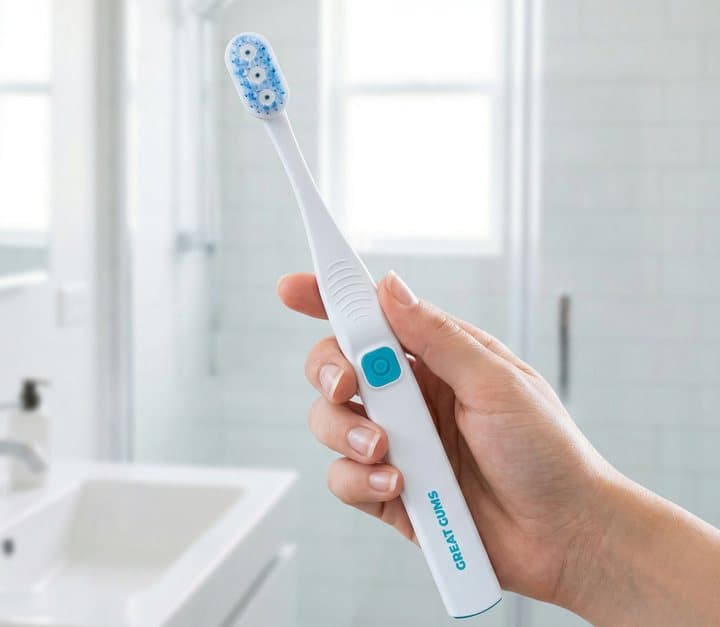
The Lite in hand
Specifications
| Spec | Great Gums Lite (brand figures) |
|---|---|
| Type | Manual toothbrush with bioelectric chip |
| Activation | Wet bristles, press button; indicator light |
| Vibration | None |
| Bristles | Ultra-soft |
| Power | Built-in battery; no charging |
| Lifespan | "3+ months" (store); "five month battery life" (offer page) |
| Replacement | Whole brush; no replacement heads |
| Guarantee | 30 days (offer page) |
Great Gums price and bundles
On 3 October 2026 the offer page our link opens showed:
| Package | Total | Per brush | Shipping |
|---|---|---|---|
| 1 brush | $29.99 | $29.99 | Not marked free |
| Buy 2, get 1 free (3) | $59.98 | $19.99 | Not marked free |
| Buy 3, get 2 free (5) | $89.97 | $17.99 | Free |
| Buy 4, get 4 free (8) | $119.96 | $14.99 | Free |
Great Gums' own store listed the same bundles at $29.95, $59.90, $89.85 and $119.80. The brand also sells a Clinical Grade rechargeable brush and a Sonic Gums model.
What it costs over a year
If you replace the brush every three months, as dental guidance suggests for any toothbrush, you need four a year.
| Option | Approximate yearly cost |
|---|---|
| Great Gums Lite, single brushes | About $120 |
| Great Gums Lite, 8-pack | About $60 for four, or two years from one 8-pack |
| Manual toothbrushes | A few dollars to $20 |
| Electric brush replacement heads | Often $30 to $60, plus the handle |
What this means for you: the 8-pack covers two years at about $15 a brush. A single brush is an expensive way to try it, but it is the sensible first step.
What is in the box
The offer page and store describe the brush itself, ready to use with no charger or heads. Bundles contain multiple brushes. Check at checkout whether any toothpaste or travel case is included, since the brand sells those separately with some products.
Who makes it
Great Gums Inc. is based in San Francisco and was founded by Mark Goldstein and Young Wook Kim, according to trade coverage. Dr. Kim developed the bioelectric toothbrush technology during doctoral research at the University of Maryland, and the brushes have been sold in South Korea since 2020, with over 600,000 units sold there, according to Dental Products Report. Trade coverage also describes research partnerships with Columbia University College of Dental Medicine and Yonsei University College of Dentistry.

Great Gums LiteScore 6.2/10
Best for: People with sensitive teeth or gums who dislike vibrating electric brushes
$29.99 at Great Gums · Price checked October 3, 2026
Check price at Great Gums (opens Great Gums in a new tab)We may earn a commission if you buy through our links.
Does Great Gums work, and what does the evidence say?
The evidence is early but promising for gum inflammation, not plaque. A published 2021 study found a microcurrent brush removed no more plaque than a manual brush, but gave a lower gingival index between teeth. A four-week preprint trial of 99 adults with mild-to-moderate gingivitis reported lower gingival index scores than manual and sonic brushes. These studies are small and short, and the preprint is not yet peer-reviewed.
Nobody on our team has used Great Gums. This section looks at published and preprint research on microcurrent toothbrushes and how it compares with the page's claims.
The published 2021 study
A 2021 study in the International Journal of Environmental Research and Public Health, Bioelectric Effect of a Microcurrent Toothbrush on Plaque Removal, tested a microcurrent brush using the same type of technology against a plain manual brush. It was an examiner-blind, randomised crossover trial in 40 people with gingivitis, using each brush for two weeks.
Both brushes reduced plaque and gum inflammation. There was no significant difference in plaque removal between them. The microcurrent brush did produce a significantly lower gingival index between teeth, which the authors described as a beneficial effect where bristles cannot reach. The study was supported by the manufacturer, ran for only two weeks per brush, and did not measure deeper plaque or periodontitis.
The four-week trial
A preprint on Research Square describes a randomised, examiner-blinded trial of 99 adults with mild-to-moderate gingivitis, comparing a bioelectric brush with manual and sonic brushes over four weeks. According to search summaries of the preprint, the bioelectric group had significantly lower gingival index scores than both comparison groups at four weeks, and lower bleeding scores than the manual brush group. A preprint has not yet been peer reviewed.
Where the page's figures come from
The page cites a randomised trial with an 18% reduction in plaque, 51% less inflammation and 64% less bleeding, and elsewhere "6x more plaque removed" and "67% better cleaning between teeth". Trade coverage quotes slightly different figures: 75% less inflammation, 59% less bleeding and 53% less bad breath. The page does not link the studies or say how the figures were measured or compared. Percentages like these often describe change from the start of a short study, not the difference from a standard brush.
How gum health is measured in studies
| Measure | What it means |
|---|---|
| Plaque index | How much plaque covers the teeth, scored by an examiner |
| Gingival index | How red, swollen and prone to bleeding the gums look |
| Bleeding on probing | Whether gums bleed when gently probed |
| Pocket depth | How deep the space between gum and tooth is; deeper means more advanced disease |
The microcurrent studies we found focused on plaque and gingival indices in people with gingivitis, over two to four weeks. They did not measure long-term pocket depth or tooth loss, which are what "reversing gum disease" would require.
Why small, short studies matter
Two to four weeks is long enough to see changes in gum inflammation, because gingivitis responds quickly to better cleaning. It is also why most people who switch to any new brush and pay more attention to their gums see some improvement in the first month. It is not long enough to show lasting benefit. People in studies also tend to brush more carefully than usual, which improves results with any brush. Comparing against a control brush, as these trials did, helps, but larger and longer independent trials would make the evidence much stronger.
What this means
There is some evidence that microcurrent brushes may reduce gum inflammation scores more than ordinary brushes over a few weeks, particularly between teeth. There is no evidence that they "heal" gums, "reverse" gum disease or stop bleeding "for good". The studies are small and short, and the strongest independent evidence in toothbrushes still belongs to powered oscillating-rotating brushes, backed by many trials.
What the dentists on the page are
The page names three dentists who recommend the brush: a dentist described as one of the top 40 dentists under 40, a professor at Columbia's College of Dental Medicine, and an advisory board member of Dentistry Today. It also quotes a senior director at Colgate. Endorsements from named professionals are more credible than anonymous ones, but they are not independent clinical evidence, and their relationship with the company is not described on the page.
The pacemaker comparison
The page compares the brush to pacemakers, wound therapy and neurostimulators to explain bioelectricity. Those are regulated medical treatments with very different currents and purposes. The comparison is marketing; a toothbrush is not a medical device in the same sense.
Are Great Gums' claims true?
Great Gums' gentle-brush claims are fair, but its health claims go too far. "Heals your gums", "reverses gum disease" and "say goodbye to bleeding gums for good" go well beyond small, short studies; gums improve when plaque is removed consistently, and persistent bleeding needs a dentist. "Clinically proven at Columbia University" overstates the strength and independence of research from a described partner. "Zero vibration" is accurate.
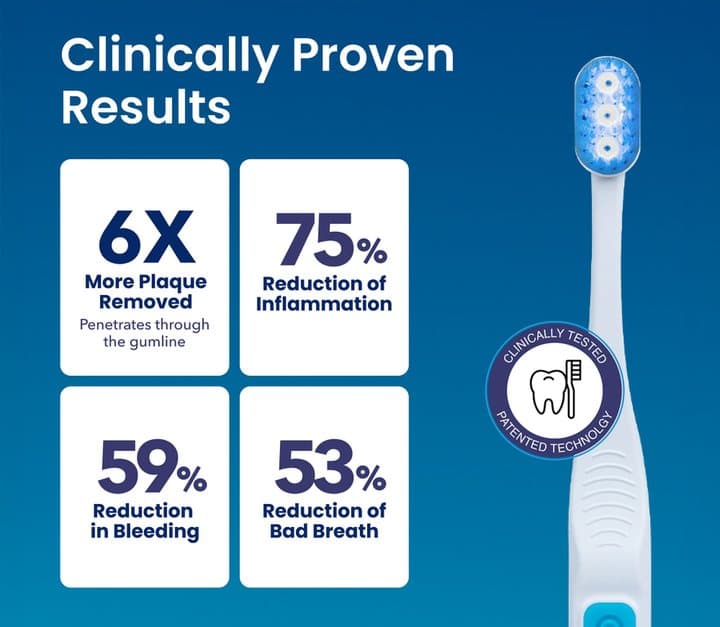
"The first toothbrush that heals your gums"
Gums heal when the cause of inflammation, plaque, is removed consistently. A good brush helps with that. "Heals" implies treatment the evidence does not support for this product alone.
"Clinically proven at Columbia University"
Columbia University College of Dental Medicine is described as a research partner. Small, short trials show improvements in inflammation scores. "Clinically proven" overstates the strength and independence of that evidence.
"Say goodbye to bleeding gums for good"
Bleeding gums usually mean gingivitis, which improves with better cleaning, but can return. Persistent bleeding needs a dental assessment. No brush guarantees an end to bleeding.
"Clinically proven gum disease reversal"
Gingivitis is reversible with good hygiene; periodontitis is not reversed by a toothbrush. The page's comparison table blurs the two.
"Zero vibration, safe for sensitivity"
Accurate and a genuine plus. Many people with sensitive teeth or receding gums find vibrating brushes uncomfortable. It also means no motor noise in the morning, which some households appreciate. Soft bristles and gentle technique are the main protections for sensitive mouths.
"Safe for implants, braces and veneers"
A soft manual brush is generally safe around dental work. The brand's Clinical Grade line sells dedicated implant and orthodontic heads, which suggests it designs for these users. Follow your dentist's specific aftercare advice.
"Your toothbrush misses up to 40% of your mouth" and "reaches all of it"
Toothbrushes do miss the spaces between teeth, which is why flossing or interdental brushes are recommended. The bioelectric effect may help a little beyond the bristles, but "reaches all of it" is not supported.
"Up to 6x more plaque removed"
The 2021 study found no difference in overall plaque removal. The "6x" figure appears to refer to hard-to-reach areas under specific conditions; the page does not explain the measurement.
"Eliminates bad breath"
Better cleaning can reduce bad breath. Persistent bad breath can have dental or medical causes that need checking. Cleaning your tongue, drinking water and treating dry mouth also help. The page's claim that freshness lasts from 8am to 8pm is a marketing line rather than a measured result.
"Save thousands on dental bills"
Preventing gum disease does save money, but the page implies the brush prevents disease on its own. Regular dental visits remain essential. A check-up and cleaning every six to twelve months, or as your dentist advises, catches problems early when they are cheapest to treat.
"17 patents" and "700,000 happy customers"
The company describes a patented technology; trade coverage mentioned 14 issued patents at the 2024 launch. Sales of over 600,000 in Korea are reported in trade press.
Claims scorecard
| Claim | Our read |
|---|---|
| Bioelectric microcurrents, no vibration | Accurate description |
| Lower gum inflammation than ordinary brushes | Some support from small, short trials |
| More plaque removed | Mixed; 2021 study found no overall difference |
| Heals gums, reverses gum disease | Not supported |
| Stops bleeding for good | Not supported |
| Clinically proven at Columbia | Research partnership; small studies |
| Five-month battery | Store says replace after 3+ months |
| Patents and sales | Plausible, per trade coverage |
Is Great Gums better than a soft manual or electric toothbrush?
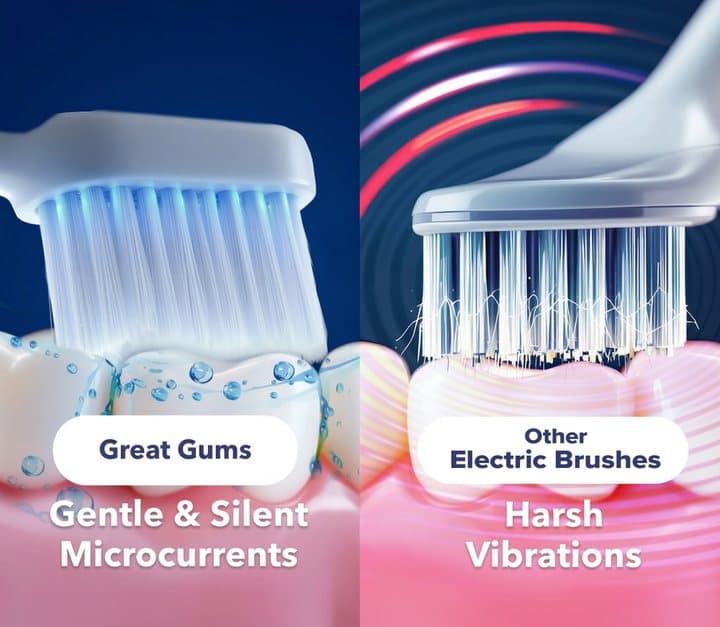
Not clearly. A soft manual brush with good technique and daily cleaning between teeth is highly effective and costs far less. Oscillating-rotating electric brushes have a long evidence record for plaque. Great Gums adds a microcurrent chip that small studies suggest may help gum inflammation between teeth, without vibration, which suits sensitive mouths. Whatever brush you choose, interdental cleaning and regular dental visits matter most.
| Option | Typical cost | Evidence | Best for |
|---|---|---|---|
| Great Gums Lite | About $15 to $30 per brush | Small, short studies | Sensitive mouths wanting a gentle brush |
| Soft manual brush | Low | Effective with good technique | Everyone, cheaply |
| Oscillating-rotating electric brush | Moderate upfront, heads ongoing | Strong long-term evidence | Better plaque and gingivitis control |
| Sonic electric brush | Moderate | Good evidence | People who like sonic brushes |
| Floss or interdental brushes | Low | Strong for between-teeth cleaning | Everyone |
| Professional cleaning | Varies | Essential for tartar and gum disease | Everyone, regularly |
What dentists generally recommend
Most dental guidance for gum health is consistent: brush twice a day for two minutes with fluoride toothpaste, clean between teeth daily, replace your brush every three to four months, limit sugary snacks and drinks, avoid smoking, and see a dentist and hygienist regularly. Any toothbrush, bioelectric or not, is one part of that.
Great Gums vs a soft manual brush
Both are manual. Great Gums adds the microcurrent chip, which small studies suggest may help gum inflammation between teeth. A soft manual brush with good technique and interdental cleaning is still highly effective and costs far less.
Great Gums vs an electric toothbrush
Powered toothbrushes, especially oscillating-rotating ones, have the strongest long-term evidence for reducing plaque and gingivitis compared with manual brushing. One four-week trial suggested the bioelectric brush lowered inflammation scores more than a sonic brush. For people who tolerate electric brushes, they remain a well-proven choice; for people who dislike vibration, Great Gums is a gentle alternative.
Great Gums vs Great Gums Clinical Grade and Sonic Gums
The brand's store also sells a rechargeable Clinical Grade model, with replaceable heads including implant and orthodontic heads, and a Sonic Gums brush that adds vibration. The Lite sold on the offer page is the simplest, cheapest option: no charging, no heads, replace the whole brush. If you want to keep one handle and replace heads, the Clinical Grade may suit you better.
Great Gums vs interdental cleaning
Cleaning between teeth daily, with floss or interdental brushes, targets exactly the areas Great Gums says it reaches. It is the most important habit for gum health that many people skip. Great Gums does not replace it.
Other health products we have reviewed
Our dental care section and health and wellness hub cover more products sold through offer pages, including Glamory, CoolCura and the Chill Pill. For whitening, our Laughland vs PurelyWHITE comparison compares an LED kit with a tooth powder.
If you want to try a gentle bioelectric brush alongside regular dental care, the Great Gums offer page (opens Great Gums in a new tab) matched the brand's own store prices.
Great Gums LiteScore 6.2/10
Why people buy it: Real company and real research: published and preprint trials involving Yonsei University and Columbia University College of Dental Medicine
$29.99 at Great Gums · Price checked October 3, 2026
Check price at Great Gums (opens Great Gums in a new tab)We may earn a commission if you buy through our links.
Is Great Gums legit, and what should you check before buying?
Great Gums is a real San Francisco company with university research partners, and the offer prices match its own store closely. Before buying, know that bleeding gums need a dental check, since a toothbrush is not treatment for gum disease. Keep cleaning between your teeth, ask your doctor if you have an implanted medical device, and note the page's 30-day money-back guarantee and free shipping only on larger bundles.
Bleeding gums need a dentist
Bleeding when brushing is a common sign of gingivitis, but it can also signal periodontitis, which needs treatment.
What to do: if your gums bleed regularly, see a dentist or hygienist. Use Great Gums alongside their advice, not instead of it.
Do not stop cleaning between your teeth
The page suggests the brush reaches places other brushes miss.
What to do: keep flossing or using interdental brushes once a day. No toothbrush cleans fully between teeth.
The guarantee
The page promises a full refund if your gums are not healthier, your breath not fresher, or you are not satisfied.
What to do: gum changes take a few weeks. Start using the brush as soon as it arrives, note any bleeding when brushing in the first week and again at week four, and decide before day 30.
Implanted medical devices
The brush sends tiny electrical currents through the mouth.
What to do: if you have a pacemaker, defibrillator or other implanted electronic device, check with your doctor or the manufacturer before using any microcurrent product.
Brush lifespan
The store says the Lite lasts 3+ months; the offer page mentions a five-month battery.
What to do: replace the brush every three to four months, or sooner if bristles fray, as dental guidance recommends for all toothbrushes.
Price and bundles
Single brushes are expensive over time.
What to do: try one brush first. If you like it, the 8-pack brings the cost to about $15 a brush, covering two years.
Shipping and returns
The page marks free shipping only on the larger bundles and offers a 30-day money-back guarantee.
What to do: check shipping at checkout, keep your order details, and decide within 30 days whether to keep it.
Disposing of the brush
Each Lite contains a small battery and circuit, and you replace the whole brush every few months.
What to do: check local rules for small electronics and batteries rather than putting used brushes in household rubbish. Four brushes a year with batteries is more waste than a manual brush or replacement heads.
Pregnancy and diabetes
Gum inflammation is more common in pregnancy, and gum disease is linked with diabetes.
What to do: if you are pregnant or have diabetes, keep up regular dental visits and ask your dentist about the best home care. A gentle brush can help comfort, but professional care matters most.
Children
The brand's page is aimed at adults.
What to do: for children, use a child-sized soft brush and fluoride toothpaste as your dentist recommends, and supervise brushing.
How to buy Great Gums the smart way
- Book a dental check if your gums bleed, then open the Great Gums offer page (opens Great Gums in a new tab).
- Start with one brush to see whether you like it.
- Check shipping and the total before paying.
- Decline add-ons you did not plan to buy.
- Keep your order confirmation for the 30-day guarantee.
- Use it twice a day for at least a month, alongside interdental cleaning.
- If it suits you, buy the 8-pack for the lowest cost per brush.
What do owners say, and how did we score Great Gums?
Great Gums scores 6.2 out of 10: claim accuracy 0.8, build durability 1.2, price competitiveness 1.3, usability 1.6 and owner satisfaction 1.3, each out of 2. Testimonials on the page describe clean-feeling teeth, a gentle brush for sensitive gums and hygienists noticing less plaque. We found no independent rating profile, and improvements may come from better brushing habits as much as the bioelectric chip.
Reviews on the page
The offer page's testimonials describe very clean-feeling teeth, a soft, gentle brush that suits sensitive gums, a light that switches on when wet, and positive comments from dental hygienists. One owner reports shallower gum pockets measured by their periodontist after two months and less frequent cleanings. These are selected testimonials and individual results.
Independent ratings
We did not find an independent rating profile for Great Gums. Trade press, including Dental Products Report and Dentistry Today, has covered its launches.
What the reviews agree on
Owners like the gentle, buzz-free experience and the clean feel. Several mention that hygienists noticed less plaque at their next cleaning, which is encouraging, though individual results depend heavily on overall habits. Whether the bioelectric effect is responsible for improvements, rather than more careful brushing with a new brush, is hard to tell from testimonials.
Reading toothbrush reviews
New toothbrushes often feel better simply because the bristles are fresh and people brush more carefully at first. Reviews written in the first week rarely reflect long-term results. The most useful reviews mention dental check-ups before and after, and describe how the person brushed and cleaned between their teeth.
Trade coverage
Dental Products Report covered the 2024 launch of the Great Gums One at $29.95 and a Clinical Grade model, noting over 600,000 units sold in Korea. Dentistry Today reported a nationwide US launch in December 2025 and research partnerships with Columbia and Yonsei. Trade coverage repeats company figures; it is not independent testing.
What we would test with Great Gums in hand
If we test it ourselves, we will check the indicator and battery life over three months, compare plaque disclosing results against a soft manual brush with the same technique, and ask volunteers under dental care to track bleeding scores. We will update this review with the results.
How we scored Great Gums
Every score on the site follows the five criteria on our how we test page.
| Criterion | Score | Why |
|---|---|---|
| Claim accuracy | 0.8 / 2 | Real research, but "heals", "reverses gum disease" and "6x plaque" overreach |
| Build durability | 1.2 / 2 | Simple brush; replaced whole every 3+ months |
| Price competitiveness | 1.3 / 2 | Matches the brand's store; costly versus manual brushes |
| Usability | 1.6 / 2 | Wet, press, brush; no charging |
| Owner satisfaction | 1.3 / 2 | Positive testimonials; large Korean sales; no independent ratings found |
| Total | 6.2 / 10 |
The score would rise with larger, longer, independent trials published in full, and marketing that describes it as supporting gum health rather than healing disease.
What we did, and did not, do
We read the offer page, Great Gums' store data, the 2021 published study, a preprint trial summary and trade coverage, all on 3 October 2026. Nobody on our team has used Great Gums, and no figures here come from our own testing.
How to use Great Gums for the best results
Wet the bristles thoroughly, because the microcurrent needs water, then add a pea-sized amount of fluoride toothpaste and press the button until the light shows. Brush gently at a 45-degree angle to the gumline in small circles for two minutes, covering every surface. Use light pressure, clean between your teeth daily, and replace the brush about every three months.
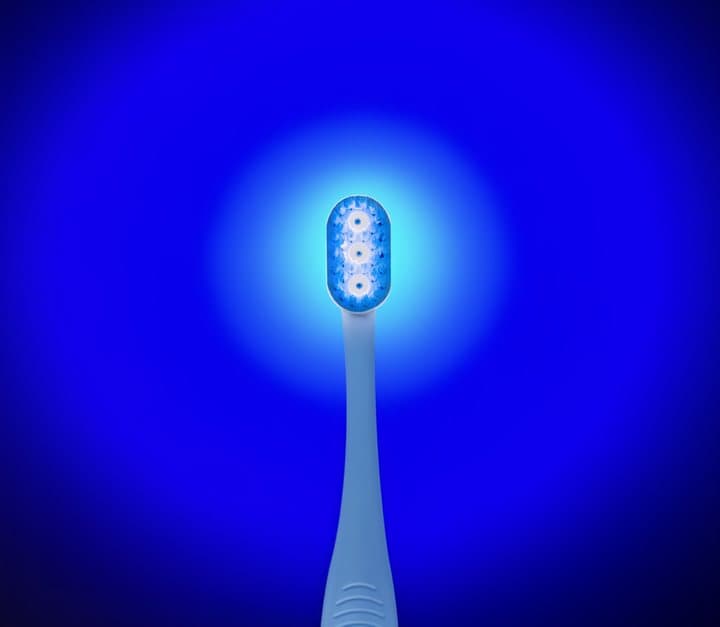
- Wet the bristles thoroughly; the microcurrent needs water to work.
- Add a pea-sized amount of fluoride toothpaste.
- Press the button and check the light is on.
- Brush gently at a 45-degree angle to the gumline, in small circles, for two minutes.
- Cover every surface: outer, inner and chewing surfaces.
- Clean between your teeth once a day with floss or interdental brushes.
- Replace the brush every three to four months or when bristles fray.
Gentle technique for sensitive gums
Use light pressure; soft bristles work best when they are not squashed flat. If the bristles splay within a few weeks, you are probably pressing too hard. Holding the brush with your fingertips rather than your fist naturally lightens the pressure. Angle them towards the gumline, where plaque collects, and let the bristles slip slightly under the gum edge.
Toothpaste
Use a fluoride toothpaste, which protects against decay. The brand sells its own toothpaste with some products; any fluoride toothpaste works.
Mouthwash
An antiseptic mouthwash can help with plaque and gingivitis for some people, but it does not replace brushing and interdental cleaning. Use it at a different time from brushing so it does not rinse away the fluoride from your toothpaste.
Brushing with braces or implants
The page says it is safe for braces and implants. Take extra time around brackets, wires and implant crowns, and use interdental brushes your dentist recommends.
Travelling
No charger means one less thing to pack. Keep it in a ventilated case so the bristles dry between uses. A closed, damp case lets bacteria grow on the bristles; open it to dry once you arrive.
Cleaning between teeth properly
Floss: wrap it around each tooth in a C shape and slide it gently under the gumline. Interdental brushes: choose the size that fits snugly without forcing, and move it in and out a few times in each gap. Water flossers suit people with braces or dexterity problems. Whichever you choose, once a day is the goal.
Building the habit
Keep the brush and floss together by the sink, brush at the same times each day, and use a two-minute timer or song. If your gums bleed at first when you start cleaning between teeth, keep going gently; bleeding usually settles within one to two weeks as inflammation reduces.
Storing your brush
Rinse it after use, stand it upright to air dry, and keep it away from other brushes.
Signs of gum problems to watch for
| Sign | What it may mean | What to do |
|---|---|---|
| Bleeding when brushing | Gingivitis | Brush and clean between teeth daily; see a dentist if it persists |
| Red, swollen gums | Inflammation | Improve cleaning; book a check-up |
| Gums pulling back from teeth | Recession or periodontitis | See a dentist |
| Persistent bad breath | Plaque, gum disease or other causes | See a dentist |
| Loose teeth or changed bite | Advanced gum disease | See a dentist promptly |
Troubleshooting
| Problem | Likely cause | Fix |
|---|---|---|
| Light does not come on | Bristles not wet, or battery spent | Wet the bristles fully and press again; replace the brush if still dark |
| Gums sore | Pressing too hard | Use lighter pressure and smaller circles |
| Bristles splayed early | Heavy brushing pressure | Brush more gently; replace the brush |
Great Gums LiteScore 6.2/10
Before you buy: Check the final price, shipping and return terms at checkout.
$29.99 at Great Gums · Price checked October 3, 2026
Check price at Great Gums (opens Great Gums in a new tab)We may earn a commission if you buy through our links.
What else do people ask about bleeding gums and toothbrushes?
Most questions are about why gums bleed and what to do. The most common cause is gingivitis, inflammation from plaque at the gumline, which usually improves within a couple of weeks of better daily cleaning. Keep brushing gently rather than avoiding bleeding areas. Gingivitis is reversible, but periodontitis, which involves loss of gum and bone, needs professional treatment, so persistent bleeding needs a dental check.
Why do my gums bleed when I brush?
The most common cause is gingivitis: inflammation from plaque at the gumline. Better daily cleaning usually helps within a couple of weeks. Bleeding that persists, or comes with swelling, recession or loose teeth, needs a dental check.
Should I stop brushing if my gums bleed?
No. Keep brushing gently and cleaning between your teeth. Avoiding the bleeding areas lets plaque build up and makes it worse. See a dentist if it does not improve.
What is the difference between gingivitis and periodontitis?
Gingivitis is gum inflammation without lasting damage, and it is reversible. Most adults have some gingivitis at some point. Periodontitis involves loss of the gum and bone supporting the teeth, and needs professional treatment.
Are electric toothbrushes better than manual ones?
Powered brushes, especially oscillating-rotating ones, have been shown to reduce plaque and gingivitis more than manual brushes on average. Good technique with a manual brush is still effective.
How often should I replace my toothbrush?
Every three to four months, or sooner if the bristles are frayed, according to common dental guidance.
What is the best toothbrush for receding gums?
A soft-bristled brush used with gentle pressure is the usual recommendation, whether manual, powered or bioelectric. Brushing too hard is a common contributor to recession. A dentist can advise on technique and whether a pressure-sensing electric brush would help.
How quickly do bleeding gums improve?
With thorough daily brushing and interdental cleaning, gingivitis often improves noticeably within one to two weeks. If bleeding continues beyond that, or you have other symptoms, see a dentist.
Does Great Gums help with plaque on braces?
Plaque builds up quickly around brackets. A soft brush helps, but people with braces usually also need interdental brushes or a water flosser and regular orthodontic check-ups. The microcurrent studies we found did not specifically show benefits for braces, though one Korean study looked at orthodontic patients.
Are soft bristles better?
Soft bristles are generally recommended because they clean effectively without damaging gums or enamel.
What is bioelectric toothbrush technology?
It uses a small battery and circuit to pass weak electrical currents through wet bristles. Research suggests the currents may help disrupt plaque biofilm, though evidence is still limited.
Can a toothbrush cure gum disease?
No. Good brushing and interdental cleaning prevent and help reverse gingivitis; periodontitis needs professional treatment.
Can I use Great Gums with an electric toothbrush?
Some people alternate, for example a powered brush in the morning and a gentle brush at night. Either way, two minutes twice a day and daily interdental cleaning matter most.
Does Great Gums work without toothpaste?
The brush activates with water, so the microcurrent does not need toothpaste. Use a fluoride toothpaste anyway, since fluoride protects against tooth decay.
Is Great Gums safe for sensitive teeth?
Its soft bristles and lack of vibration suit sensitive teeth. Pair it with a toothpaste for sensitive teeth if needed, and see a dentist if sensitivity is new or severe.
Is Great Gums worth it?
If you have sensitive gums, dislike electric brushes and want to try something gentle with early evidence, it can be worth trying, especially with the 30-day guarantee. If you are happy with an electric brush, or on a tight budget, a proven powered brush or a soft manual brush with daily flossing is a better use of money.
Frequently asked questions
What is Great Gums?
Great Gums makes a manual toothbrush with a small chip that sends imperceptible microcurrents through wet bristles. The Lite model has ultra-soft bristles, no vibration and no charging; you replace the whole brush after about three months. Small studies suggest the microcurrent may reduce gum inflammation.
Does Great Gums really work?
Small studies suggest microcurrent brushes may reduce gum inflammation more than ordinary brushes, especially between teeth. A published 2021 crossover study of 40 people found no overall difference in plaque removal. The evidence is promising but limited, short-term and mostly linked to the companies.
Can Great Gums heal gum disease?
No toothbrush treats gum disease on its own. Gingivitis improves with good daily cleaning, including between teeth, and professional cleaning. Periodontitis needs dental treatment. If your gums bleed, see a dentist. Great Gums can be a gentle brush to use alongside their advice, not instead of it.
How much does Great Gums cost?
On 3 October 2026 the offer page showed $29.99 for one, $59.98 for three, $89.97 for five and $119.96 for eight. Great Gums' own store listed the same bundles at $29.95, $59.90, $89.85 and $119.80. Free shipping applies only to larger bundles.
How long does a Great Gums brush last?
The brand's store says the Lite lasts three months or more, after which you replace the whole brush. The offer page mentions a five-month battery. Dental guidance is to replace brushes every three to four months or sooner if bristles fray.
Can I feel the microcurrent?
No. The brand says the current is imperceptible. A light shows when it is on. Wet the bristles thoroughly first, because water completes the circuit. There is no vibration, so the brush feels like an ordinary soft manual toothbrush, which suits people with sensitive gums.
Is Great Gums safe with braces, implants or veneers?
The page says it is safe for implants, braces and veneers, and Great Gums sells implant and orthodontic brush heads for its Clinical Grade model. Ask your dentist or orthodontist if you are unsure. Use gentle pressure around brackets.
Is Great Gums better than an electric toothbrush?
Powered toothbrushes, especially oscillating-rotating ones, have strong long-term evidence for reducing plaque and gingivitis. One small trial found the bioelectric brush lowered gum inflammation scores more than a sonic brush over four weeks. Longer, independent studies are needed.
We may earn a commission if you buy through our links.
This content is for informational purposes and is not medical advice. Talk to a qualified professional before using any product that affects your health.
Prices accurate as of October 3, 2026. Check the seller's checkout for current pricing, promotions and terms.
What we checked: No hands-on use. Claims, clinical figures, expert names, prices, guarantee and testimonials from the Great Gums offer page our link opens (getgreat-gums.com) on 2026-10-03. Store prices, product description and company location from Great Gums' own store data the same day. The 2021 study in the International Journal of Environmental Research and Public Health, a Research Square preprint on bioelectric brushing, and trade coverage in Dental Products Report and Dentistry Today were read the same day.

About the author
James Wilson, Consumer Tech Writer
James Wilson covers health and wellness technology for Top10Gadgets: breathing devices, massagers, hearing aids, dental and weight-loss products, and the other gadgets sold with a promise to make life easier. James write…
- Health and wellness gadgets
- Over-the-counter hearing aids
- Breathing and massage devices
- FDA clearance and registration
- Tech for beginners
Writing for Top10Gadgets since 2026Full profile