Health Gadgets / Smart scales
Hume Body Pod Review: How the Smart Scale With Handles Works, How Accurate It Is and What the App Costs
A body composition scale with pull-out handles that estimates fat, muscle and water. Well built and useful for trends, but the '98% DEXA accuracy' claim overreaches and the best coaching needs a subscription.

By James Wilson, Consumer Tech Writer at Top10Gadgets
Updated 29 min readHow we test
Quick answer
Yes, if you want an easy home scale for tracking body fat and muscle trends, and you accept the numbers are estimates. The Hume Body Pod adds pull-up handles to an 8-electrode impedance scale, supports unlimited users and costs $229 with free shipping, the same as Hume's cheapest store price.
Score 5.2/10$229.00 at Hume Health
Check price at Hume Health (opens Hume Health in a new tab)We may earn a commission if you buy through our links.
- Best for
- People tracking fat loss or muscle gain who want trends beyond the number on a normal scale
- Not for
- Anyone with a pacemaker, implanted defibrillator or other implanted electronic device
$229.00 at Hume Health
Check price at Hume Health (opens Hume Health in a new tab)We may earn a commission if you buy through our links.
On this page · 14 sections
- 01Our verdict
- 02The short version
- 03Pros & cons
- 04How it works
- 05Who it's for
- 06What do you get with the Hume Body Pod, and what does it cost?
- 07How accurate is the Hume Body Pod?
- 08Are Hume's claims true?
- 09Is the Hume Body Pod better than a basic smart scale or a DEXA scan?
- 10Is the Hume Body Pod legit, and what should you check before buying?
- 11What do owners say, and how did we score the Hume Body Pod?
- 12How to use the Hume Body Pod for the best results
- 13What else do people ask about body composition scales?
- 14Frequently asked questions
Our verdict
Yes, if you want an easy home scale for tracking body fat and muscle trends, and you accept the numbers are estimates. The Hume Body Pod adds pull-up handles to an 8-electrode impedance scale, supports unlimited users and costs $229 with free shipping, the same as Hume's cheapest store price. But "98% DEXA accuracy", "12X faster" results and spotting heart problems go far beyond what a home scale can do, and coaching needs a paid plan. The Hume Body Pod scores 5.2 out of 10, held back by overstated claims and mixed support reviews.
The short version
- A smart scale with a pull-up handle bar for hand-to-foot bioimpedance.
- Tracks 45+ metrics in the Hume Health app, including weight, body fat, muscle and water.
- $229 on 4 October 2026; $343.50 for two and $458 for three, with free shipping.
- 30-day money-back guarantee and one-year warranty.
- 400 lb maximum weight; unlimited user accounts.
- App basics are free; paid Hume plans unlock coaching and more.
- Not for people with pacemakers or implanted electronic devices.
- Trustpilot: 3.5 from about 6,500 reviews.
- Best trait: an easy way to see whether fat and muscle are moving in the right direction.
- Biggest drawback: accuracy and health claims that outrun the technology.
- Our score: 5.2 out of 10.
Pros & cons
The Body Pod is a real, well-designed product from a company that sells a range of health devices. The cons are mostly about the marketing and the subscription, not the hardware.
What we like
- Handles plus foot pads measure through arms, torso and legs, which is generally more informative than foot-only smart scales
- Tracks weight, body fat, muscle and water trends over time, which is where home scales are most useful
- Unlimited user accounts on one scale, 400 lb weight limit, free shipping and a one-year warranty
- Owners on the page describe readings close to DEXA scans they had done
- The offer page price matched the lowest Body Pod price in Hume's own store data
What we don't
- "98% accuracy comparable to DEXA" is not backed by published independent data, and Hume's own figures vary
- "12X faster" results, "catch serious problems" and "discover which foods cause inflammation" overstate what a scale can do
- The free app covers basics; AI coaching and full insights are part of paid Hume plans
- Not for people with pacemakers or other implanted electronic devices, and less accurate in pregnancy
- Trustpilot score of 3.5 from about 6,500 reviews, with 29% one-star, many about support, returns and connectivity
- The page says both "dual-frequency" and "8-frequency", and claims 1.2 million customers with no source
Sold by Hume Health
Hume Body Pod$229.00
How it works
Body composition scales use bioelectrical impedance analysis, usually shortened to BIA. A very small, harmless alternating current passes through your body between metal electrodes. Water-rich tissue like muscle conducts it well; fat conducts it poorly. By measuring the resistance, along with your height, weight, age and sex, the scale estimates how much of you is fat, muscle and water.
Download the app and step on
Step 1: Install the free Hume Health app, create an account and pair the scale by Bluetooth. Stand barefoot on the glass platform so your feet touch the metal electrodes.
Pull out the handles and hold still
Step 2: Pull the handle bar up from the scale and hold it with both hands, arms down by your sides. The page says a full scan takes under 20 seconds.
A small current estimates your composition
Step 3: The scale passes a tiny, harmless electrical signal through your body and measures resistance. Fat resists current more than muscle and water, so the app uses those readings, plus your height, age and sex, to estimate body fat, muscle, water and more.
Most cheap smart scales have four electrodes under the feet, so the current runs up one leg and down the other. They measure your lower body well and estimate the rest. The Body Pod adds a handle bar with electrodes for your hands, so the current also passes through your arms and torso. That is the same basic approach used by many professional body composition analysers.
Single, dual and multi-frequency
Different frequencies of current pass through tissue differently. Low frequencies mostly travel through fluid outside cells; higher frequencies pass through cells as well. Using several frequencies can help separate water inside and outside cells. The page describes both "dual-frequency" and "8-frequency" scanning in different places, so the exact technology is unclear.
What the 45+ metrics are
Most are calculated from the same few measurements: weight, impedance and your profile. Metrics like body fat percentage, muscle mass, water, bone mass, visceral fat, BMR (calories at rest), metabolic age and segmental fat and muscle are estimates from equations. More metrics do not mean more measurements; they mean more ways of presenting the same data.
The heart rate feature
The page says the scale has a built-in heart rate monitor and claims it helps "detect irregularities" and "catch potentially serious problems". Some impedance scales estimate heart rate from tiny changes in impedance with each heartbeat. A heart rate reading is useful for tracking resting heart rate trends, but a scale is not a medical device for diagnosing heart rhythm problems.
Why handles make a difference
With foot-only scales, the current takes the shortest path: up one leg, across the pelvis and down the other leg. Your arms and most of your torso are barely measured, so upper-body fat and muscle are estimated from your legs. That works reasonably for many people but can mislead for anyone whose fat or muscle sits mostly in the upper body, such as people who lift weights or carry weight around the middle.
Adding hand electrodes lets the scale measure several paths: arm to arm, arm to leg and leg to leg. That is how segmental readings for each arm, each leg and the torso are produced.
What resting heart rate tells you
A lower resting heart rate generally reflects better cardiovascular fitness, and a rising trend can reflect stress, illness, poor sleep or overtraining. The American Heart Association's guide to heart rate explains typical resting ranges. A morning reading on the scale can be a handy extra trend line, as long as it is treated as a lifestyle number rather than a diagnosis.
Who it's for
The Body Pod suits people who are trying to lose fat or build muscle and find a plain scale discouraging. If you are exercising and your weight is not moving, a body composition scale can show whether fat is going down while muscle goes up, which is motivating and useful. It also suits households that want one scale for several people.
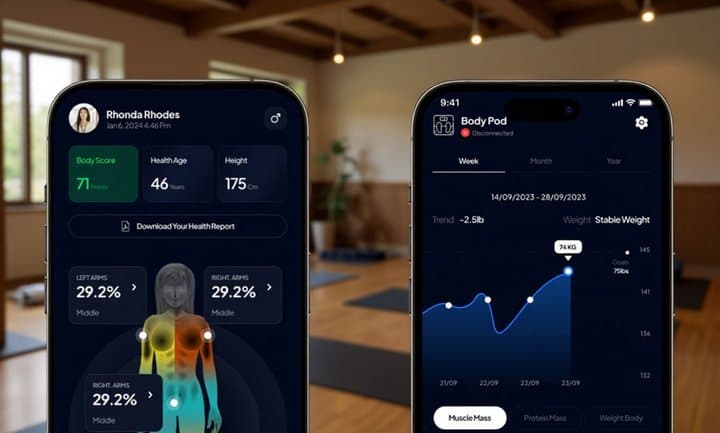
Hume Health app screens
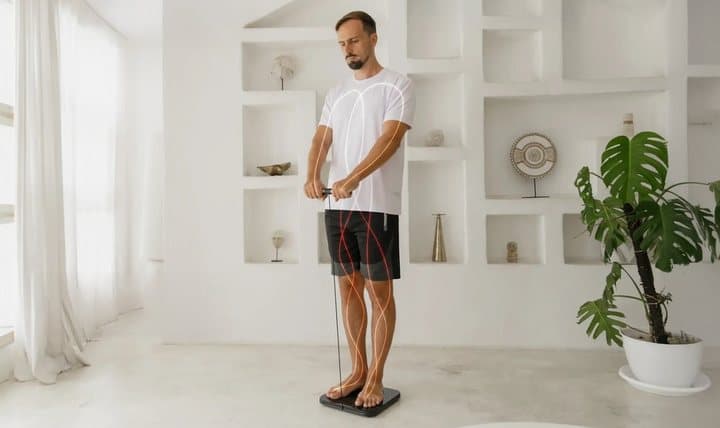
Taking a full-body reading with the handles
It does not suit people with implanted electronic devices, people who need medical measurements, or people who find detailed body numbers stressful.
Why the Hume Body Pod appeals
DEXA scans, the accepted reference for body composition in research and sports, cost money and need a clinic visit. A scale that promises similar insights every morning at home is appealing. The Body Pod looks premium, with a dark glass platform and a neat retractable handle bar, the app looks polished, and owners on the page describe readings close to DEXA scans they had done.
A typical morning with it
You get up, use the bathroom and step on the scale barefoot before eating or drinking. You pull up the handles, hold them with arms straight down, and keep still for a few seconds. The app on your phone shows today's weight, body fat and muscle, and a chart of the last few weeks. You glance at the trend line rather than today's number. That is how the FAQ recommends using it, and it is the most useful way to use any body composition scale.
Who gets the most value
People on a structured diet or training plan who weigh in daily and look at weekly trends get the most value. Households where two or three people want to track progress can share one device.
Who gets the least
People who want exact numbers, people who weigh in irregularly at different times of day, and people who only care about weight get the least. A basic scale does the last job for much less.
What it will not do
It will not measure fat as precisely as DEXA, diagnose heart conditions, tell you which foods cause inflammation, or make you lose weight faster on its own. Those outcomes depend on your diet, activity, sleep and health care.
As a gift
A body composition scale can be a sensitive gift. It suits someone who has asked for one or is actively working on fitness goals. For others, it may feel like a comment on their body.
Athletes and people who lift
People who train hard often want to know whether they are gaining muscle or fat. A hand-and-foot scale can show useful trends, but hydration swings after training, creatine use and carbohydrate loading all shift BIA readings. Weigh on rest days or always before training for the most consistent picture.
Older adults
Keeping muscle becomes more important with age, and a scale that tracks muscle mass trends can be motivating alongside strength training. The handles may help with balance when stepping on, but anyone unsteady on their feet should place the scale near something stable to hold, and make sure the glass surface is dry.
- People tracking fat loss or muscle gain who want trends beyond the number on a normal scale
- Households that want one scale for several people, each with their own account
- Data-minded users who like seeing weight, fat and muscle together in an app
Who should skip it
- Anyone with a pacemaker, implanted defibrillator or other implanted electronic device
- Pregnant people, for whom body composition readings are unreliable
- Anyone who needs medical-grade body composition or heart monitoring; see a clinician
- People prone to fixating on body numbers, for whom more metrics may not help
What do you get with the Hume Body Pod, and what does it cost?
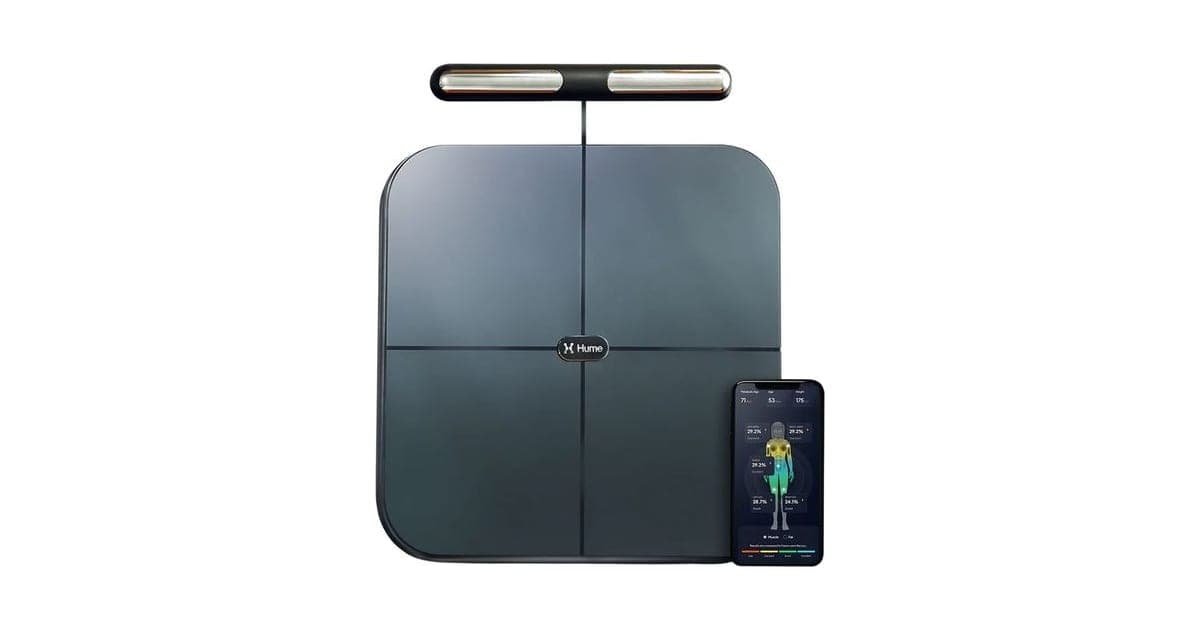
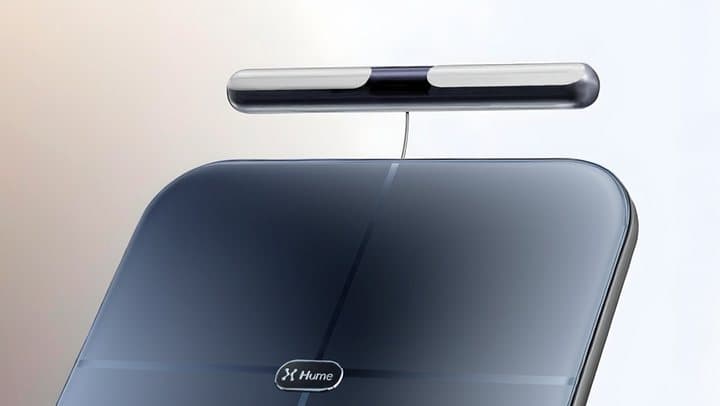
The offer page shows a square dark glass scale with metal electrode pads, a pull-up handle bar on a cable, and the Hume Health app. The page says one charge lasts a year. The FAQ gives a weight range of 6.6 lb to 400 lb.
Specifications
| Item | Detail |
|---|---|
| Type | Smart scale with hand and foot electrodes |
| Technology | Bioelectrical impedance; described as dual-frequency and 8-frequency |
| Metrics | 45+ in the Hume Health app |
| Scan time | Under 20 seconds, according to the page |
| Weight range | 6.6 to 400 lb (3 to 181.4 kg) |
| Users | Unlimited accounts; one phone connected at a time |
| Connection | Bluetooth to the Hume Health app |
| Battery | Rechargeable; one year per charge, according to the page |
| Wearable sync | Smartwatches and fitness trackers, according to the page |
| Warranty | One year |
| Guarantee | 30-day money-back |
Hume Body Pod price and bundles
On 4 October 2026 the Hume Body Pod offer page (opens Hume Health in a new tab) listed:
| Bundle | Price | Per scale | Shipping |
|---|---|---|---|
| 1 Body Pod | $229 | $229 | Free |
| Buy 1, get 1 50% off (2) | $343.50 | $171.75 | Free |
| Buy 2, get 1 free (3) | $458 | $152.67 | Free |
The buy button showed the two-scale bundle at $343.50 by default. Most households need only one scale, since it supports unlimited users.
Hume Health's own store
Hume Health's store data, checked the same day, listed several Body Pod products: a Body Pod at $229 (compare-at $299), other Body Pod listings at $352 and $366, Body Pod 2.0 listings at $383.50, versions bundled with a lifetime warranty, and a separate lifetime warranty add-on for $35. The store also sells the Hume Band wearable.
What this means for you: the offer page's $229 matched the lowest Body Pod price we saw in Hume's store data. Check whether the offer page sends the original Body Pod or the newer 2.0, which was listed separately at a higher price.
The app and its costs
The FAQ says the Hume Health app is free for essential features including weigh-ins, measurements and progress tracking. The page also promotes 24/7 AI coaching and weekly reports. App Store in-app purchase listings for the Hume Health app show paid plans, including Hume Plus at $99.99 a year in the US, among other monthly and annual options.
What this means for you: budget for a subscription if you want the coaching features the page highlights. The scale works for basic tracking without one.
Is it good value?
At $229, the Body Pod costs more than foot-only smart scales and less than some premium hand-and-foot scales from long-established brands. Its handle bar is a genuine upgrade over foot-only designs for whole-body estimates. Whether it is good value depends on whether you will use the trends and whether you add a subscription.
Total cost over two years
If you buy one Body Pod at $229 and add Hume Plus at $99.99 a year, two years of use costs about $430. Without a subscription, it is $229. Compare that with a few DEXA scans, which many clinics and sports centres offer for a per-scan fee, and decide which gives you more useful information for your goals.
Data and privacy
Body composition, weight and heart rate are personal health data. Hume's app syncs with wearables and stores your history in your account.
What this means for you: read the app's privacy policy, check what is shared with other apps, and use the export or delete options if you stop using it.
Who makes it
Hume Health sells health hardware and an app, including the Body Pod and the Hume Band. Its store data lists Wilmington, Delaware. App Store listings show the app's subscriptions include items carrying FitTrack names, a brand of smart scales that appears linked to the same app.

Hume Body PodScore 5.2/10
Best for: People tracking fat loss or muscle gain who want trends beyond the number on a normal scale
$229.00 at Hume Health · Price checked October 4, 2026
Check price at Hume Health (opens Hume Health in a new tab)We may earn a commission if you buy through our links.
How accurate is the Hume Body Pod?
The Hume Body Pod is best treated as a trend tool, not a precise measurement. Like every home impedance scale, it estimates fat and muscle from how a small current flows through your body, so hydration, meals, exercise and even your grip on the handles change the reading. Its handles add arm and torso measurements, but Hume's "98% comparable to DEXA" figure is not backed by published independent data.
Nobody on our team has used the Body Pod, so this section is based on how impedance scales work, what research says about their limits, and what owners and other reviewers report.
What DEXA is, and why it is the reference
DEXA (dual-energy X-ray absorptiometry) uses two low-dose X-ray beams to estimate bone, fat and lean tissue directly. It is widely used in research and sports science as a reference method. It is not perfect, but it is far less affected by hydration than BIA.
Why home BIA is less accurate
BIA does not measure fat directly. It measures how easily current flows and plugs that into equations built from populations of people. Your hydration, recent meals, exercise, alcohol, skin temperature and even how you hold the handles change the reading. Published research and manufacturer guidance list fever, heavy drinking, intense exercise, large meals, lots of water, baths and saunas as things that make readings less accurate.
What Hume claims
The page says "clinical-grade 98% accuracy" and "98% accuracy comparable to DEXA scans", and the gallery adds "99%" compared with a medical-grade analyser. A review summary we found notes that Hume's own materials give several different accuracy figures. Without a published independent study describing how accuracy was measured, these numbers cannot be checked. A "98%" figure can also mean very different things depending on whether it compares averages across a group or individual readings.
What owners and reviewers say
Owners on the page say readings were close to their own DEXA scans and to a doctor's office scale, and that results were consistent. One review summary of independent testing reported body fat readings that differed substantially from DEXA. Experiences vary, which is typical for BIA.
Where it is most useful
For tracking direction over weeks and months, measured consistently, impedance scales work well. If your body fat estimate falls steadily while your weight stays the same, that is a meaningful signal even if the exact percentage is off by a few points.
Where it is least useful
Day-to-day changes, single readings, comparisons between different scales, and anyone whose hydration varies a lot, such as athletes after training or people on diuretics.
How big are typical BIA errors?
Studies comparing consumer impedance scales with reference methods commonly find individual body fat estimates several percentage points away from DEXA, with some people much further out, even when the average across a group looks close. That is why a scale can claim high agreement on average while an individual sees a big difference. It is also why the same person can get a different body fat reading on two scales from different brands.
Making the most of an imperfect number
The practical answer is consistency. Same scale, same time, same conditions, and a focus on the trend over weeks. If your body fat estimate drops from 30% to 27% over three months on the same scale under the same conditions, the real change is probably in that direction even if the true numbers are different.
Are Hume's claims true?
Hume's basic claims are plausible: the app shows 45+ metrics and an under-20-second scan is believable. The bigger claims are not supported. "Clinical-grade 98% accuracy comparable to DEXA" has no published independent study behind it, "12X faster" results are unsourced, a scale's heart rate reading cannot catch serious heart problems, and no scale can show which foods cause inflammation.
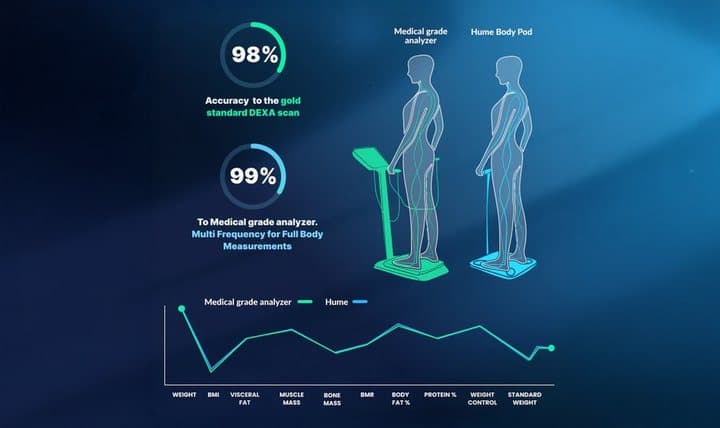
"Clinical-grade 98% accuracy comparable to DEXA"
Not supported by published independent data. Hume's own figures vary, and BIA is inherently less accurate than DEXA for individuals.
"Achieve your health goals 12X faster" and "break through weight plateaus 12X faster"
Unsourced. A scale can help you track progress; it does not change how fast your body loses fat.
"Tracks 45+ health metrics"
Plausible as a count of displayed metrics. Most are calculated from the same few measurements.
"Built-in heart rate monitor... detect irregularities... catch potentially serious problems"
Overstated. A scale's heart rate reading is not a diagnostic test. If you have symptoms such as chest pain, palpitations, fainting or breathlessness, see a doctor.
"Discover which foods cause inflammation"
Not something a scale can measure. Daily weight and water changes after meals reflect salt, carbohydrate and fluid, not inflammation.
"Uses multiple frequencies to penetrate deeper tissue layers, 2X more accurate"
Multi-frequency BIA can improve some estimates. The "2X" figure has no source, and the page uses both "dual" and "8" frequency.
"One-year battery life per charge"
Plausible for a scale used briefly each day. We could not verify it.
"1,200,000+ happy customers" and "1.2 million success stories"
Unsourced.
"The same technology hospitals use"
BIA is used in some clinical and research settings, usually with stricter protocols and validated equations. Shared technology does not mean shared accuracy.
Claims scorecard
| Claim | Our view |
|---|---|
| 98% DEXA accuracy | Not supported |
| 12X faster results | Unsourced |
| 45+ metrics | Plausible, mostly calculated |
| Detects heart irregularities | Overstated |
| Finds foods that cause inflammation | Not possible |
| Multi-frequency, 2X accuracy | Unclear |
| One-year battery | Plausible |
| 1.2 million customers | Unsourced |
Is the Hume Body Pod better than a basic smart scale or a DEXA scan?
The Hume Body Pod beats a foot-only smart scale for arm and torso estimates, because its handles measure the upper body. If you mostly track weight, a cheaper basic scale is enough. A DEXA scan every few months is far more reliable for body composition, and some people pair the two. A weekly waist measurement is a cheap, dependable check on fat loss alongside any scale.
| Option | Typical cost | Accuracy | Convenience | Notes |
|---|---|---|---|---|
| Hume Body Pod | $229 | Trend tool | Daily at home | Handles add arm and torso readings |
| Foot-only smart scale | Lower | Lower for upper body | Daily at home | Good for weight trends |
| Other hand-and-foot smart scales | Similar or higher | Similar | Daily at home | Compare apps and fees |
| Professional BIA analyser (gym, clinic) | Per scan | Better protocol | Occasional | Same principle, stricter setup |
| DEXA scan | Per scan | Reference | Clinic visit | Small radiation dose |
| Tape measure and photos | Free | Rough | Weekly | Surprisingly useful for trends |
Hume Body Pod vs a basic smart scale
Foot-only smart scales cost less and track weight well. Their body fat estimates rely mostly on the lower body. If you mostly care about weight, a basic scale is enough. If you want arm and torso estimates, the Body Pod's handles are the upgrade.
Hume Body Pod vs other hand-and-foot scales
Several brands sell eight-electrode scales with handles. Compare the price, whether the app needs a subscription, how data can be exported, and the company's support record.
Hume Body Pod vs DEXA
A DEXA scan every few months gives a more reliable snapshot; a scale every morning shows trends between scans. Some people use both: DEXA to anchor the numbers, a scale for day-to-day direction.
Hume Body Pod vs a tape measure
Waist measurement is cheap, quick and linked to health risk in its own right. Measuring your waist weekly alongside weight is a simple, reliable way to track fat loss.
Other health gadgets we have reviewed
Our Hale breathing review covers a nasal dilator, our Moksha Beam review looks at a light therapy device, and our CoolCura review covers a cooling device. Our AirPhysio review looks at a breathing device. You can browse the rest in our health gadgets category.
Hume Body PodScore 5.2/10
Why people buy it: Handles plus foot pads measure through arms, torso and legs, which is generally more informative than foot-only smart scales
$229.00 at Hume Health · Price checked October 4, 2026
Check price at Hume Health (opens Hume Health in a new tab)We may earn a commission if you buy through our links.
Is the Hume Body Pod legit, and what should you check before buying?
Hume Health is a real company with 6,477 Trustpilot reviews and a 3.5 score, and the Body Pod is a working smart scale. Before buying, note that people with pacemakers or other implanted electronic devices should not use its electrodes, readings are unreliable in pregnancy, and coaching needs a paid Hume plan. Owners report slow support and returns, so keep the packaging during the 30-day guarantee.
Implanted medical devices
The electrical signal is tiny, but impedance scale makers widely warn against use with pacemakers, implanted defibrillators and other implanted electronic devices.
What to do: if you have any implanted electronic device, do not use the handle or foot electrodes; ask your cardiologist or device clinic. Some scales offer a weight-only mode; ask Hume support whether the Body Pod does.
Pregnancy
Body composition readings are unreliable in pregnancy, and many makers advise against impedance measurements during pregnancy.
What to do: if you are pregnant, use weight only or pause body composition tracking, and follow your midwife or doctor's advice.
Health decisions
The page encourages using the scale to improve heart health and manage weight.
What to do: use the scale for motivation and trends. Talk to a doctor about any health condition, and do not change medication based on scale readings.
Eating disorders and body image
Detailed body numbers every day can be unhelpful for some people.
What to do: if you have a history of disordered eating, or notice the numbers making you anxious, consider weighing less often or hiding body composition metrics, and speak to a health professional.
The subscription
Coaching and some features are paid.
What to do: check which features you will use before starting a trial, note when any trial ends, and set a reminder to cancel if you do not want to continue.
Support and returns
Trustpilot reviewers describe slow support and difficult returns.
What to do: test the scale in the first week, contact support in writing if anything is wrong, and keep the box for the 30-day window.
Which model you receive
Hume's store lists both the original Body Pod and a 2.0 version.
What to do: check the order confirmation for the model, and ask support if it is unclear.
Floors and placement
Scales read most accurately on hard, level floors. Carpet, rugs and uneven tiles can affect weight readings.
What to do: keep the scale in one place on a hard floor and avoid moving it between rooms. If you must move it, zero it before weighing.
Slippery glass
Glass platforms can be slippery with wet feet.
What to do: dry your feet before stepping on, especially after a shower, and keep a non-slip mat beside the scale.
How to buy the Hume Body Pod the smart way
- Make sure nobody in your household has an implanted electronic device, then order from the Hume Body Pod order page (opens Hume Health in a new tab).
- Choose one scale; it supports unlimited users, and the two-pack is preselected.
- Decide whether you want a paid app plan, and check its price before any trial.
- Note the 30-day guarantee and one-year warranty, and keep all packaging.
- Set up each person's account and weigh in at the same time each day.
What do owners say, and how did we score the Hume Body Pod?
The Hume Body Pod scores 5.2 out of 10: claim accuracy 0.6, build durability 1.2, price competitiveness 1.1, usability 1.4 and owner satisfaction 0.9, each out of 2. On Trustpilot it shows 3.5 from 6,477 reviews, with 52% five-star and 29% one-star. Owners praise the tracking features and easy setup; complaints focus on slow support, connection problems, faulty units and difficult returns.
Reviews on the page
The offer page shows about 20,000 reviews and four testimonials. Owners describe a year of daily use, readings close to DEXA and doctor's office scales, durable glass, and easy setup. One owner who previously used a Withings scale says the Body Pod was closer to DEXA. One notes you need to zero the scale after moving it.
Trustpilot
On 4 October 2026 the Trustpilot profile for humehealth.com showed a TrustScore of 3.5 from 6,477 reviews: 52% five-star and 29% one-star. Praise focuses on tracking features and easy setup. Complaints focus on slow or absent support, connectivity problems, faulty units and difficult returns. Trustpilot shows the company replies to most negative reviews.
What the reviews agree on
The scale and app work well for many people. Problems are concentrated in support, returns and connection reliability, which matter for a device that relies on an app.
Reading the testimonials
The four testimonials on the page are unusually detailed for an offer page. One owner describes a year of daily use; another compares the Body Pod with a Withings Body Scan and a DEXA scan; another explains the need to zero the scale after moving it. That level of detail reads like genuine owner feedback. They are still selected by the seller, and owners who had poor experiences are more likely to be found on Trustpilot.
Connectivity complaints
Several Trustpilot reviewers describe the scale failing to connect or sync. Bluetooth scales depend on the phone, the app version and the phone's permissions. If you have trouble, check the app has Bluetooth and location permissions, close the app on other phones, and update the app before assuming the scale is faulty.
What we would test with the Body Pod in hand
If we test it ourselves, we will compare readings with a DEXA scan on several people, check consistency across repeated readings, test Bluetooth reliability with multiple users, and look at which features need a subscription. We will update this review with the results.
How we scored the Hume Body Pod
Every score on the site follows the five criteria on our how we test page.
| Criterion | Score | Why |
|---|---|---|
| Claim accuracy | 0.6 / 2 | 98% DEXA, 12X faster, heart and inflammation claims overreach |
| Build durability | 1.2 / 2 | Glass platform, handle bar, one-year warranty |
| Price competitiveness | 1.1 / 2 | Matches Hume's lowest store price; subscription extra |
| Usability | 1.4 / 2 | Quick scan, unlimited users, clear app |
| Owner satisfaction | 0.9 / 2 | Product liked; Trustpilot 3.5 with many support complaints |
| Total | 5.2 / 10 |
The score would rise with published independent accuracy data, claims limited to what a scale can do, and clearer subscription pricing on the page.
What we did, and did not, do
We read the offer page and FAQ, Hume Health's store data, App Store in-app purchase listings, the Trustpilot profile and research summaries on BIA limits, all on 4 October 2026. Nobody on our team has used the Body Pod, and no figures here come from our own testing.
How to use the Hume Body Pod for the best results
Place the scale on a hard, flat floor, pair it with the Hume Health app and weigh in at the same time each morning, after using the bathroom and before eating or drinking. Step on barefoot with clean, dry feet, pull up the handles with your arms straight down and stay still until the reading finishes. Avoid weighing after exercise, a sauna, alcohol or a large meal.
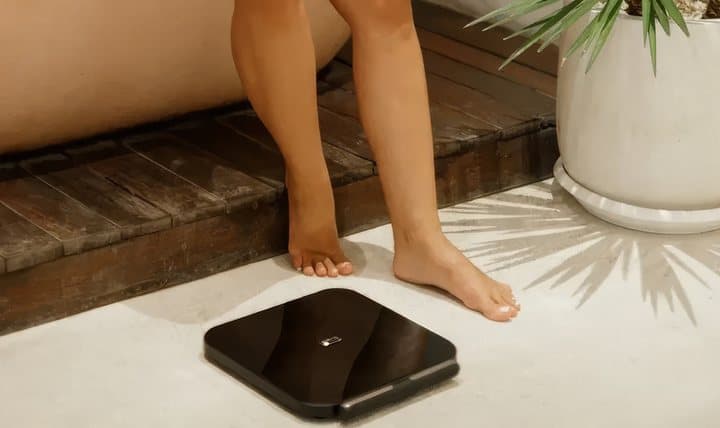
Stepping on barefoot
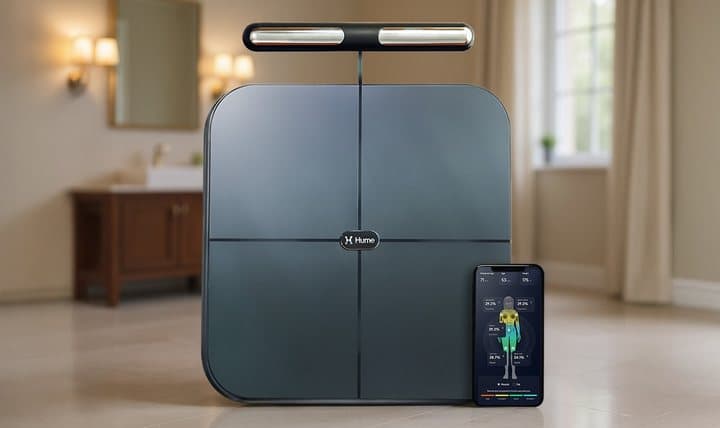
The scale and app result
- Place the scale on a hard, flat floor, not carpet.
- Download the Hume Health app, create your profile and pair the scale.
- Weigh in at the same time each morning, after using the bathroom and before eating or drinking.
- Step on barefoot with clean, dry feet centred on the electrodes.
- Pull up the handles and hold them with arms straight down, not touching your body.
- Stay still until the reading finishes.
- Look at weekly averages and trends rather than daily numbers.
Getting consistent readings
Avoid weighing after exercise, a sauna, a hot shower, alcohol or a large meal. Keep your profile details accurate, especially height and age. If you move the scale, zero it as an owner on the page describes before stepping on.
Setting up family accounts
Each person needs their own Hume account and profile. The scale connects to one phone at a time, so close the app on other phones when someone else weighs in.
Reading the metrics
Focus on a few: weight, body fat percentage, muscle mass and waist measurement if you add it. Ignore metabolic age and other derived numbers if they confuse more than help.
Pairing the scale with habits
The scale does not change your body; your habits do. Use it alongside a simple plan: regular meals with plenty of protein and vegetables, strength training two or three times a week, daily walking and enough sleep. Check the trend every week or two and adjust one habit at a time.
Weighing when travelling
Your readings will shift when your routine changes, such as on holiday or during illness. Do not read too much into readings taken at those times; wait until you are back to your normal routine.
Using a subscription wisely
If you start a trial, decide in advance which features you want to test, and check before it renews whether you used them.
Troubleshooting
| Problem | Likely cause | What to try |
|---|---|---|
| Readings jump day to day | Hydration, food, timing | Weigh at the same time; use weekly averages |
| Will not connect | Bluetooth or another phone connected | Close the app on other phones; restart Bluetooth |
| Weight seems off | Uneven floor or moved scale | Use a hard floor; zero the scale |
| Body fat seems high or low | BIA estimate | Compare trends, not absolutes |
| No body composition | Feet or hands not on electrodes | Stand barefoot; grip handles fully |
| Wrong user recorded | Shared phone | Use separate accounts and phones |
Hume Body PodScore 5.2/10
Before you buy: Check the final price, shipping and return terms at checkout.
$229.00 at Hume Health · Price checked October 4, 2026
Check price at Hume Health (opens Hume Health in a new tab)We may earn a commission if you buy through our links.
What else do people ask about body composition scales?
Most questions are about accuracy and safety. Home body composition scales are useful for trends but can be several percentage points off for individuals, and readings shift with water intake, so consistent timing matters. Impedance scales are safe for most people because the current is very small, but not for anyone with an implanted electronic device, and readings are unreliable in pregnancy. A scale cannot replace a doctor's check-up.
Are smart scales accurate for body fat?
They are useful for trends but can be several percentage points off for individuals. Accuracy improves with consistent conditions.
What is a healthy body fat percentage?
Healthy ranges vary with age and sex, and different organisations publish different charts. Rather than chasing a specific figure from a scale, use the trend and your waist measurement, and ask your doctor what is sensible for you.
Can the Body Pod measure children?
The FAQ gives a minimum measurement weight of 6.6 lb, but body composition equations are generally designed for adults. Use weight only for children unless a health professional advises otherwise.
Is BIA safe?
For most people, yes; the current is very small. It is not recommended for people with implanted electronic devices, and readings are unreliable in pregnancy.
Why does my body fat change after drinking water?
More water lowers impedance, which the equations read as less fat. That is why consistent timing matters.
Should I weigh myself every day?
Daily weighing works for some people because it smooths out fluctuations into a trend. Others find weekly weigh-ins less stressful. Choose what keeps you consistent and calm.
Does the Body Pod work with Apple Health or Google Fit?
The page says it syncs with smartwatches and fitness trackers. Check the Hume Health app's listing for the specific platforms it supports before buying if this matters to you.
How long does the battery take to charge?
The page says one charge lasts a year but does not give a charging time or say which cable is used. Check the quick start guide when it arrives, and charge it fully before setting up.
Is the glass strong enough?
Smart scale platforms are usually made from tempered glass rated for the stated maximum weight, here 400 lb. One owner on the page describes the glass and feet as durable after long use. Avoid dropping heavy objects on it and do not stand on the edges.
Can I use it with wet feet?
The electrodes need skin contact, and slightly damp feet can actually improve contact, but wet glass is slippery. Dry your feet for safety and consistent readings.
Why does the app show a different body fat from my gym's analyser?
Different devices use different electrodes, frequencies and equations. Readings from two devices are rarely identical; compare each device only with itself.
What is visceral fat?
Fat stored around the organs in the abdomen. Scales estimate it from equations; waist measurement is a simple, well-studied alternative indicator.
Can a smart scale replace a doctor's check-up?
No. It can show trends and prompt questions to ask your doctor, but it cannot diagnose anything.
Do I need the subscription?
Not for basic weighing and tracking, according to the FAQ. Coaching and some features are part of paid plans.
Is the Hume Body Pod worth it?
If you want a well-made hand-and-foot scale for tracking trends and can use it consistently, it is a reasonable choice at $229, the same as Hume's lowest store price. Treat the accuracy and health claims as marketing, and factor in any subscription.
Frequently asked questions
What is the Hume Body Pod?
It is a smart scale with a pull-up handle bar, made by Hume Health. It uses bioelectrical impedance through your hands and feet to estimate body fat, muscle, water and other measures, which it sends to the Hume Health app.
How much does the Hume Body Pod cost?
On 4 October 2026 the offer page listed one Body Pod at $229, two for $343.50 and three for $458, all with free shipping. Hume's own store data listed several Body Pod products, the cheapest also at $229.
Is the Hume Body Pod as accurate as a DEXA scan?
No home scale is. The page claims 98% accuracy compared with DEXA, but Hume has not published independent validation we could find, and BIA readings change with hydration, food and exercise. Use it for trends rather than exact figures.
Is the Hume app free?
The FAQ says the app is free for essential features such as weigh-ins and progress tracking. App Store listings show paid Hume plans, including Hume Plus at $99.99 a year, which unlock extra features such as coaching. Weigh-ins and basic trends work without paying.
Can more than one person use it?
Yes. Each person uses their own Hume account. The FAQ notes that the scale connects to one phone at a time by Bluetooth, so other users may need to close the app. Most households need only one scale, since it supports unlimited users.
Who should not use the Hume Body Pod?
People with pacemakers or other implanted electronic medical devices should not use impedance scales, because of the small electrical current. Readings are also unreliable in pregnancy. Ask your doctor if unsure. Some scales offer a weight-only mode; ask Hume support whether the Body Pod does before relying on it.
What is the weight limit?
The FAQ says the maximum is 400 lb (181.4 kg) and the minimum is 6.6 lb (3 kg). Body composition equations are generally designed for adults, so use weight only for children unless a health professional advises otherwise.
What is the return policy?
The offer page shows a 30-day money-back guarantee and a one-year warranty. Some Trustpilot reviewers describe slow returns, so keep the packaging and your order confirmation. Contact support before sending anything back, and test the scale early in the window.
We may earn a commission if you buy through our links.
This content is for informational purposes and is not medical advice. Talk to a qualified professional before using any product that affects your health.
Prices accurate as of October 4, 2026. Check the seller's checkout for current pricing, promotions and terms.
What we checked: No hands-on use. Claims, prices, bundles, FAQ answers, guarantee, warranty, testimonials and images from the Hume Body Pod offer page our link opens (gethumebodypod.com) on 2026-10-04. Store product list and prices from Hume Health's store data the same day. App pricing from App Store in-app purchase listings for the Hume Health app; owner sentiment from the Trustpilot profile for humehealth.com (3.5 from 6,477 reviews on 2026-10-04); impedance scale safety and accuracy limits from manufacturer safety guidance and published research summaries. Promotional press releases about the product were read and treated as advertising.

About the author
James Wilson, Consumer Tech Writer
James Wilson covers health and wellness technology for Top10Gadgets: breathing devices, massagers, hearing aids, dental and weight-loss products, and the other gadgets sold with a promise to make life easier. James write…
- Health and wellness gadgets
- Over-the-counter hearing aids
- Breathing and massage devices
- FDA clearance and registration
- Tech for beginners
Writing for Top10Gadgets since 2026Full profile