Health Gadgets / Pain relief
Kinzeno V2 Review: Is the Magnetic Gel Roller Worth It?
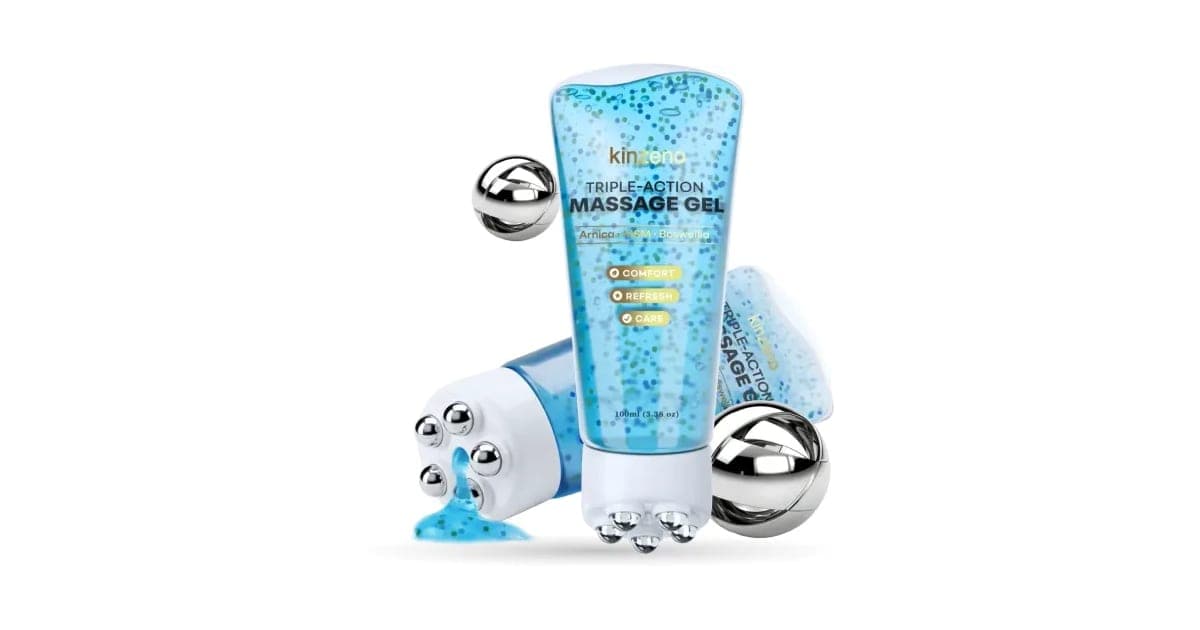
A 100 ml massage gel with a five-ball magnetic roller cap. The roller and the menthol are genuinely useful, but the magnetic therapy the brand is named for has been tested and failed.

By James Wilson, Consumer Tech Writer at Top10Gadgets
Updated 27 min readHow we test
Quick answer
Worth it if you want a clean, hands-free way to apply a menthol and arnica gel to your own back or shoulders, and you ignore the magnets entirely. The roller cap is a genuinely good piece of design for anyone with sore hands or a hard-to-reach ache.
Score 5.5/10INR 4817.00 at Kinzeno
See Kinzeno bundles and prices (opens Kinzeno in a new tab)We may earn a commission if you buy through our links.
- Best for
- People who want a topical massage gel they can apply to their own back or shoulders without help and without greasy hands
- Not for
- Anyone with a pacemaker, implantable defibrillator, cochlear implant or insulin pump: the brand itself says do not use it
INR 4817.00 at Kinzeno
See Kinzeno bundles and prices (opens Kinzeno in a new tab)We may earn a commission if you buy through our links.
On this page · 13 sections
- 01Our verdict
- 02The short version
- 03Pros & cons
- 04How it works
- 05Who it's for
- 06What does Kinzeno V2 cost, and why can't you see a price first?
- 07Do moving magnets actually relieve pain?
- 08Which Kinzeno ingredients have real evidence behind them?
- 09Is Kinzeno V2 better than a drugstore gel or a massage roller?
- 10Is Kinzeno legit, and what should you check before buying?
- 11How did we score Kinzeno V2?
- 12How to use Kinzeno V2 for the best results
- 13Frequently asked questions
Our verdict
Worth it if you want a clean, hands-free way to apply a menthol and arnica gel to your own back or shoulders, and you ignore the magnets entirely. The roller cap is a genuinely good piece of design for anyone with sore hands or a hard-to-reach ache. But the magnetic therapy Kinzeno is named for has been tested in placebo-controlled trials and did not beat dummy magnets, two "clinically studied" ingredients were studied as oral doses rather than gels, and the checkout hides the price, localises your currency and carries a recurring-purchase option. Kinzeno V2 scores 5.5 out of 10, held back by a headline mechanism the evidence does not support.
The short version
- A 100 ml (3.38 fl oz) gel tube with a five-ball magnetic roller cap that turns 360 degrees.
- The applicator is the real product: no hands, no residue, reaches your own back.
- Menthol and arnica have legitimate topical evidence; the magnets do not.
- A meta-analysis of nine placebo-controlled trials found static magnets no better than dummies.
- Boswellia and MSM are "clinically studied" at oral doses, not as a topical gel.
- Advertised at "up to 70% off", while the checkout bundles showed 25% to 55%.
- No price before checkout; currency and language set by your location.
- Trustpilot: 4.4 from 381 reviews, 90% four or five star, 4% one star.
- Complaints cluster on add-ons and unwanted subscriptions, not on delivery.
- 60-day guarantee on unused product only, return postage at your cost.
Pros & cons
The split here is unusually clean. Almost everything good about Kinzeno V2 is about the applicator and the two ingredients with real topical evidence. Almost everything poor is about the claims layered on top and the way the product is sold.
What we like
- The roller cap genuinely solves a real problem: you can treat a shoulder blade or lower back without twisting a sore arm or getting gel on your hands
- Menthol is a recognised topical analgesic, listed in the FDA's over-the-counter monograph for external analgesics at 1.25 to 16%
- Arnica gel has reasonable trial support, with one hand osteoarthritis study finding it comparable to an ibuprofen gel
- Trustpilot shows 4.4 from 381 reviews, with 90% at four or five stars and only 4% at one star
- The brand states the pacemaker contraindication plainly and carries a correct "not intended to diagnose, treat, cure or prevent" disclaimer
- 360 degree rolling head, odour-free formula and no residue, so it fits into a workday
What we don't
- The magnetic therapy the product is built around failed its biggest test: a meta-analysis of nine placebo-controlled trials found no meaningful pain difference versus dummy magnets
- Boswellia and MSM are called "clinically studied", but those trials used oral doses, not a gel rubbed on the skin
- The page advertises "up to 70% off", yet the four bundles in the checkout data showed 25%, 33%, 46% and 55%
- No price appears until the order step, and the currency and language are set by your location, not your choice
- The checkout carries a recurring-purchase option, and Trustpilot reviewers report unwanted add-ons and accidental subscriptions
- The 60-day guarantee covers unused product only, and return postage is yours to pay
Sold by Kinzeno
Kinzeno V2INR 4817.00
How it works
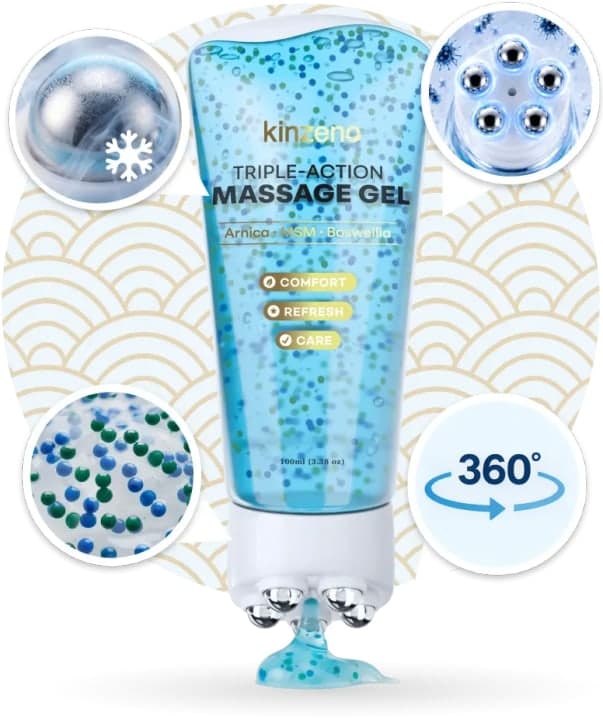
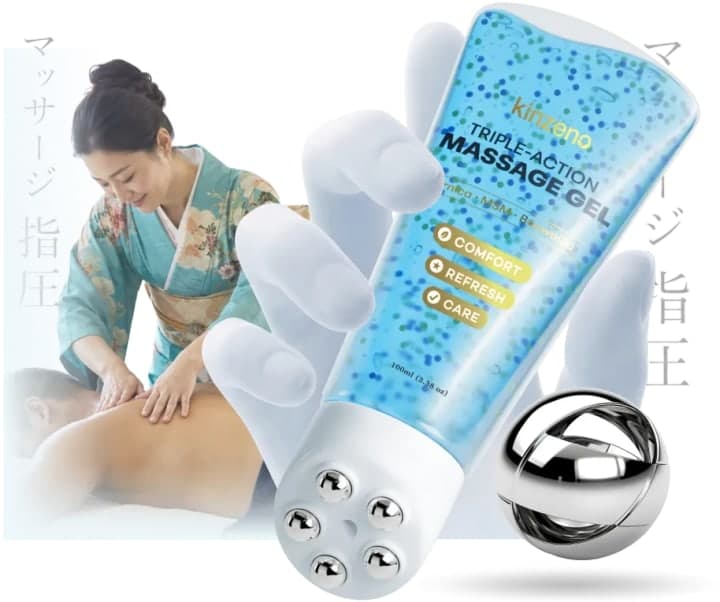
Kinzeno V2 is a tube of gel whose cap is a rotating head set with five chrome-finished neodymium balls. You press the head to your skin and roll. The gel feeds out between the balls, so the rollers massage and spread it at the same time and your fingers never touch it. That combination, a counterirritant gel plus light mechanical massage, is the part that works.
Roll it onto the sore area
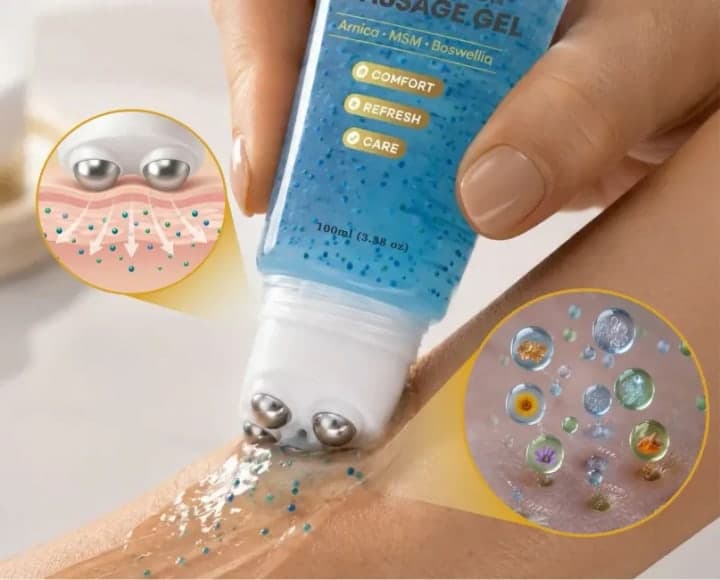
Step 1: Press the five-ball head against the skin and roll. The gel feeds out between the balls, so your hands stay clean and you can reach a shoulder blade or the back of a knee without contorting.
The balls knead, the menthol cools
Step 2: The rolling gives a light mechanical massage while menthol produces the familiar cooling sensation. Both are ordinary, understood effects that do not depend on the magnets.
Repeat through the day
Step 3: The brand says the formula is safe to repeat two to four times daily. It suggests a cooling sensation first, then an easing of everyday aches with consistent use.
The brand adds a third mechanism on top: a "shifting magnetic field" from the moving neodymium balls, which it says "may affect nerve activity". That is the claim this review spends most of its time on, because it is the one the product is named and priced for, and it is the one the evidence does not support. We cover it in full under the magnet question below.
Who it's for
This suits a narrower buyer than the marketing suggests, and that buyer is real. If reaching your own lower back or shoulder blade with a normal tube is awkward, or if arthritic hands make squeezing and rubbing the painful part of applying a gel, the applicator is doing genuine work for you. People in that position often get more practical value from Kinzeno V2 than from a stronger gel in a harder-to-use package.
- People who want a topical massage gel they can apply to their own back or shoulders without help and without greasy hands
- Anyone who already finds menthol rubs useful and would rather not touch the gel or wash their hands afterwards
- People with arthritic or sore hands, for whom squeezing and rubbing a normal tube is itself the painful part
- Buyers who treat it as a nicer applicator for a familiar type of gel, not as a treatment
Who should skip it
- Anyone with a pacemaker, implantable defibrillator, cochlear implant or insulin pump: the brand itself says do not use it
- People buying it for the magnetic therapy, which placebo-controlled trials have not supported
- Anyone with new, severe or unexplained pain that a clinician has not assessed
- Buyers who want a clear price before checkout, or who are wary of a recurring-purchase option
The first of those is not a cautious suggestion from us. The brand states it directly: if you have a pacemaker, implantable defibrillator, cochlear implant, insulin pump or any other implanted electronic medical device, do not use this product. Credit where it is due, Kinzeno puts that warning in its own words on the offer page rather than burying it.
What does Kinzeno V2 cost, and why can't you see a price first?
There is no price on the offer page at all. The pricing appears only at the order step, and it is set by your location rather than your choice. Checked on 8 October 2026 from our location, the site served Indian pricing: 4,817 rupees for one tube, 8,670 for two, 10,404 for three and 11,560 for four, plus 862 rupees for standard delivery. The checkout data carried an underlying list price of 66.66 US dollars per tube.
What you actually receive
One tube, 100 ml (3.38 fl oz), with the roller head as its cap. The gel and applicator are a single unit, not a separate jar and tool. Some third-party write-ups describe a "V2 kit" with a jar, a separate applicator and a sleeve. The product our affiliate link opens is the tube pictured above, so treat those kit descriptions with caution.
The discount that does not match
The page is headed "up to 70% off" and repeats that figure throughout. The four bundles in the site's own checkout data showed discounts of 25% for one tube, 33% for two, 46% for three and 55% for four. None reached 70%. A discount figure that the deepest bundle still misses by fifteen points is the kind of detail worth noticing before you judge any other number on the page.
Shipping is not always free
The delivery section displays "Free Shipping" labels, but the checkout data we read also included a standard delivery line at 862 rupees. Whether you pay it may depend on country and bundle size. Check the order total on the final screen rather than trusting the label.
The recurring-purchase option
This is the part to slow down for. The checkout template includes wording for a deferred, subscription or recurring purchase, including the line "Billed every month. Cancel anytime. No hidden fees." A one-off tube of massage gel does not obviously need a monthly plan, and as the owner evidence below shows, this is exactly where buyers report going wrong.
The bundle maths
The four-tube bundle drops the per-tube price by about 40% against buying one, which is a real saving if you were always going to use four tubes. The catch is that four tubes of a gel you have never tried is a large commitment to a product whose central claim does not hold up, and the 60-day guarantee covers unused product only. Buying one and reordering costs more per tube and risks far less.
How long one tube lasts
Nobody publishes a figure, and it depends entirely on how much area you treat. A 100 ml tube used two to four times a day on a single knee will last considerably longer than the same tube used on a whole back. The checkout quotes a price per day, which implies a 30-day expectation per tube at the bundle sizes offered. Treat that as a marketing assumption rather than a measured figure.
Is the price reasonable?
Measured as a massage gel, no. A 100 ml tube at a list price near 67 US dollars is many times what a drugstore menthol or arnica gel costs. Measured as a gel plus a well-made applicator you will reuse, it is less extreme, though a plain roller-ball bottle costs a few dollars. Our view is that you are paying a large premium for the magnets, which is the one component that does nothing.
Because the figure depends on where you are, the only way to know your own price is to open the Kinzeno order step (opens Kinzeno in a new tab) and read it in your currency before committing to anything.

Kinzeno V2Score 5.5/10
Best for: People who want a topical massage gel they can apply to their own back or shoulders without help and without greasy hands
INR 4817.00 at Kinzeno · Price checked October 8, 2026
See Kinzeno bundles and prices (opens Kinzeno in a new tab)We may earn a commission if you buy through our links.
Do moving magnets actually relieve pain?
No, on the best evidence available. A meta-analysis published in the Canadian Medical Association Journal pooled nine placebo-controlled trials of static magnets and found a weighted mean difference of about 2 mm on a 100 mm pain scale against placebo, which is far too small to notice. The authors concluded magnets could not be recommended for pain. The National Center for Complementary and Integrative Health states plainly that static magnets have not been shown to treat pain.
What the brand claims
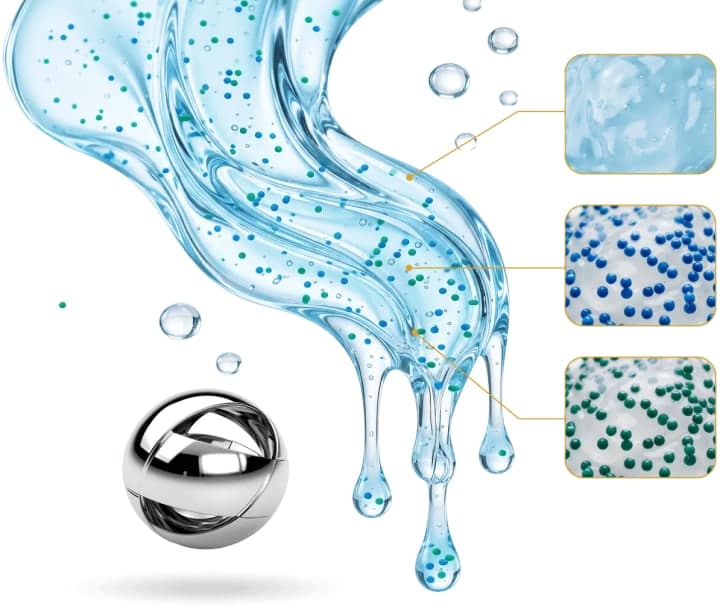
Kinzeno is careful with its wording here. The page says five neodymium balls "create a shifting magnetic field that enhances every massage experience for fast-acting relief", and that "exciting studies suggest this field may affect nerve activity". Note the hedge: "suggest", "may". The brand never names a study, and we could not find one supporting a hand-rolled magnet as a pain treatment.
Does a moving magnet change the answer?
This is the strongest version of Kinzeno's case, so it deserves a fair hearing. A rolling magnet does produce a varying field rather than a constant one, and pulsed electromagnetic field therapy, which is a different and much more powerful technology, has a more interesting research record. But the field from a small permanent magnet rolled across skin is weak and shallow, and it is nothing like the clinical devices in that research. Borrowing credibility from pulsed field studies is not justified here.
What the Cochrane evidence adds
A Cochrane review of chronic neck pain found magnetic necklaces no more effective than placebo. A separate Cochrane review of pelvic pain found no difference between magnetic therapy and a control magnet, rating the evidence quality as very low. Different body areas, same result. When several independent reviews converge, that is usually the answer rather than a gap in the research.
How strong is that field anyway?
Kinzeno publishes no field strength for its balls, which is itself informative. Magnetic field strength falls away steeply with distance, and a small permanent magnet's useful range is measured in millimetres. Between the ball and anything that might matter sits a layer of gel, the skin, and usually some fat. Even if a magnetic field could influence nerve activity, the field reaching a knee joint or a sciatic nerve from a rolling ball is vanishingly small.
What regulators have done about magnet claims
This category has a long enforcement history in the United States. The Federal Trade Commission took the makers of the Q-Ray bracelet to court over claims it gave fast, significant pain relief, and the court ordered them to give up 22.5 million dollars in profits and pay up to 87 million in consumer refunds, a ruling upheld on appeal in 2008. The marketers of the Balance Bracelet paid 400,000 dollars in 2004 over similar pain-relief claims. In 1999, as part of Operation Cure.All, Magnetic Therapeutic Technologies accepted a consent order over claims that magnetic devices could treat serious disease.
Why Kinzeno's wording stays on the safe side
Read the page again with that history in mind and the careful phrasing makes sense. "Exciting studies suggest this field may affect nerve activity" asserts almost nothing a regulator could test. The products that drew enforcement promised relief outright. Kinzeno gestures at a mechanism, hedges it twice, and lets the reader's assumption do the rest. That is lawful, and it is also why you should read the sentence rather than the impression it leaves.
Why people still feel better
Because something real is happening, just not magnetically. You are massaging a sore area, applying a cooling gel and paying deliberate attention to the problem, two to four times a day. Massage has short-term effects on muscle soreness, menthol has a genuine analgesic action, and the ritual itself carries a placebo effect that is well documented for pain. A satisfied owner is not mistaken about feeling better. They are mistaken about which part did it.
What this means for you
What to do: judge Kinzeno V2 as a menthol and arnica gel with an unusually good applicator, and pay what that is worth to you. If the magnets are the reason you are interested, the evidence does not support the purchase.
Which Kinzeno ingredients have real evidence behind them?
Two do, in topical form. Menthol is a recognised topical analgesic, listed in the FDA's over-the-counter monograph for external analgesic drug products as a counterirritant at 1.25 to 16%, and a placebo-controlled trial in workers with carpal tunnel syndrome found topical menthol improved pain more than placebo. Arnica gel has reasonable support too, including a knee osteoarthritis trial and a hand osteoarthritis study where it performed comparably to an ibuprofen gel.
The oral-dose problem
Kinzeno describes boswellia as "clinically studied for joint comfort and stiffness" and MSM as "clinically studied for joint comfort and mobility". Both statements are true of the ingredients. Neither is true of this product. The trials behind those claims used oral capsules at measured daily doses. Rubbing an unquantified amount of either onto skin is a different intervention, and the research does not transfer across.
The quantity problem
No concentration is given for anything. The page names fifteen ingredients and then adds "+20 more natural ingredients as Inositol, B5, and others". Menthol works in a dose range; arnica trials used specific preparations. A list of 35 ingredients with no amounts cannot be checked against any of that evidence, and a long list is often a sign of small amounts of each.
Reading the ingredient claims carefully
To the brand's credit, most of the individual blurbs are hedged accurately. Mannitol gets "early research suggests it may help", ginseng gets "traditionally supports", moringa gets "promising". Those are honest hedges. The two that overreach are boswellia and MSM, where "clinically studied" is doing work the topical evidence cannot support.
The concentration that would settle it
Menthol is effective in a known range, and the FDA monograph sets it at 1.25 to 16% for an external analgesic. A product at the bottom of that range and one near the top are different experiences. Kinzeno gives no percentage for menthol or anything else. If the gel is well dosed, publishing the figure would be an easy win for the brand, and the absence invites the less flattering reading.
Magnesium through the skin
Magnesium appears on the list described as an "essential mineral for muscles", which is true of magnesium in the body and says nothing about a gel. Whether meaningful magnesium crosses intact skin at all is contested, and the research supporting topical absorption is thin and small-scale. The mineral's genuine role in muscle function is being used to carry a topical claim it has not earned.
Turmeric, ginger and the penetration problem
Curcumin, the compound behind turmeric's reputation, is known for being hard to get into the body even when swallowed, which is why oral supplements add absorption enhancers. Pushing it through skin is harder still. Ginger and moringa face the same question. These ingredients are not fake, and they are not doing what their reputations imply in a gel rolled across a knee.
The chart with no axes
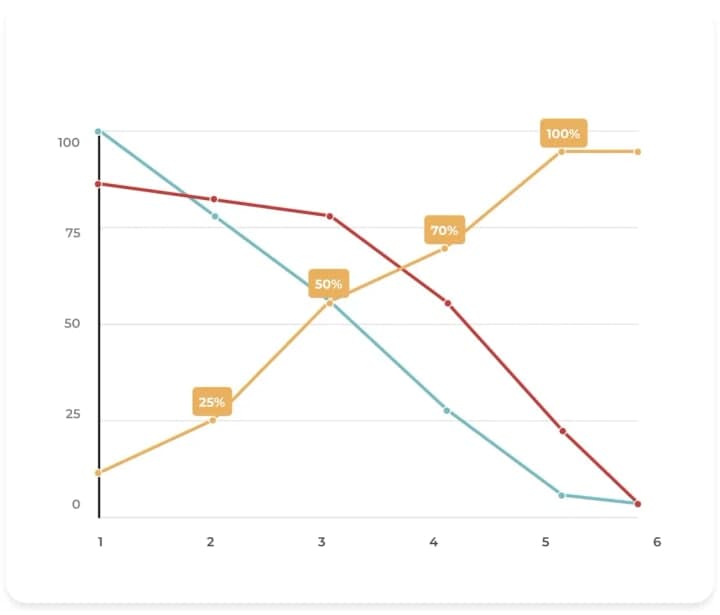
The offer page carries a line chart with callouts at 25%, 50%, 70% and 100%. It has no axis labels, no units, no sample size, no time period and no source. We do not know what is being measured or in whom. A chart like this is decoration, not evidence, and we would weigh it at zero.
What this means for you
What this means for you: the gel is plausible where it names menthol and arnica, and unsupported where it leans on boswellia, MSM and a 35-ingredient list with no quantities. If your aches respond to a cooling rub, this will probably feel like the cooling rubs you already know.
Is Kinzeno V2 better than a drugstore gel or a massage roller?
For reaching your own back, yes. For value, no. The honest comparison is that Kinzeno V2 bundles two cheap things, a counterirritant gel and a roller applicator, at a premium justified by a third thing that does not work. Whether that trade is worth it depends entirely on how much the hands-free application matters to you.
| Option | Typical cost | What it does well | Where it loses |
|---|---|---|---|
| Kinzeno V2 | Around 67 US dollars list, per 100 ml | Hands-free, reaches your own back, odour-free, cooling | Large premium, magnet claims unsupported, no price shown upfront |
| Drugstore menthol gel | Under 15 dollars | Same counterirritant action, often higher menthol content, clear labelling | You rub it in by hand, and reaching your back needs help |
| Arnica gel from a pharmacy | Under 20 dollars | The arnica evidence, at a stated concentration | No applicator, no massage element |
| Roller-ball bottle plus your own gel | A few dollars for the bottle | Nearly all of Kinzeno's practical benefit | Fiddly to fill, no magnets, which is no loss |
| Handheld massage gun | 50 to 200 dollars | Much stronger mechanical effect on muscle | Loud, bulky, no topical analgesic, not for joints or skin |
Against a massage gun
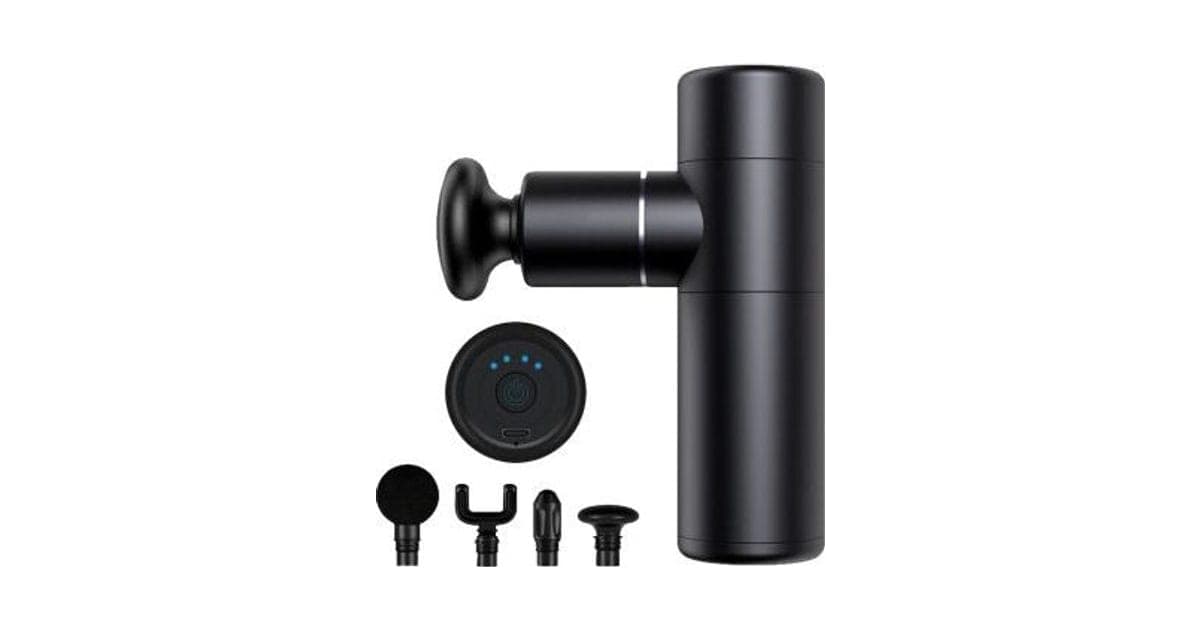
A gun delivers far more mechanical energy to muscle than a rolled ball ever will, so for general muscle soreness after exercise it is the stronger tool. Our MuscleRelax Pro review covers where that category oversells itself, and it is a useful comparison because the failure mode is similar: a plausible core function wrapped in claims it cannot support. Kinzeno wins only on portability and on being usable at a desk.
Against a cold therapy device
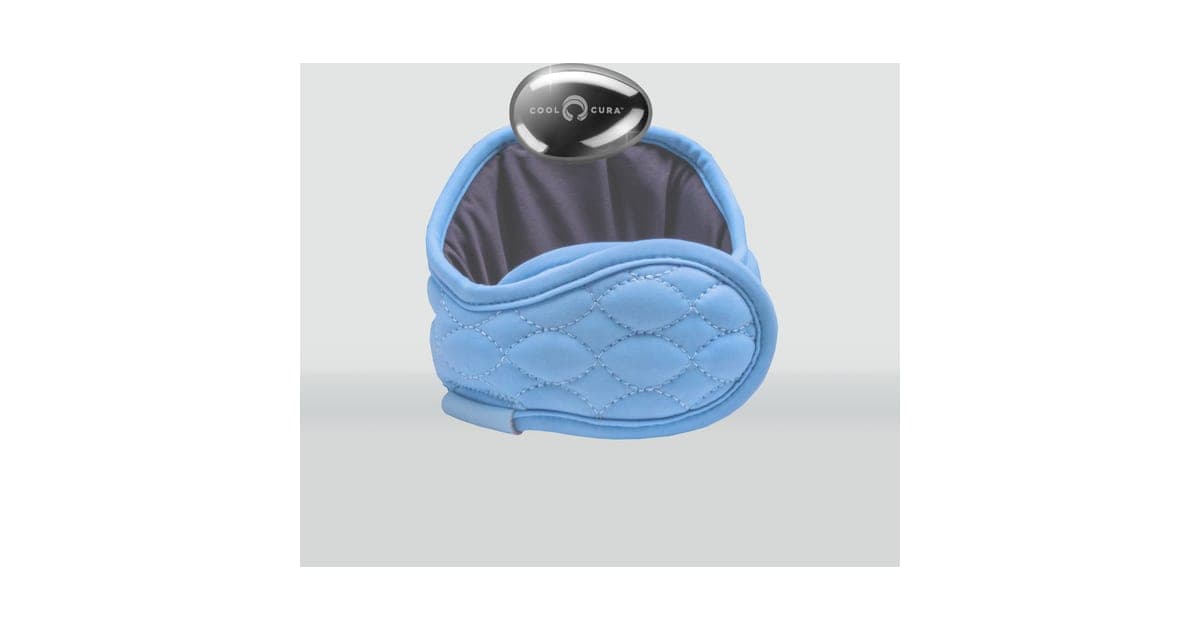
For an inflamed joint or a headache, cold has better support than magnets and costs less. Our CoolCura review looks at how far that evidence actually stretches. Menthol's cooling is a sensation rather than a temperature change, so it is not a substitute for real cold if swelling is your problem.
Against a drug-free nerve stimulation device
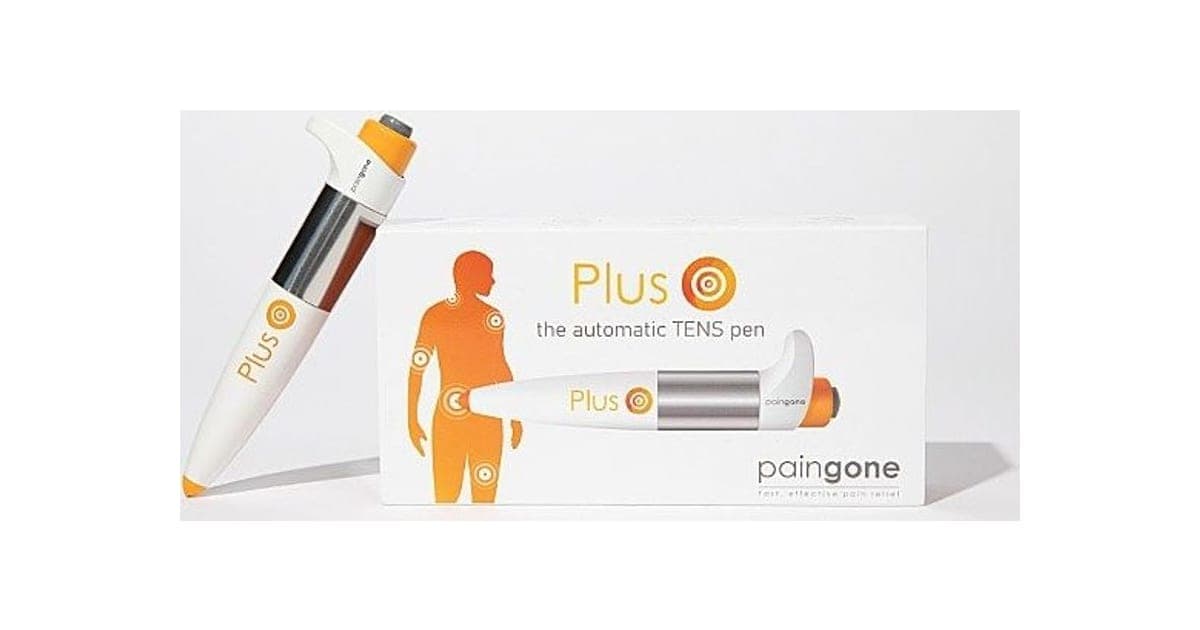
If you want a drug-free device with some clinical backing, transcutaneous electrical nerve stimulation is the better-supported category, though results vary. Our Paingone Plus review weighs the evidence and the owner split for that approach. Kinzeno is cheaper to run and far simpler, but it is not in the same evidence bracket.
Against a knee or joint support
For a specific joint that needs compression and warmth rather than a cooling sensation, a support is the better match, and our KneeWrap Pro review covers what that category does and does not deliver. The two are not really competitors: a support holds a joint through activity, while a gel is something you apply and then carry on. Several people would reasonably use both.
Against the free option
The honest baseline for everyday muscle stiffness is movement, warmth and time, and it costs nothing. A hot shower, gentle range-of-motion work and not sitting still for six hours will outperform any topical gel for ordinary desk-related aches. We mention it because the comparison tables in this category never do, and because a gel used instead of moving is a worse outcome than no gel at all.
Where Kinzeno honestly wins
One scenario, and it matters more than the list above suggests. If you cannot comfortably reach the sore spot, or your hands are the problem, every cheaper option on that table requires a second person or a painful stretch. Kinzeno V2 does not. For some buyers that single difference is worth the premium, and we would not argue them out of it. If that describes you, the Kinzeno offer page (opens Kinzeno in a new tab) is where to check the current bundle prices.
Kinzeno V2Score 5.5/10
Why people buy it: The roller cap genuinely solves a real problem: you can treat a shoulder blade or lower back without twisting a sore arm or getting gel on your hands
INR 4817.00 at Kinzeno · Price checked October 8, 2026
See Kinzeno bundles and prices (opens Kinzeno in a new tab)We may earn a commission if you buy through our links.
Is Kinzeno legit, and what should you check before buying?
Yes, in the sense that matters most: this is a real business that ships real product. It lists support numbers in the United States, United Kingdom and Germany, publishes return and shipping policies, and replies to effectively all negative Trustpilot reviews. The Trustpilot profile for kinzeno.com stood at 4.4 from 381 reviews on 8 October 2026, with 56% five star and 4% one star. The complaints are about how it sells, not whether it delivers.
What owners actually complain about
The negative reviews cluster tightly. Reviewers describe add-ons and extra promotional items pushed repeatedly through the ordering flow, and being opted into automatic subscriptions or facing charges they did not expect. One describes several attempts to get an address correct. Delivery failure and product defects are not the pattern. What to do: read every checkout screen, decline the upsells deliberately, and check your confirmation email for a recurring line.
The customer count that does not add up
The page claims "more than 30,050+ satisfied customers". The Trustpilot profile holds 381 reviews. Those two numbers can both be true, since most buyers never review anything, but the gap is worth holding in mind. Other pages about this product quote different figures again, including 4.8 stars from 76,845 customers and 4.9 from more than 30,000. We could verify one source: Trustpilot, at 4.4 from 381 on 8 October 2026.
How to read the search results for this product
Search the product name and almost every result is an affiliate page, several of them hosted on cloud storage buckets rather than real sites, all reaching a buy recommendation. The figures they quote for ratings and customer counts contradict each other, which is a reliable sign that none of them checked. What to do: ignore the star ratings quoted in articles, including this one, and open the Trustpilot profile yourself before buying.
What a 4.4 actually tells you
It tells you that people who received the product were mostly content with it, which is genuinely positive and not nothing. It does not tell you the gel relieved pain better than a cheaper one, because nobody reviewing a product has a control group. Satisfaction scores measure the purchase experience and expectations met. They are not evidence of efficacy, and they are the only owner data anyone has here.
The disclaimer is correct
The footer carries the right language: Kinzeno products are "not intended to diagnose, treat, cure, or prevent any specific disease or condition". The page also declines to give medical advice about prescription medications and points you to a pharmacist or clinician. That is the correct posture for a topical product, and plenty of competitors in this category do worse.
But the symptom list is not
The top of the page lists knee pain and stiffness, sciatic nerve burning, rotator cuff pain, and swelling and fluid build-up. Sciatica and rotator cuff injury are specific diagnoses with specific treatments. Naming them while disclaiming disease claims in the footer is a tension the page never resolves. What to do: if one of those is your actual diagnosis, get it treated properly, and treat any gel as comfort alongside that care.
Skin reactions worth watching for
Arnica and menthol are both common causes of contact irritation in people who react to them, and a 35-ingredient botanical blend gives your skin plenty to object to. Patch test on a small area of forearm and leave it a day before treating anything larger. Stop if you get redness that outlasts the cooling, itching, or a rash. Do not use it on broken skin, and keep it away from the eyes, which menthol will punish you for.
Children, pregnancy and other medicines
The brand does not state an age limit, and it declines to advise on interactions with prescription medication, pointing to a pharmacist or clinician instead. That is a reasonable position for them and an unhelpful one for you. Topical botanical blends are not usually a good idea in pregnancy or on young children without asking first. What to do: if you are pregnant, breastfeeding, treating a child, or taking anything regularly, ask a pharmacist before the first use rather than after a reaction.
Buy from the official route
Third-party marketplace listings for products sold this way carry a genuine risk of counterfeit or expired stock, and you lose the guarantee. Buy through the brand's own checkout if you buy at all.
The guarantee's fine print
Sixty days, money back, on unused product, with return postage at your expense and a return authorisation required from support. Read "unused" carefully. A tube you have been rolling on for three weeks does not obviously qualify, which makes this weaker than a typical try-it-and-see guarantee. What to do: decide within the first week or two and start a return early, so postage time does not eat the window.
Pricing transparency
Deciding whether to buy something whose price you cannot see until you have entered the checkout is a poor position for a buyer. The currency and language are set by your location, which also means the price you are quoted may not match what a review written in another country reports. Treat every price you read online for this product, including ours, as location-specific.
How to buy Kinzeno V2 the smart way
- Open the Kinzeno offer page (opens Kinzeno in a new tab) and go through to the order step to see the price in your own currency, before deciding anything.
- Choose the single tube first. Bundle discounts are real, but four tubes of a gel you have not tried is a poor bet.
- Decline every add-on screen deliberately, and look for any wording about a recurring or deferred purchase.
- Check the final total against the bundle price, including delivery.
- Read the confirmation email the day it arrives, and contact support immediately if a subscription appears.
- Give it two weeks, and start the return early if it is not helping.
How did we score Kinzeno V2?
Kinzeno V2 scores 5.5 out of 10, which lands it mid-table among the pain relief products we cover. The score is the sum of five criteria worth two points each, applied the same way to every product on the site. Here it splits unusually wide: the product is genuinely good at what it physically does and genuinely poor at what it claims to do.
The full breakdown sits in the table below, and the rest of the pain relief products we have assessed are in our health gadgets category.
| Criterion | Score | Why |
|---|---|---|
| Claim accuracy | 0.8 / 2 | The central magnetic mechanism is not supported; boswellia and MSM claims rest on oral trials. Hedged ingredient wording and a correct disclaimer earn back some credit |
| Build durability | 1.0 / 2 | A simple, robust roller design, but no material spec, no refill information and nothing we can verify |
| Price competitiveness | 0.6 / 2 | A large premium over equivalent gels, no price before checkout, and an advertised discount the bundles do not reach |
| Usability | 1.6 / 2 | The strongest part: hands-free, 360 degree head, no residue, odour-free, usable several times a day |
| Owner satisfaction | 1.5 / 2 | 4.4 from 381 on Trustpilot with 90% positive, but complaints cluster on checkout practices |
Where it sits against its siblings
That 5.5 puts it just below Paingone Plus and CoolCura, both on 5.8, and well above the weaker massagers in the category. It loses to those two on claim accuracy and price, and beats most of the category on usability. The best health gadgets guide sets out how we rank this category overall.
What we did, and did not, do
Nobody on our team has used Kinzeno V2. We have not felt the gel, timed how long the cooling lasts, checked how the rollers hold up after a month, or measured the field strength of the magnets. Everything above comes from the brand's own offer page and checkout data, the published research on static magnets and topical analgesics, and the public Trustpilot profile. Our scoring method is set out in full on how we test.
What we would check with one in hand
Three things. How much gel the rollers actually dispense per pass, and so whether 100 ml lasts weeks or days. Whether the balls clog or stiffen once dried gel builds around them. And whether the cooling lasts long enough to matter, or fades within minutes the way weaker menthol products do.
How to use Kinzeno V2 for the best results
Use it as a massage tool that happens to dispense gel, not as a medicine you apply. Roll slowly over clean, unbroken skin, give the area thirty to sixty seconds rather than one quick pass, and let it dry before dressing. The cooling arrives first, the massage effect builds with the time you spend, and neither depends on believing anything about magnets.
- Clean and dry the skin first. Gel over sweat or moisturiser spreads unevenly and absorbs poorly. A quick wipe is enough.
- Roll slowly, for thirty to sixty seconds per area. The massage is doing real work, and a single quick swipe skips it. Slow passes in two directions beat fast ones.
- Work towards the heart on limbs. Rolling up a calf or forearm rather than down is the convention in massage practice and costs you nothing to follow.
- Let it dry before you dress. The brand says it is not designed to stain, but gel transferred onto a shirt helps nobody. Test fabric on a hidden area if you are worried.
- Keep it to two to four times a day. That is the brand's own stated ceiling. More frequent use will not speed anything up and raises the chance of skin irritation.
- Clean the roller head weekly. Dried gel around five ball seats is the most likely failure point. Warm water and a cloth, then dry it before capping.
- Keep a one-line pain note for two weeks. A score out of ten each evening tells you far more than memory will, and it gives you a real answer inside the guarantee window.
The mistakes that waste a tube
Three come up with any roller product. Applying it over a moisturiser or sunscreen, which blocks absorption. Using it once and judging it, when the massage element needs repeated sessions to show anything. And rolling hard enough to drag the skin, which irritates without improving the massage. Firm contact and slow movement beat pressure every time.
The self-test that answers the magnet question
If you want to know whether the magnets contribute anything for you, the test is cheap. Use Kinzeno V2 on one sore area for a week, noting your score each evening. Then use a drugstore menthol gel, applied with a plain roller-ball bottle, on the same area for a week the same way. If the scores track each other, you have your answer about what you are paying for, and you can buy the cheap version indefinitely.
If it is not working
Check three things before giving up. That you are using enough gel, since the rollers meter it out slowly and a thin film does little. That you have given it the full two to four applications a day the brand suggests. And that the pain is the kind a topical product can reach at all: deep joint pain, nerve pain and referred pain are poor candidates for anything applied to skin, whatever the label says.
What to do: if two weeks of consistent use shows nothing in your notes, stop and start the return rather than waiting out the 60 days.
If you have read this far and still want the applicator, buy a single tube from the Kinzeno checkout (opens Kinzeno in a new tab), decline the add-ons, and treat the magnets as packaging.
Kinzeno V2Score 5.5/10
Before you buy: Check the final price, shipping and return terms at checkout.
INR 4817.00 at Kinzeno · Price checked October 8, 2026
See Kinzeno bundles and prices (opens Kinzeno in a new tab)We may earn a commission if you buy through our links.
Frequently asked questions
What is Kinzeno V2?
Kinzeno V2 is a 100 ml (3.38 fl oz) topical massage gel in a tube with a five-ball magnetic roller cap. You roll it directly onto sore muscles and joints. The named actives include arnica, boswellia, MSM, menthol, magnesium, turmeric and ginger, with "+20 more" ingredients the page does not quantify.
Does magnetic therapy actually work for pain?
The best available evidence says no. A meta-analysis in the Canadian Medical Association Journal pooled nine placebo-controlled trials and found a difference of about 2 mm on a 100 mm pain scale, which is not meaningful. The National Center for Complementary and Integrative Health says static magnets have not been shown to treat pain.
So does Kinzeno V2 do anything at all?
Probably, though not for the reason on the label. Rolling gives a light massage, and menthol is a recognised topical analgesic listed in the FDA's over-the-counter monograph for external analgesics. Arnica gel also has reasonable trial support. The relief people feel is most likely the gel and the massage rather than the magnets.
How much does Kinzeno V2 cost?
The page shows no price until the order step, and sets the currency by your location. Checked on 8 October 2026 it served Indian pricing: one tube 4,817 rupees, two 8,670, three 10,404 and four 11,560, plus 862 for standard delivery. The underlying list price in the checkout data was 66.66 US dollars per tube.
Is there a subscription?
The checkout includes a recurring-purchase option, with wording about being billed every month. Several Trustpilot reviewers describe being opted into subscriptions they did not want, or meeting repeated add-on offers during ordering. Read every screen before confirming, and check your confirmation email for any recurring line.
What is the return policy?
A 60-day money-back guarantee on unused product, with return postage at the buyer's expense, and you must contact support for a return authorisation. An opened tube you have been using is not covered by that wording, so decide early if it is not helping you.
Who should not use Kinzeno V2?
The brand says anyone with a pacemaker, implantable defibrillator, cochlear implant, insulin pump or other implanted electronic device must not use it, because of the neodymium magnets. Ask your doctor or device specialist first. Also avoid broken skin, and stop if the skin becomes irritated.
Is Kinzeno a legitimate company?
It is a real, reachable business rather than a vanishing storefront. It lists support numbers in the United States, United Kingdom and Germany, publishes return and shipping policies, and replies to effectively all negative Trustpilot reviews. The problems reported are marketing and checkout practices, not undelivered orders.
We may earn a commission if you buy through our links.
This content is for informational purposes and is not medical advice. Talk to a qualified professional before using any product that affects your health.
Prices accurate as of October 8, 2026. Check the seller's checkout for current pricing, promotions and terms.
What we checked: No hands-on use. Product details, ingredient list, claims, contraindications, guarantee wording and images come from the Kinzeno offer page our link opens (get-kinzeno.com) on 2026-10-08. Prices, bundle discounts, the delivery charge and the recurring-purchase option were read from that site's own checkout data on the same day, which served Indian pricing based on our location. Magnet evidence from the 2007 meta-analysis of static magnets in the Canadian Medical Association Journal and the National Center for Complementary and Integrative Health. Menthol from the FDA over-the-counter monograph for external analgesic drug products and a placebo-controlled carpal tunnel trial; arnica from published knee and hand osteoarthritis trials. Owner sentiment from the Trustpilot profile for kinzeno.com (4.4 from 381 reviews on 2026-10-08).
See how Kinzeno V2 compares in The Best Health Gadgets of 2026

About the author
James Wilson, Consumer Tech Writer
James Wilson covers health and wellness technology for Top10Gadgets: breathing devices, massagers, hearing aids, dental and weight-loss products, and the other gadgets sold with a promise to make life easier. James write…
- Health and wellness gadgets
- Over-the-counter hearing aids
- Breathing and massage devices
- FDA clearance and registration
- Tech for beginners
Writing for Top10Gadgets since 2026Full profile