Health Gadgets / Nerve stimulation
Pulsetto Review: Can a Neck-Worn Vagus Nerve Stimulator Really Calm Stress and Improve Sleep?
A neckband that sends gentle electrical pulses to the vagus nerve area, run by an app. Many owners report calmer evenings, but it is not FDA cleared and the studies are small and company-funded.

By James Wilson, Consumer Tech Writer at Top10Gadgets
Updated 29 min readHow we test
Quick answer
Maybe, if you are a healthy adult curious about vagus nerve stimulation for everyday stress or winding down, and you will treat the 30 days as a trial. Pulsetto is hands-free, simple to use and well rated by thousands of owners.
Score 6.3/10$259.00 at Pulsetto
Check price at Pulsetto (opens Pulsetto in a new tab)We may earn a commission if you buy through our links.
- Best for
- Healthy adults curious about vagus nerve stimulation for everyday stress and winding down
- Not for
- Anyone with a pacemaker, implanted device, metal neck implant, heart condition or seizure disorder, or who is pregnant
$259.00 at Pulsetto
Check price at Pulsetto (opens Pulsetto in a new tab)We may earn a commission if you buy through our links.
On this page · 14 sections
- 01Our verdict
- 02The short version
- 03Pros & cons
- 04How it works
- 05Who it's for
- 06How much does Pulsetto cost, including the app?
- 07Does Pulsetto work, and what does the evidence say?
- 08Are Pulsetto's claims true?
- 09Is Pulsetto better than slow breathing or other neck stimulators?
- 10Is Pulsetto legit, and what should you check before buying?
- 11What do owners say, and how did we score Pulsetto?
- 12How to use Pulsetto for the best results
- 13What else do people ask about vagus nerve stimulation?
- 14Frequently asked questions
Our verdict
Maybe, if you are a healthy adult curious about vagus nerve stimulation for everyday stress or winding down, and you will treat the 30 days as a trial. Pulsetto is hands-free, simple to use and well rated by thousands of owners. But it is not FDA cleared, studies of its exact settings are small and company-funded, "zero side effects" overstates it, and the app pushes a paid subscription. Pulsetto scores 6.3 out of 10, held back by thin independent evidence and upsells rather than the hardware.
The short version
- A neckband that sends gentle electrical pulses to the vagus nerve area through the skin.
- Four-minute sessions controlled by a phone app with five programs.
- $259 on the offer page on 4 October 2026; two for $336, three for $448, free shipping.
- Pulsetto's own store listed the Fit model at $269.
- Not FDA cleared; sold as a general wellness device.
- Studies of its exact settings are small, company-funded and mostly self-reported.
- Trustpilot: 4.1 from 3,459 reviews, with 16% one-star.
- Owners praise calmer moods and sleep; complaints focus on app upsells, support and some device failures.
- Not for people with implanted devices, neck implants, heart conditions or during pregnancy.
- 30-day money-back guarantee and two-year warranty.
- Best trait: an easy, hands-free relaxation routine.
- Biggest drawback: weak independent evidence for its specific settings.
- Our score: 6.3 out of 10.
Pros & cons
Pulsetto is a real company and a widely used device, with genuine fans. The main questions are whether the evidence justifies the price and how you feel about app upsells.
What we like
- Non-invasive, hands-free neckband with short four-minute sessions
- Five programs in the free app: stress, worry, sleep, burnout, and pain and recovery
- Trustpilot 4.1 from 3,459 reviews, with many owners reporting calmer moods and easier sleep
- $259 on the offer page, slightly below Pulsetto's own store price for the Fit model
- 30-day money-back guarantee and two-year warranty, according to the page
What we don't
- Not FDA cleared; it is sold as a general wellness device
- The only studies of its exact settings are small, company-funded and largely self-reported
- "Zero side effects" overstates it; headache, dizziness and skin reactions are possible
- The app pushes a paid premium subscription; owners complain about upsells
- Not for people with implanted devices, heart conditions, neck implants or during pregnancy
Sold by Pulsetto
Pulsetto$259.00
How it works
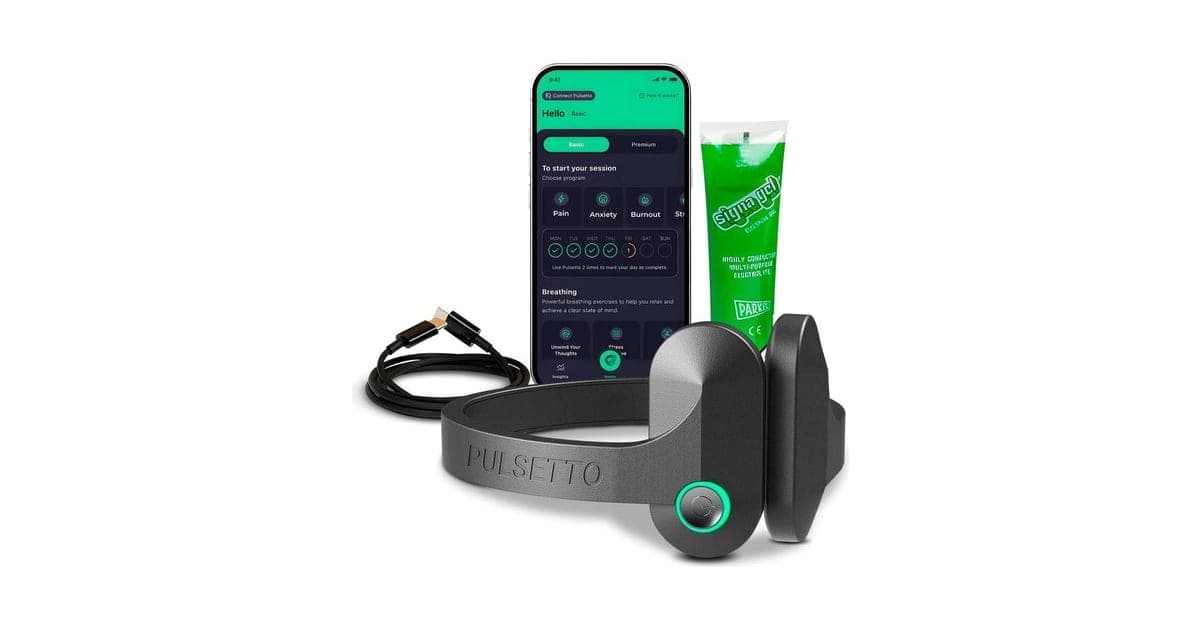
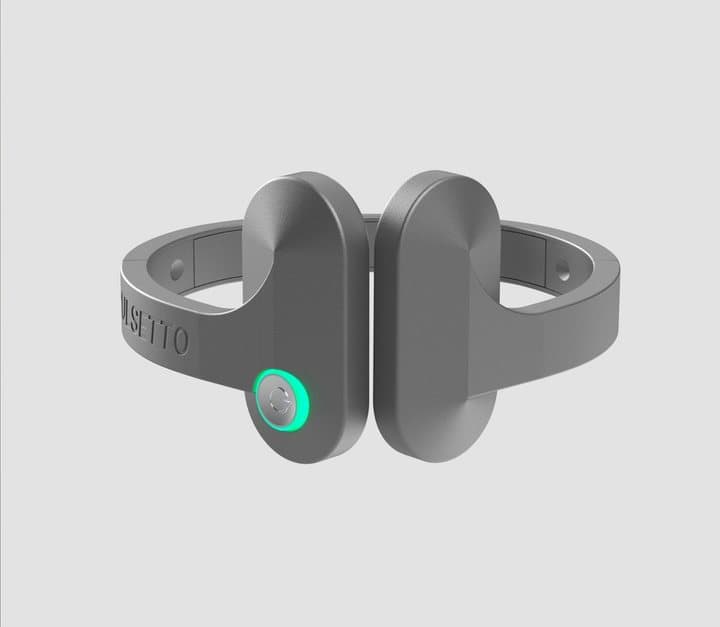
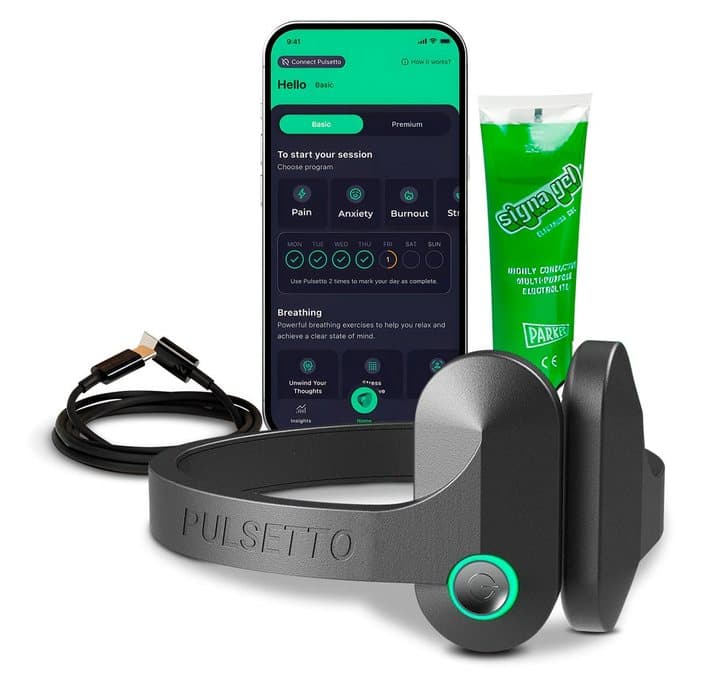
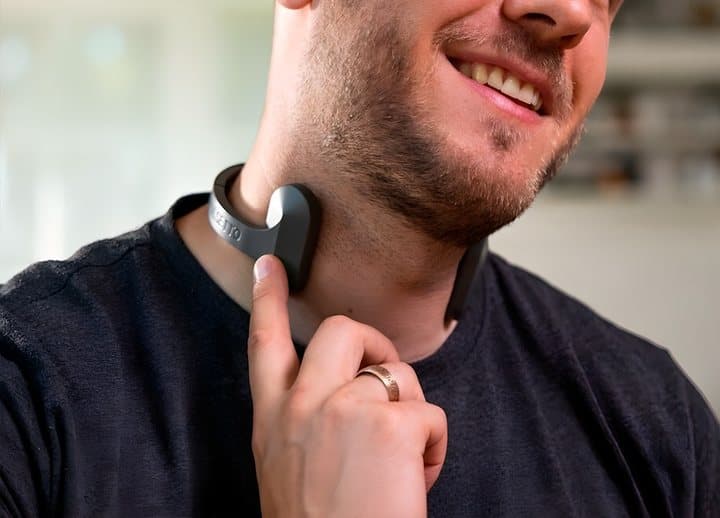
Pulsetto is a curved grey band worn around the back of the neck, with two rounded pads that rest on the sides of the neck below the jaw. Each pad has an electrode. When you start a session in the app, the electrodes send small electrical pulses through the skin.
Charge, pair and apply gel
Step 1: Charge the neckband, pair it with the Pulsetto app, and apply a little conductive gel to the electrodes.
Place it on your neck
Step 2: Wear the band so the electrodes sit on the sides of your neck, over the area where the vagus nerve runs.
Choose a program and relax
Step 3: Pick a program such as stress or sleep, set a comfortable intensity and sit or lie still for the session, usually about four minutes.
The seller's program labels
The Pulsetto neckband
The vagus nerve
The vagus nerve is the longest cranial nerve. It runs from the brainstem down each side of the neck to the heart, lungs and gut. It is a major part of the parasympathetic nervous system, the "rest and digest" side that slows heart rate and helps the body recover. Part of the nerve passes close to the surface on the sides of the neck, which is why neck-worn stimulators target that area.
What stimulation is meant to do
The idea is that gentle electrical stimulation of the vagus nerve nudges the nervous system towards a calmer state, raising heart rate variability and reducing feelings of stress. Doctors have used implanted vagus nerve stimulators for years to treat some forms of epilepsy and depression. Non-invasive devices like Pulsetto aim to stimulate the nerve through the skin instead.
The programs
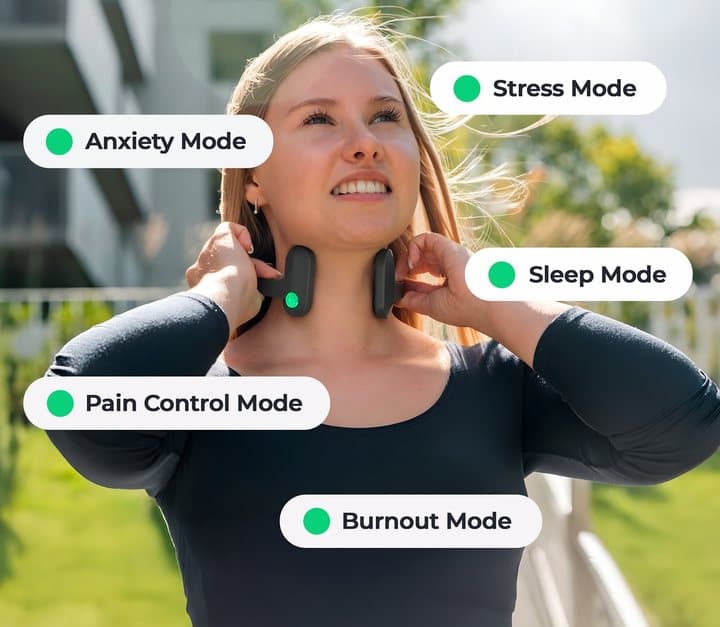
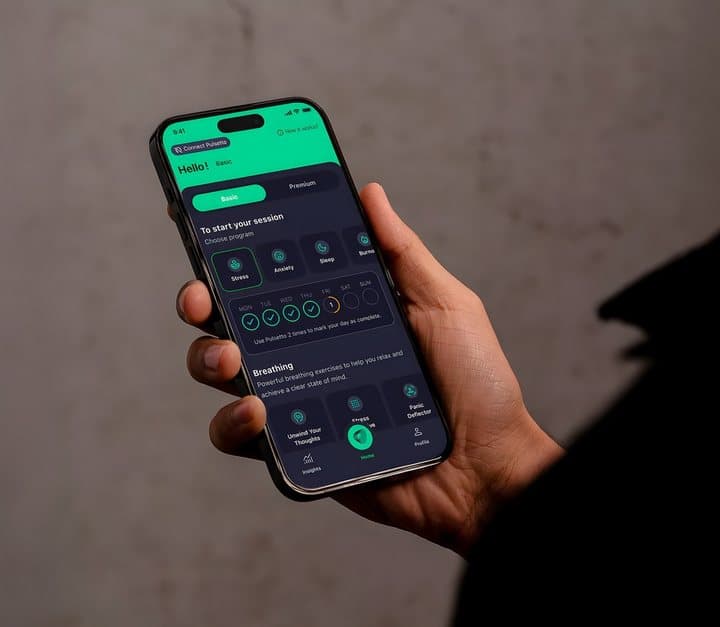
The free app includes five programs: soothe stress, calm worry and overwhelm, fall asleep, relieve burnout, and pain control and recovery. You choose a program, set an intensity that feels comfortable and stay still for the session. The app also has a library of calming sounds and session reminders.
Why it needs an app
All control happens in the app, which connects to the neckband by low-energy Bluetooth. That makes it easy to switch programs and intensity, but it means you need your phone nearby, Bluetooth on and the app updated. If the app has problems, the device is hard to use. The page says the app is regularly updated, so the device can gain features without new hardware.
The gel
Pulsetto uses a conductive gel on the electrodes, which helps the current pass through the skin evenly and comfortably. A tube is included. One hands-on review found the gel a little messy, and a Trustpilot reviewer complained about the price of replacement gel.
How it compares with other neck stimulators
According to a hands-on review by Innerbody, Pulsetto's operating frequencies are similar to those of gammaCore, a non-invasive vagus nerve stimulator that is FDA cleared for certain headache conditions. Similar settings do not mean similar proven effects, but it shows the device is built around a recognised approach.
Heart rate variability
Heart rate variability (HRV) is the natural variation in time between heartbeats. Higher HRV is generally linked with a more relaxed, resilient nervous system, and it rises when the vagus nerve is more active. Pulsetto's marketing and its company-funded research focus partly on HRV. If you own a wearable that tracks HRV, you can watch whether your numbers change after sessions, though HRV is affected by sleep, alcohol, exercise and illness, so single readings mean little.
Why intensity matters
Stimulation needs to be strong enough to reach the nerve but comfortable enough to relax into. The app lets you adjust intensity. Most people settle on a level where they feel a clear but gentle tingle. Turning it up until it is uncomfortable is unlikely to help and may cause muscle twitching or irritation.
Who it's for
Pulsetto suits healthy adults who feel stressed, wired at night or burnt out, and who are curious about vagus nerve stimulation. It suits people who find meditation hard to stick with and want something they can wear while sitting quietly. It also suits people who like gadgets and data.
It is not a treatment for anxiety disorders, depression or insomnia, and it is not suitable for anyone with implanted devices or certain medical conditions.
Common reasons people buy it
From the testimonials and marketing, buyers usually want one of a few things: to fall asleep more easily, to calm down after stressful workdays, to manage burnout, or to experiment with nervous system "biohacking". Some hope for pain relief or help with digestion. Sleep and everyday stress are where owners most often report benefits.
People who already meditate
If you already meditate or practise breathing exercises, you may find Pulsetto adds little, or you may enjoy it as a different way to relax. Some people use it on days when they lack the focus to meditate.
Why Pulsetto appeals
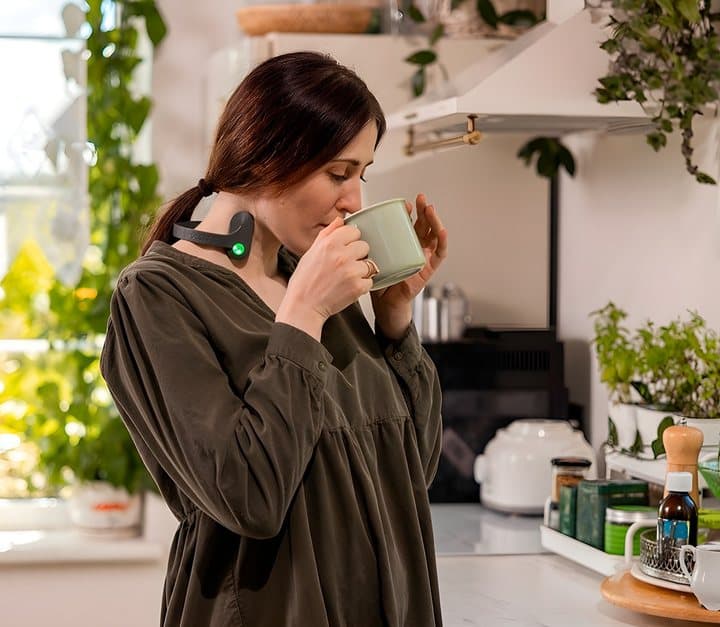
Stress and poor sleep are common, and many people want something drug-free that works quickly. Pulsetto promises calm in four minutes, without having to concentrate. It is hands-free, so you can wear it while reading, having a cup of tea or lying in bed. The app makes it feel modern and personalised, and endorsements from well-known wellness figures add appeal.
A typical evening
After dinner, you charge the band, put a little gel on the pads and fit it around your neck. You open the app, choose the sleep program and set the intensity until you feel a light tingle. You sit quietly with a book for a few minutes while it runs. When the session ends, you take it off, wipe the pads and get ready for bed. Some owners say they feel noticeably calmer; others feel little change.
A typical first two weeks
In the first few sessions, most of the attention goes on getting the fit and intensity right and getting used to the tingling. By the end of the first week, the routine becomes familiar. Owners who notice benefits usually describe falling asleep a little more easily or feeling less wound up after work. Those who notice nothing after two weeks of daily use rarely find it changes later, which is why the 30-day window is the right time to decide.
Shift workers and travellers
People who sleep at irregular times, such as shift workers and frequent flyers, often struggle to wind down when their body clock disagrees. A short, consistent pre-sleep ritual, which Pulsetto can be part of, may help. Light exposure, meal timing and consistent sleep schedules still matter far more.
Daytime stress
Several testimonials describe using it during busy workdays to reset between tasks. Because it is hands-free and sessions are short, it can fit into a break. It is less discreet in an office than at home, as the band is visible.
Athletes and biohackers
The page quotes longevity author Peter Diamandis and biohacker Ben Greenfield, and Pulsetto is popular with people who track heart rate variability and recovery. If you already track your HRV with a wearable, you can see whether sessions make a difference for you.
Parents and busy professionals
The page targets busy professionals and parents, and the four-minute sessions suit them. Being hands-free means you can wear it while doing something calm, though the device works best when you sit or lie still rather than multitask.
Older adults
Older adults are more likely to have heart conditions, implanted devices or take medicines that affect heart rate. Anyone over 60 should check with their doctor before using any nerve stimulator.
- Healthy adults curious about vagus nerve stimulation for everyday stress and winding down
- People who struggle with meditation and want a hands-free relaxation routine
- Anyone happy to treat it as an experiment within the 30-day guarantee
Who should skip it
- Anyone with a pacemaker, implanted device, metal neck implant, heart condition or seizure disorder, or who is pregnant
- People with diagnosed anxiety, depression or insomnia looking for a treatment rather than an add-on
- Buyers who dislike app subscriptions and upsells
- People with very slender necks, who may struggle with fit, according to a hands-on review
How much does Pulsetto cost, including the app?
Pulsetto costs $259 on the offer page on 4 October 2026, with two for $336 and three for $448, all with free shipping, while Pulsetto's own store listed the Pulsetto Fit at $269. The box holds the neck stimulator, application gel, a charging cable and a manual, with a free app offering five programs. A premium subscription adds more, which a hands-on review reported at $129 a year.
What comes in the box
The Pulsetto app
In the box
According to the page, you get the Pulsetto stimulator, access to the app with five programs, a tube of application gel, a charging cable and a user manual.
Pulsetto price and bundles
On 4 October 2026 the Pulsetto offer page (opens Pulsetto in a new tab) listed:
| Package | Price | Shown against | Per device | Shipping |
|---|---|---|---|---|
| 1 Pulsetto | $259 | $524 | $259 | Free |
| 2 Pulsetto (second half price) | $336 | $572 | $168 | Free |
| 3 Pulsetto (buy 2, get 1 free) | $448 | $858 | $149.33 | Free |
The "retail" prices do not add up consistently: one is shown against $524, but two against $572. The three-pack is labelled "only $179 each", but $448 divided by three is about $149. Treat the sale prices as the real prices.
Pulsetto's own store listed the Pulsetto Fit at $269 and the Fix X at $314 on the same day, so the offer page was slightly cheaper for a single device.
The premium app
The basic app is free. A premium tier adds programs such as head pain, inflammation and gut health, plus meditation and breathing features. Innerbody reported it at $129 a year, and Pulsetto's store listed a 24-month premium plan at $480. Several Trustpilot reviewers object to premium upsells and difficulty cancelling trials.
Is it good value?
At $259, Pulsetto is one of the cheaper neck-worn vagus nerve stimulators, but it is still a significant purchase for a wellness device with limited independent evidence. Factor in replacement gel and, if you want it, a premium subscription. For people who find it helpful, the cost per session over a year is modest. For people who do not, the 30-day guarantee matters.
Total cost over a year
A realistic first-year cost is the device at $259, a few replacement tubes of gel and, if you choose it, premium at around $129 a year according to Innerbody. That brings the total to roughly $260 to $400, depending on choices. If you use it nightly, that is roughly 70 cents to $1.10 a session over the year.
The pricing labels
Offer pages often show "retail" prices to make discounts look larger. Pulsetto's inconsistent labels, such as "only $179 each" for a bundle that works out at about $149 each, suggest the comparison prices should not be relied on. Judge the price against Pulsetto's own store and competitors instead.
Replacement gel
The gel helps conductivity and comfort. When the included tube runs out, you can buy more from Pulsetto. One Trustpilot reviewer criticised its price. Ask Pulsetto whether a general-purpose conductive gel, such as those used for TENS devices, is compatible, as using the wrong product could affect comfort or the warranty.
Who makes it
Pulsetto is a Lithuanian company. The page quotes Dr Andrius Radziunas, a medical doctor, describing it as the leading non-invasive stimulator, and shows a "doctor approved" badge. The device won recognition in a design award listing.

PulsettoScore 6.3/10
Best for: Healthy adults curious about vagus nerve stimulation for everyday stress and winding down
$259.00 at Pulsetto · Price checked October 4, 2026
Check price at Pulsetto (opens Pulsetto in a new tab)We may earn a commission if you buy through our links.
Does Pulsetto work, and what does the evidence say?
Vagus nerve stimulation is a real medical treatment in implanted form, and research on non-invasive stimulation for stress, mood and sleep is promising but mixed. For Pulsetto's own settings, the only studies are small, company-funded and rely largely on self-reported measures, according to Innerbody. Many owners report feeling calmer and sleeping better with daily use, but it is not FDA cleared and is sold as a wellness device.
Vagus nerve stimulation in medicine
Implanted vagus nerve stimulators, surgically placed around the nerve in the neck, are approved in the US for some forms of epilepsy and treatment-resistant depression. Those are serious medical treatments with strong stimulation directly on the nerve.
Non-invasive stimulation
Non-invasive devices stimulate the nerve through the skin, either at the neck or the ear. Research is growing. One neck device, gammaCore, is FDA cleared for treating certain headaches. Studies of non-invasive stimulation for stress, mood, inflammation and sleep show some promising results, but many are small, short and vary in method, and it is not always clear how much of the effect comes from the stimulation versus expectation.
Pulsetto's own research
According to Innerbody, the only studies of Pulsetto's specific settings are small, thesis-level studies funded by the company, looking at stress and heart rate variability, inflammation in ankylosing spondylitis, and migraine, and relying largely on self-reported measures. We found no independent, peer-reviewed trial of Pulsetto.
Implanted versus external stimulation
Implanted stimulators wrap electrodes directly around the vagus nerve and deliver precise, programmed stimulation over months. External devices pass current through skin, fat and muscle to reach the nerve, and the dose that arrives is less certain. That is one reason results from implanted devices cannot simply be transferred to external ones.
The page's figures
The page says 86% of users felt calmer and less stressed, and that after 14 days of daily use, 1,000+ users reported a 28% decrease in stress, 18% increase in sleep quality and other improvements. These appear to be in-app survey results from customers. They are encouraging but uncontrolled: people who buy a stress device and keep using it are likely to report feeling better, with or without the device.
What hands-on testers found
Innerbody's testers reported modest stress relief and easier sleep onset, comfortable fit for one tester and awkward fit for another with a slender neck, good battery life, an intuitive app, messy gel and weaker effects than a more expensive competitor.
Realistic expectations
Expect a calm, pleasant routine that some people find genuinely relaxing, especially before bed. Effects, if you notice them, may be modest. Combining it with good sleep habits, exercise and stress management will do more than the device alone.
Why owners' experiences vary
Stress and sleep are influenced by many things, and people respond differently to stimulation. Some feel a strong, immediate calm; others feel nothing. Expectation also plays a part: a calming ritual, a pleasant tingle and the hope of relief can all help people relax. That does not make the relief imaginary, but it is why controlled trials, which compare a real device with a sham, are needed to know how much the stimulation itself contributes.
What a strong study would look like
A convincing trial would randomly assign a large group of adults with defined stress or sleep problems to Pulsetto or a sham device that feels similar but does not stimulate the nerve, measure outcomes objectively as well as by questionnaire, run for several weeks and be published in a peer-reviewed journal by independent researchers. We found no study of Pulsetto that meets that standard.
Are Pulsetto's claims true?
Pulsetto's claims mostly go further than the evidence. "Clinically proven" applies to vagus nerve stimulation in specific medical forms, not to Pulsetto's settings, which have only small company-funded studies. "Calm your mind in just 4 minutes" is plausible for some people but not guaranteed. "Zero side effects" overstates it, since headache, dizziness and skin reactions are reported, and "the app is 100% free" ignores the premium upsell.
"Clinically proven vagus nerve stimulation"
Overstated. Vagus nerve stimulation has clinical evidence in specific medical forms. Pulsetto's own settings have only small, company-funded studies.
"Calm your mind in just 4 minutes"
Plausible for some people; not guaranteed.
"The #1 doctor-recommended vagus nerve stimulator"
Unverified. The page quotes one doctor and shows a "doctor approved" badge.
"No side effects" and "zero side effects in 1.5 million stimulations"
Overstated. Possible side effects of neck stimulators include headache, dizziness, nausea and skin irritation, according to hands-on reviewers.
"Fully certified by the FCC and CE… approved for use for general health"
Misleading. FCC certification covers radio emissions. It does not mean the device is approved to improve health.
"Aids cognitive function", "relieves inflammation", "helps with depression"
Overstated for this device. These findings come mainly from implanted or other stimulators in specific studies.
"The app is 100% free"
Partly true. The basic app is free; premium features cost extra.
"100,000+ happy customers" and "20,000+ 5-star reviews"
Unverifiable on the page. Trustpilot showed 3,459 reviews averaging 4.1.
"The world's top experts use Pulsetto"
The page quotes longevity author Peter Diamandis, biohacker Ben Greenfield and a vagus nerve educator. These are endorsements from well-known wellness figures, not independent clinical evaluations. They show the device is popular in the biohacking community, not that it works for everyone.
Claims scorecard
| Claim | Our view |
|---|---|
| Clinically proven | Overstated for this device |
| Calm in 4 minutes | Plausible for some |
| #1 doctor recommended | Unverified |
| Zero side effects | Overstated |
| FCC and CE approved for health | Misleading |
| Cognition, inflammation, depression | Overstated |
| Free app | Partly; premium extra |
Is Pulsetto better than slow breathing or other neck stimulators?
Slow breathing with a longer out-breath stimulates the vagus nerve naturally, is free and is well studied, and tools like Moonbird make it easier. Pulsetto's main advantage is that it needs no effort. More expensive neck stimulators exist, including one FDA cleared for certain headaches, and Innerbody's testers felt a pricier competitor gave stronger effects. Pulsetto is the budget hands-free option.
| Option | Cost | Evidence | Notes |
|---|---|---|---|
| Pulsetto | $259 + optional premium | Limited for this device | Hands-free, four-minute sessions |
| Other neck stimulators | Often more | Varies; one FDA-cleared device for headaches | Some have stronger research |
| Ear-based stimulators | Varies | Mixed | Clip to the ear |
| Slow breathing | Free | Good for short-term calm | Stimulates vagus nerve naturally |
| Exercise | Free | Strong for stress and sleep | Long-term benefits |
| Therapy (such as CBT) | Varies | Strong for anxiety and insomnia | Treats underlying issues |
Pulsetto vs slow breathing
Slow breathing, especially with a longer out-breath, stimulates the vagus nerve naturally and raises heart rate variability. It is free and well studied. Breathing guides like the Moonbird make it easier. Pulsetto requires no effort, which is its main advantage.
Pulsetto vs other neck stimulators
More expensive neck stimulators exist, and one is FDA cleared for certain headaches. Innerbody's testers felt a pricier competitor gave stronger effects. Pulsetto is the budget option.
Pulsetto vs ear stimulators
Ear-based stimulators clip to the outer ear, where a branch of the vagus nerve reaches the skin. They are often cheaper and smaller. Research on ear stimulation is active and mixed. Some people find ear clips more comfortable; others prefer a neckband.
Pulsetto vs meditation apps
Meditation apps cost far less and teach skills you can use anywhere. They need effort and focus, which is exactly what some stressed people struggle with. Pulsetto needs no effort. Some people use both: Pulsetto to settle, then a short meditation.
Pulsetto vs exercise
Regular exercise is one of the most effective ways to reduce stress, improve sleep and raise heart rate variability over time. It is free and benefits almost every part of health. Pulsetto can sit alongside exercise but cannot replace it.
Pulsetto vs therapy and medicine
For anxiety disorders, depression or chronic insomnia, therapy such as cognitive behavioural therapy and, where needed, medicine have the strongest evidence. Pulsetto is at best an add-on.
Pulsetto vs other health gadgets we have reviewed
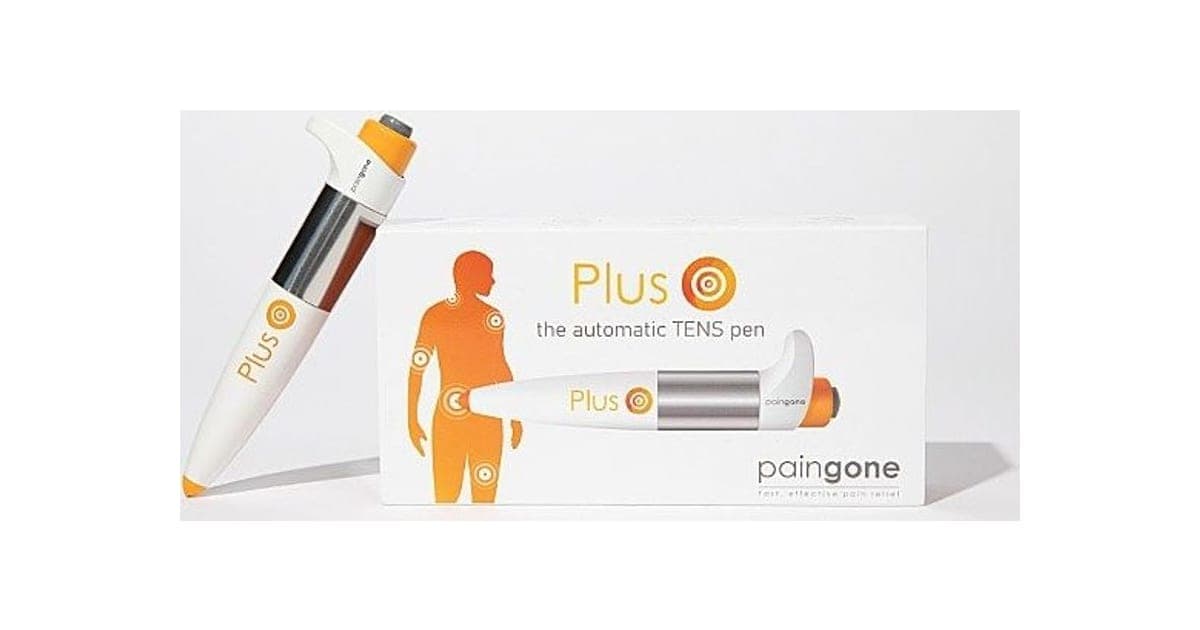
We have reviewed other drug-free devices, including the Moonbird breathing coach, the Paingone Plus TENS pen, the Hale breathing aid and AirPhysio. More are in our health gadgets category.
If you want to try Pulsetto, compare today's Pulsetto offer (opens Pulsetto in a new tab) with Pulsetto's own store before you buy.
If you are choosing between stimulation and guided breathing, our Pulsetto vs Moonbird comparison weighs the two on evidence, safety, owner ratings and total cost.
PulsettoScore 6.3/10
Why people buy it: Non-invasive, hands-free neckband with short four-minute sessions
$259.00 at Pulsetto · Price checked October 4, 2026
Check price at Pulsetto (opens Pulsetto in a new tab)We may earn a commission if you buy through our links.
Is Pulsetto legit, and what should you check before buying?
Pulsetto is a real device with a Trustpilot score of 4.1 from 3,459 reviews, a 30-day money-back guarantee and a two-year warranty, but it is not FDA cleared. Before buying, check the exclusions, including implanted devices, metal neck implants, heart and lung conditions and pregnancy, and ask your doctor if unsure. Decide whether you want the paid app, and do not change any prescribed treatment.
It is a wellness device
What to do: do not stop or change treatment for anxiety, depression, sleep disorders or other conditions. See a doctor for ongoing symptoms.
Safety exclusions
According to Innerbody, contraindications include implanted devices, metallic neck implants, cardiovascular conditions, lung disorders, a single vagus nerve, a history of cancer, abnormal neck anatomy and pregnancy.
What to do: if any apply, or you are unsure, ask your doctor before using it. Position the electrodes only as the manual shows, on the sides of the neck, never across the front of the throat.
Side effects
What to do: start at low intensity. Stop if you feel dizzy, faint, nauseous or develop a headache or skin irritation.
App subscription
What to do: decide whether you want premium features before starting a trial, and set a reminder to cancel if not.
Using it with other devices
What to do: do not use it at the same time as other electrical stimulation devices, such as TENS units, unless your doctor agrees. Remove metal jewellery around the neck before sessions.
Fit
What to do: if you have a very slender or very large neck, check the fit within the guarantee period.
Returns and warranty
What to do: keep your confirmation and packaging. Try it daily for two to three weeks, then decide within the 30 days.
Customer support
Trustpilot reviewers mention slow replacements and frustration with AI-driven support, and Innerbody describes support as email-based.
What to do: keep records of every contact, and start any return or warranty claim early.
Shipping times
Innerbody reported shipping delays of up to weeks in some cases, although the page promises fast free shipping.
What to do: note your 30-day guarantee start date and check whether it runs from purchase or delivery.
How to buy Pulsetto the smart way
- Check the safety exclusions, then go to the Pulsetto order page (opens Pulsetto in a new tab).
- Buy one device; bundles only suit households where two people will use it.
- Note the 30-day return date.
- Use the free programs before deciding on premium.
- Keep your confirmation for the two-year warranty.
What do owners say, and how did we score Pulsetto?
Pulsetto scores 6.3 out of 10: claim accuracy 0.8, build and durability 1.3, price competitiveness 1.2, usability 1.6 and owner satisfaction 1.4, each out of 2. On Trustpilot it shows 4.1 from 3,459 reviews, with 62% five-star and 16% one-star. Owners praise stress relief, better sleep and ease of use, while complaints concern subscriptions, support and device failures.
Trustpilot
On 4 October 2026, Pulsetto's Trustpilot profile showed 4.1 out of 5 from 3,459 reviews: 62% five-star, 16% four-star, 4% three-star, 2% two-star and 16% one-star. Owners praise stress relief, better sleep and ease of use, especially with daily use. Complaints focus on premium app upsells, difficulty cancelling trials, AI-driven support, slow replacements, device failures within months and expensive gel.
The testimonials on the page
The page shows four testimonials (two repeated): a user who feels calmer and sleeps better, an online worker who feels more focused, a long-term poor sleeper who saw improvement in a few nights, and a user who noticed better sleep after a week but stresses consistency. They are selected by the seller.
Reading the Trustpilot pattern
A 4.1 average from thousands of reviews, with most giving five stars, suggests many owners are satisfied. The 16% one-star share is significant and mostly concerns the business side: subscriptions, support and failures. That suggests the device itself pleases many users, while the sales and support experience frustrates a meaningful minority.
What we would want to know from owners
Useful owner reviews would say whether they had diagnosed conditions, how often they used it, how long before they noticed changes, whether effects lasted, whether they used HRV data, and whether they bought premium. Long-term reports on device reliability would also help.
Why we score it where we do
Pulsetto has a large base of satisfied owners, a reasonable price for its category and a sensible, hands-free design. Its score is held back by marketing that leans on evidence from other kinds of vagus nerve stimulation, claims such as "zero side effects" and FCC certification framed as health approval, the limited, company-funded research on its own settings, and complaints about subscriptions and support. Independent trials and clearer, less pushy app pricing would raise the score.
How we scored Pulsetto
Scores follow the five criteria on our how we test page, each worth up to 2 points.
| Criterion | Score | Why |
|---|---|---|
| Claim accuracy | 0.8 | "Clinically proven", "zero side effects" and FCC claims overstate |
| Build and durability | 1.3 | Two-year warranty; some reported failures |
| Price competitiveness | 1.2 | Budget for its type, plus gel and optional premium |
| Usability | 1.6 | Hands-free, simple app |
| Owner satisfaction | 1.4 | 4.1 on Trustpilot from thousands of reviews |
| Total | 6.3 |
What we did, and did not, do
Nobody on our team has used Pulsetto. We checked the offer page our link opens, Pulsetto's own store, Innerbody's hands-on review and research summary, and the Trustpilot profile. We did not test the device or measure its effects.
How to use Pulsetto for the best results
Read the contraindications first and ask your doctor if unsure. Charge Pulsetto fully and pair it with the app, then apply a small amount of gel to each electrode and position them on the sides of the neck as the manual shows, never across the front of the throat. Start at a low intensity, stick with one program for a week, and breathe slowly during sessions.
- Check suitability. Read the contraindications and ask your doctor if unsure.
- Charge and pair. Charge fully and pair with the app before first use.
- Use gel sparingly. A small amount on each electrode is enough.
- Position carefully. Electrodes on the sides of the neck, as shown in the manual.
- Start low. Increase intensity slowly to a comfortable tingle.
- Be consistent. Use it daily, at the same time, for two to three weeks.
- Track how you feel. Note stress, sleep and mood scores before and after.
Choosing a program
Start with the program that matches your main goal, such as sleep or stress, and stick with it for a week before trying others. Switching programs every day makes it hard to tell what is helping.
Pair it with breathing
Breathe slowly during sessions, with a longer out-breath. That supports the same calming response the device aims for.
Before bed
Use the sleep program after screens are off and lights are low, as part of a wind-down routine.
Cleaning
Wipe the electrodes after each use to remove gel and skin oils, and let them dry.
Building a routine
Owners who report benefits usually use it at a consistent time, often before bed or after work. Linking it to an existing habit, such as after brushing your teeth, makes it easier to stick with for the two to three weeks needed to judge it.
When to stop
Stop using it and see a doctor if you feel faint, notice changes in your heartbeat, have a persistent headache or develop skin irritation that does not settle. Do not use it while driving or operating machinery.
PulsettoScore 6.3/10
Before you buy: Check the final price, shipping and return terms at checkout.
$259.00 at Pulsetto · Price checked October 4, 2026
Check price at Pulsetto (opens Pulsetto in a new tab)We may earn a commission if you buy through our links.
What else do people ask about vagus nerve stimulation?
Most questions are about what the vagus nerve does and whether stimulation is safe. The nerve helps regulate heart rate, breathing, digestion and the body's rest-and-recover response. Non-invasive stimulation is generally considered safe for healthy adults within recommended settings, with exclusions for certain conditions and implants. Evidence for everyday anxiety is promising but limited, and slow breathing stimulates the nerve naturally.
What does the vagus nerve do?
It helps regulate heart rate, breathing, digestion and the body's rest-and-recover response.
Does vagus nerve stimulation work for anxiety?
Implanted stimulation is used for some treatment-resistant depression. Evidence for non-invasive devices and everyday anxiety is promising but limited.
Is vagus nerve stimulation safe?
Non-invasive stimulation is generally considered safe for healthy adults within recommended settings, with exclusions for certain conditions and implants.
Can I stimulate my vagus nerve naturally?
Slow breathing, cold water on the face, humming, singing and exercise are all thought to engage the vagus nerve.
How long does it take to work?
Some feel calmer after a single session; others notice changes after a few weeks or not at all.
Is Pulsetto legit?
Yes. It is a real device from an established company with thousands of reviews. Its evidence and marketing claims are weaker than the page suggests.
Can I use Pulsetto every day?
The seller says it is designed for daily use, and many owners use it once or twice a day. Follow the app's guidance and do not exceed recommended sessions.
Can I use Pulsetto while lying down?
Yes. Many owners use the sleep program in bed. Make sure the electrodes stay in contact with the skin.
Can Pulsetto help with pain?
The app includes a pain and recovery program, and some research explores vagus nerve stimulation for pain and inflammation. Evidence for this device is limited. For persistent pain, see a doctor.
Does it work through hair or a beard?
The electrodes need good skin contact. Thick beards on the sides of the neck can reduce contact; the gel helps, but you may need to adjust placement.
Will Pulsetto help with anxiety attacks?
During an acute anxiety or panic attack, slow breathing, grounding techniques and, if prescribed, medicine are the usual first steps. Pulsetto is designed for calm sessions, not emergencies, and needs setup time. If you have frequent panic attacks, talk to a doctor or therapist about treatment that addresses them directly.
Is it safe to use with medication?
Electrical stimulation does not interact chemically with medicines. Some medicines, such as those that slow the heart rate, act on the same systems the vagus nerve influences, so check with your doctor first if you take heart or blood pressure medicine.
Does Pulsetto record health data?
The app records sessions and, in some versions, stress and recovery metrics. Read the privacy policy if you are concerned about how health-related data is stored and shared, and turn off optional data sharing you do not want.
How long does the battery last?
Owners and hands-on testers report that the battery comfortably covers many short sessions between charges. With four-minute sessions once or twice a day, most people charge it every week or two. Charge it fully before travelling.
Can I take Pulsetto on a plane?
Small rechargeable wellness devices are generally allowed in hand luggage. Keep it in your carry-on, and check your airline's rules on lithium batteries if you are unsure.
What if I forget to use it?
Missing a day is not a problem. The app can send reminders, and pairing sessions with a fixed part of your evening makes them easier to remember. If you find you rarely use it after the first week, that is useful information to act on within the guarantee, because a device you do not use offers no benefit at all, however good the technology behind it may be. Be honest with yourself about whether a nightly session fits your life before the return window closes.
Can two people share one device?
Yes, but each person should clean the electrodes before use and set their own intensity. The bundles suit households where two people want to use it at the same time.
Can Pulsetto help digestion?
The vagus nerve influences digestion, and the page mentions digestive benefits. There is little evidence that external neck stimulation meaningfully improves digestion in healthy people.
Is Pulsetto worth it?
For curious, healthy adults who want a hands-free relaxation tool and will use the guarantee if it does not help, it can be. For treatment of a condition, look to proven medical care.
Frequently asked questions
What is Pulsetto?
Pulsetto is a neck-worn device that sends gentle electrical pulses through the skin on the sides of the neck, where the vagus nerve runs. It is controlled by a phone app with programs for stress, sleep, burnout and pain.
How much does Pulsetto cost?
On 4 October 2026 the offer page our link opens listed one Pulsetto at $259, two for $336 and three for $448, with free shipping. Pulsetto's own store listed the Pulsetto Fit at $269 the same day. The premium app is extra.
Is Pulsetto FDA cleared?
No. It is sold as a general wellness device. Its FCC and CE marks relate to radio emissions and product safety, not proof that it treats any condition. It does not replace treatment for anxiety, depression or sleep disorders, so keep any prescribed treatment unchanged.
Does Pulsetto work?
Many owners report feeling calmer and sleeping better. Research on non-invasive vagus nerve stimulation is promising but mixed, and the studies of Pulsetto's own settings are small and company-funded. Treat the first 30 days as a trial, using one program daily.
Is the app free?
The basic app with five programs is free. A premium subscription adds more programs; a hands-on review reported it at $129 a year. Some owners dislike the upsell. Decide whether you want it, and set a reminder before any renewal date.
Is it safe?
Generally safe for healthy adults when used as directed. Do not use it with implanted devices, metal neck implants, heart conditions or during pregnancy, and stop if you feel dizzy, faint or unwell. Place it only on the sides of the neck.
What does it feel like?
Most people describe a light tingling or tickling on the sides of the neck. Intensity is adjustable in the app. Start low and increase it gradually until you feel a comfortable tingle, and stop if it becomes uncomfortable or you feel unwell.
What is the guarantee?
The page shows a 30-day money-back guarantee and a two-year warranty. Use it daily during the 30 days so you can judge it fairly, and keep your order confirmation. Some Trustpilot complaints concern support and device failures, so test it early.
We may earn a commission if you buy through our links.
This content is for informational purposes and is not medical advice. Talk to a qualified professional before using any product that affects your health.
Prices accurate as of October 4, 2026. Check the seller's checkout for current pricing, promotions and terms.
What we checked: No hands-on use. Claims, programs, included items, study figures, FAQ answers, expert quotes, prices, bundles, guarantee, warranty, testimonials and images from the Pulsetto offer page our link opens (nervecalmdevice.com) on 2026-10-04. Store prices from Pulsetto's own store data the same day. Research, regulatory status, premium price and hands-on findings from Innerbody's review. Owner sentiment from the Trustpilot profile for pulsetto.tech (4.1 from 3,459 reviews on 2026-10-04).
Compare Pulsetto
See how Pulsetto compares in The Best Health Gadgets of 2026

About the author
James Wilson, Consumer Tech Writer
James Wilson covers health and wellness technology for Top10Gadgets: breathing devices, massagers, hearing aids, dental and weight-loss products, and the other gadgets sold with a promise to make life easier. James write…
- Health and wellness gadgets
- Over-the-counter hearing aids
- Breathing and massage devices
- FDA clearance and registration
- Tech for beginners
Writing for Top10Gadgets since 2026Full profile