Audio / Air-tube earbuds
SafeSleeve Air-Tube Headphones Review: What They Block, How They Sound and Who Should Buy
Wired earbuds that send sound up hollow tubes to cut EMF exposure. They do keep electronics out of your ears; the health problems the page links to EMF are not supported by evidence.

By Ethan Walker, Hardware & Gadget Tester at Top10Gadgets
Updated 29 min readHow we test
Quick answer
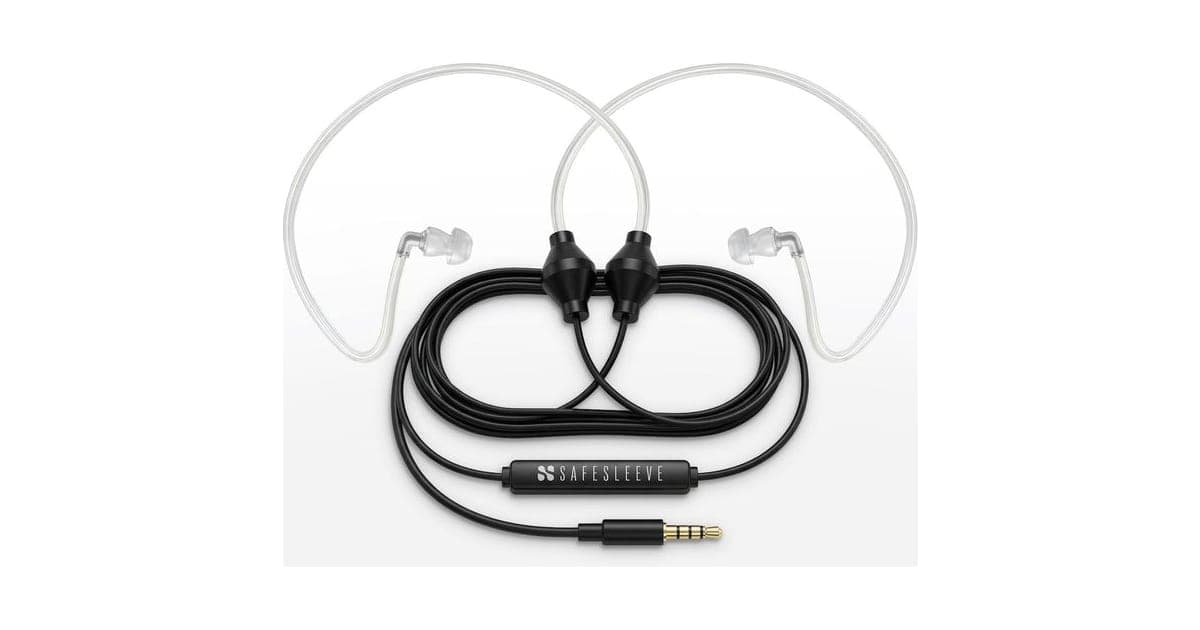
Yes, if you want inexpensive wired earbuds that keep electronics out of your ears and the phone away from your head, and you see that as a personal preference rather than a health fix. SafeSleeve Air-Tube headphones do what the design says: the speaker sits on the cable and sound travels up silicone tubes.
Score 5.6/10$34.99 at SafeSleeve
Check price at SafeSleeve (opens SafeSleeve in a new tab)We may earn a commission if you buy through our links.
- Best for
- People who want to keep electronics out of their ears and the phone away from their head on calls, and accept it as a personal preference
- Not for
- Music lovers who want full bass and detail; ordinary wired earbuds or good wireless ones sound better
$34.99 at SafeSleeve
Check price at SafeSleeve (opens SafeSleeve in a new tab)We may earn a commission if you buy through our links.
On this page · 14 sections
- 01Our verdict
- 02The short version
- 03Pros & cons
- 04How it works
- 05Who it's for
- 06What comes with Air-Tube headphones, and what do they cost?
- 07Are the Air-Tube headphones' claims true?
- 08How do Air-Tube headphones sound and feel?
- 09Are Air-Tube headphones better than ordinary wired or Bluetooth earbuds?
- 10Are Air-Tube headphones legit, and what should you check before buying?
- 11What do owners say, and how did we score Air-Tube headphones?
- 12How to use Air-Tube headphones for the best results
- 13What else do people ask about EMF and headphones?
- 14Frequently asked questions
Our verdict
Yes, if you want inexpensive wired earbuds that keep electronics out of your ears and the phone away from your head, and you see that as a personal preference rather than a health fix. SafeSleeve Air-Tube headphones do what the design says: the speaker sits on the cable and sound travels up silicone tubes. They do not do what the sales page implies, which is relieve headaches, insomnia or tinnitus caused by EMF. They score 5.6 out of 10, held back by those claims, softer sound than normal earbuds and an offer price above SafeSleeve's own store.
The short version
- Wired earbuds with a 10 mm speaker driver on the cable and hollow silicone tubes carrying sound to your ears.
- Built-in mic, one button, a volume slider, three tip sizes, a 40-inch cable and a zip case; 3.5 mm plug with a USB-C adapter on the offer page.
- On 3 October 2026: $34.99 for one pair, $79.98 for three and $119.97 for five on the offer page, with a 30-day guarantee. SafeSleeve's own store listed them at $29.95.
- Best trait: an easy, cheap way to take calls and listen with nothing electronic in your ears.
- Biggest drawback: health claims that the science on EMF does not support, and sound that is typically thinner than standard earbuds.
- Our score: 5.6 out of 10, with the lowest mark for claim accuracy.
Pros & cons
Air-Tube headphones are a simple, cheap product with a clear design idea. Whether that idea is worth paying for depends on why you want it. As a preference for fewer electronics near your head, they deliver. As a cure for symptoms, they are sold on claims the evidence does not support.
What we like
- Moves the speaker driver about a hand's width down the cable, so no electronics sit in your ears
- Built-in microphone, a play/answer button and a volume slider let you take calls with the phone away from your head
- Three tip sizes, a 40-inch cable and a zip carrying case included
- Inexpensive: $34.99 for one pair with a USB-C adapter, less per pair in bundles
- No battery, Bluetooth or charging to think about
What we don't
- Claims that headphone EMF causes headaches, insomnia, tinnitus or memory loss are not supported by evidence
- The 99% figure comes from the brand's own lab testing, which we could not read
- Air tubes typically soften bass and detail compared with ordinary in-ear earbuds
- Wired only; most new phones need the adapter, which some owners find fiddly
- SafeSleeve's own store listed the same headphones for less than the offer page on the day we checked
Sold by SafeSleeve
SafeSleeve Air-Tube Headphones$34.99
How it works
Air-tube earphones are not new. Security staff and broadcasters have used the same principle for years: a speaker on the cable, a clear tube up to the ear. SafeSleeve applies it to a consumer headset with a mic and controls.
The speaker sits on the cable, not in your ear
Step 1: Each earbud's small speaker driver is housed in a black capsule on the cable, below your ear, instead of inside the earbud.
Sound travels up a hollow tube
Step 2: The driver pushes sound into a clear silicone tube that runs up to a soft tip in your ear canal, the same principle as the air-tube earpieces used by security staff.
Less metal and electronics near your head
Step 3: With no driver, magnet or wire at the ear, the earbud itself carries no electrical signal; the phone stays at arm's length on calls, which is the main way any headset reduces radio-frequency exposure to the head.
It is worth separating two things the sales page blends together. The tube design removes the small electrical signal and magnet from the earbud. The bigger effect on radio-frequency exposure comes from using any headset at all, because it keeps the phone, the actual transmitter, away from your head.
Who it's for
Air-Tube headphones suit people who prefer to keep electronics out of their ears and away from their heads, whether from caution or comfort, and want an inexpensive headset that does that. They suit heavy phone and video-call users who want the phone off their face and a mic on the cable. And they suit listeners whose main use is speech: podcasts, audiobooks, meetings.
They are not the right buy if sound quality comes first, if you want noise cancelling, or if you are hoping they will fix symptoms you have put down to EMF. For that last group, the honest advice is a doctor's appointment, not a headset.
- People who want to keep electronics out of their ears and the phone away from their head on calls, and accept it as a personal preference
- Anyone who spends hours on calls and wants a cheap wired headset with a mic
- Listeners who mainly use speech, such as podcasts, audiobooks and meetings, where bass matters less
Who should skip it
- Music lovers who want full bass and detail; ordinary wired earbuds or good wireless ones sound better
- Anyone buying them to treat headaches, insomnia, tinnitus or other symptoms; see a doctor instead
- People who want noise blocking for flights or commuting; air tubes do not cancel noise
- Anyone who dislikes cables or adapters
What comes with Air-Tube headphones, and what do they cost?
An order contains the headphones in black or white, three sets of ear tips in different sizes, a zip carrying case and, on the offer page, a USB-C to 3.5 mm adapter. The cable is about 40 inches long and ends in a standard 3.5 mm four-pole plug.
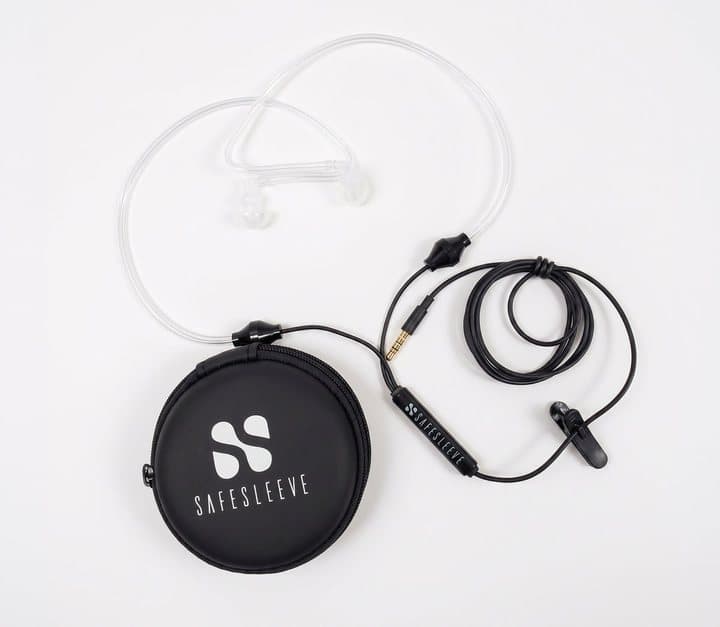
The headphones and the included carrying case
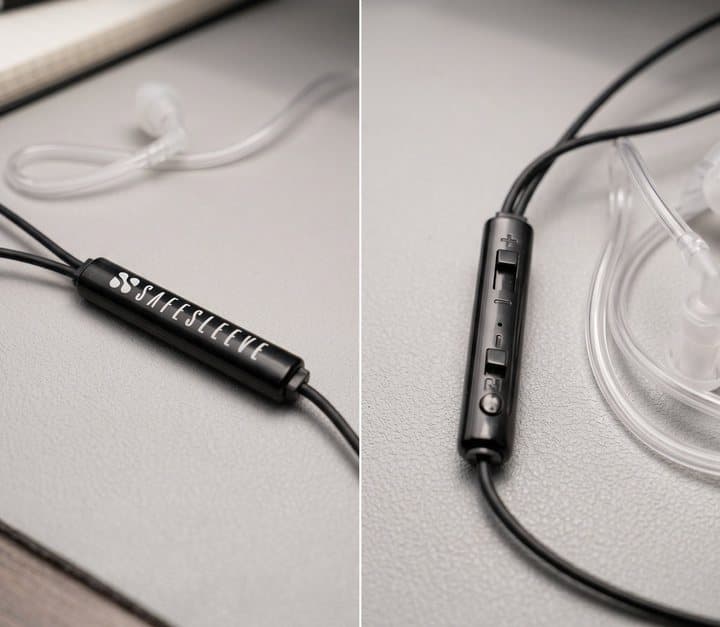
The in-line microphone, button and volume slider
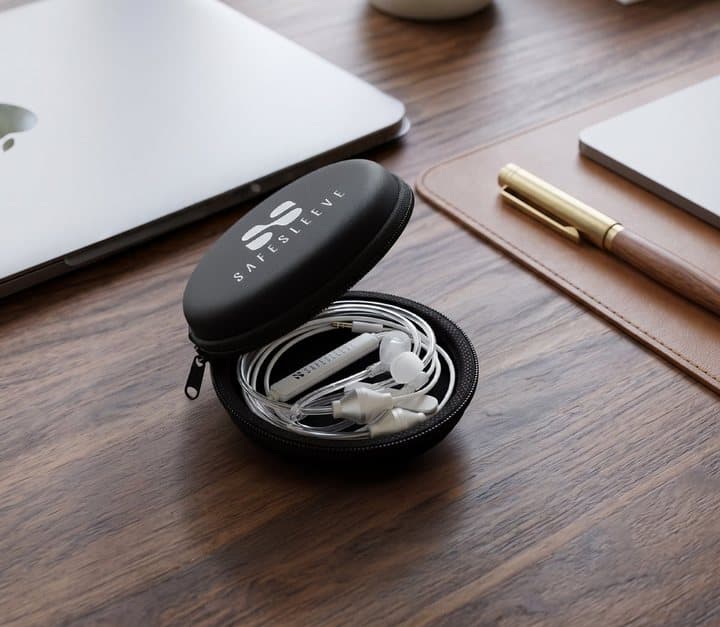
The white version in its case
Specifications
| Spec | Air-Tube headphones |
|---|---|
| Driver | 10 mm, one per side, on the cable |
| Sensitivity | 102 ± 3 dB |
| Frequency range | 20 Hz to 20 kHz (stated) |
| Impedance | 32 ohms |
| Rated power | 10 mW |
| Cable | About 40 in (1 m) |
| Plug | 3.5 mm; USB-C adapter on the offer page |
| Controls | One button (play, answer, skip, assistant), volume slider, I/N switch |
| Microphone | Built in, on the remote |
| Tips | Three sizes |
| Colours | Black, white |
The specs are ordinary for wired earbuds. The 32-ohm impedance and 102 dB sensitivity mean they will play loud enough from any phone or laptop without an amplifier. The 20 Hz to 20 kHz range is a standard claim; the tube design affects what reaches your ear more than the driver's range does.
The I/N switch
The remote has a small switch marked "I" and "N". SafeSleeve's instructions say to leave it on "I" for most devices. Switches like this usually swap the wiring standard for the microphone, because some older Android phones and other devices use a different plug wiring. If your mic does not work on calls, try the other position.
Air-Tube price and bundles
On 3 October 2026 the offer page our link opens showed:
| Package | Total | Per pair | Shown as | Extras |
|---|---|---|---|---|
| 1 pair | $34.99 | $34.99 | Retail $39.99 | USB-C adapter |
| Buy 2, get 1 free (3 pairs) | $79.98 | $26.66 | Retail $119.97 | USB-C adapter, free shipping |
| Buy 3, get 2 free (5 pairs) | $119.97 | $23.99 | Retail $199.95 | USB-C adapter, free shipping |
The same day, SafeSleeve's own store listed the headphones at $29.95, or $32.90 with a USB adapter. If you want a single pair, that was the cheaper route. The bundles only make sense if several people in your household want a pair.
Is $35 good value?
For wired earbuds with a mic, $35 is mid-range. Ordinary wired earbuds from a phone maker cost about $20. Generic air-tube headsets cost from about $15 to $40, so SafeSleeve sits in the normal range for the category, with a better kit (case, three tip sizes, adapter) than many cheaper ones.
What the offer page says about awards and ratings
The page says the headphones are rated 4.8 out of 5 with more than 7,500 five-star reviews, and calls them a 2026 Oprah Daily "O-ward" winner. We could not confirm which SafeSleeve product the award was for, and the review count appears to cover the brand's products rather than these headphones alone. Independent ratings are much smaller (see "What owners say").
Who SafeSleeve is
SafeSleeve is a US company best known for phone, tablet and laptop cases that it sells as EMF-shielding, and the headphones are part of the same range. The offer page our link opens is run on a third-party sales platform, while SafeSleeve also sells directly through its own store. Customer support for both goes through SafeSleeve's support email.

SafeSleeve Air-Tube HeadphonesScore 5.6/10
Best for: People who want to keep electronics out of their ears and the phone away from their head on calls, and accept it as a personal preference
$34.99 at SafeSleeve · Price checked October 3, 2026
Check price at SafeSleeve (opens SafeSleeve in a new tab)We may earn a commission if you buy through our links.
Are the Air-Tube headphones' claims true?
Air-Tube's design claim is true: the driver sits on the cable, so there are no electronics in your ear canal, and sound travels up hollow silicone tubes. The "up to 99%" EMF reduction comes from the brand's own lab testing, which we could not read. Claims linking headphone EMF to headaches, insomnia, tinnitus or memory loss are not supported by the evidence health agencies have reviewed.
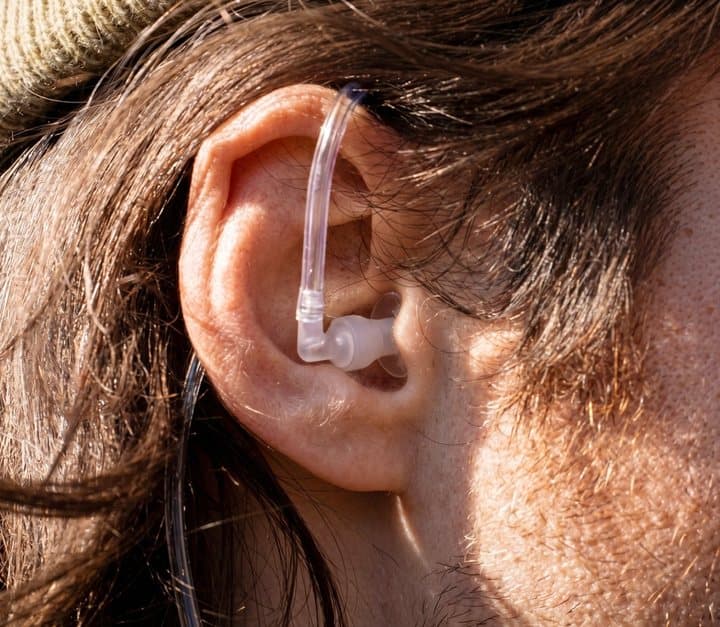
The sales page makes three kinds of claim: about what the design does, about how much EMF it removes, and about what EMF does to your health. They need to be judged separately.
"No electronics in your ears"
This is true. The earbud is a soft tip on a hollow tube. The driver, with its magnet and the wire carrying the audio signal, sits on the cable below your ear. If you want nothing electrical in your ear canal, the design achieves that.
"Reduces EMF exposure to your brain by up to 99%"
The page says the headphones were lab tested in an FCC-accredited lab and reduce radio-frequency radiation by up to 99% and low-frequency radiation by up to 92%. We could not find the test report, so we cannot say what was measured, at what distance, or against which comparison headphones.
What we can say is that wired earbuds do not transmit radio signals; they carry a low-power audio signal, which creates a very weak magnetic field at the driver. Moving the driver a few inches away does reduce that field at the ear, because fields like this fall off quickly with distance. Whether that reduction matters for health is a separate question.
"Wired and wireless headphones put a powerful source of EMF in your ear"
This overstates things. Bluetooth earbuds do contain a low-power radio transmitter, but it is far weaker than a phone held to the head. Wired earbuds have no transmitter at all. The Federal Communications Commission's consumer guide on wireless devices and health concerns says wired and wireless earpieces both greatly reduce exposure to the head by moving the phone away. It also notes some wired earpieces may conduct a little energy, which is the gap air tubes aim to close.
Symptoms the page links to EMF
The page lists headaches, dizziness, fatigue, poor concentration, memory loss, nausea, tingling, rashes, aches, anxiety, insomnia, tinnitus and light flashes as effects of EMF exposure, and says the headphones may reduce or even eliminate them. The World Health Organization's position on electromagnetic hypersensitivity is that these symptoms are real and can be disabling, but that studies have not found a link between them and electromagnetic fields.
In double-blind tests, people who report sensitivity to EMF cannot tell when a field is switched on or off any better than chance, and their symptoms appear whether or not the field is real. That is why doctors focus on treating the symptoms, which often have other causes worth finding.
Why the symptom list is so broad
The symptoms on the page, from headaches and tiredness to anxiety, poor sleep and aches, are among the most common complaints in everyday life. Almost everyone has some of them some of the time. When a sales page links them to a hidden cause and offers a simple fix, many readers will recognise themselves, which is persuasive but is not evidence that the cause is real.
If you do feel better after switching headphones, that may be genuine relief from worry, from taking the phone off your face, or from a change in how you use your phone. Those are worthwhile, and you do not need the EMF explanation to enjoy them.
Long-term health and brain cancer
The page refers to protecting your brain from the long-term consequences of EMF exposure. The International Agency for Research on Cancer classed radio-frequency fields as "possibly carcinogenic" in 2011, the same category as pickled vegetables and aloe vera extract, on limited evidence. Since then, the evidence has become more reassuring. A WHO-commissioned systematic review published in 2024, covering 63 studies from 1994 to 2022, found no link between mobile phone use and brain cancer, even with long or heavy use.
"Doctor-endorsed" and "safe for all ages"
The page quotes "Dr. N. Patel, M.D." recommending them to patients, without saying who that is or what kind of doctor. One quoted endorsement is marketing, not evidence. "Safe for all ages" is fair in the sense that wired earbuds pose no special risk, but the real risk for children with any earbuds is volume, not EMF.
"Keeps your head cooler"
The page lists heat as a form of radiation the headphones protect against. Wired earbuds produce almost no heat. Holding a phone against your head on a long call warms your ear mostly through contact and the phone's own warmth, which any headset avoids.
Claims scorecard
| Claim | What the evidence shows | Our view |
|---|---|---|
| No electronics in the ear | True of the design | Supported |
| Phone kept away from the head on calls | True of any headset; the main way to cut RF exposure | Supported |
| Reduces EMF at the ear by up to 99% | Plausible for the ear itself; brand's test report not available | Unverified |
| Ordinary headphones are a powerful EMF source | Wired earbuds do not transmit; Bluetooth is low power | Overstated |
| Reduces headaches, insomnia, tinnitus and other symptoms | WHO finds no link between these symptoms and EMF | Not supported |
| Protects against long-term brain harm | Large 2024 review found no phone-brain cancer link | Not supported |
| Same premium sound | Air tubes typically soften bass and detail | Overstated |
How do Air-Tube headphones sound and feel?
Expect thinner sound than ordinary earbuds. When sound travels up a narrow tube, some energy is lost and the tube resonates, so air-tube earphones usually have less deep bass, a slightly hollow character in the mids and less fine detail. They are fine for calls, podcasts and casual music. A good seal matters most, so try each of the three tip sizes, and a modest bass boost can help.

Sound is the trade-off with any air-tube design, and it is where buyers are most likely to be disappointed if they expect ordinary earbuds.
Why air tubes sound different
When sound travels up a narrow, flexible tube, some of its energy is lost along the way, and the tube itself resonates at certain frequencies. In practice, air-tube earphones usually have less deep bass, a slightly hollow or "tubey" character in the mids, and less fine detail than in-ear earbuds with the driver right at the ear canal. Voices stay clear, which is why the design suits calls, podcasts and audiobooks.
What owners say about the sound
The testimonials on the sales page say the sound is just like regular headphones or better than expected, and one runner says they sound better than his previous running earphones. Independent reviews of air-tube earphones generally describe them as fine for speech and casual music, with weaker bass. We have not listened to them, so expect the honest middle ground: good enough for most everyday listening, not a pick for bass-heavy music.
Fit and comfort
The tips sit in your ear canal like standard in-ear earbuds, and the tube can loop over the ear to hold the earbud in place. With three tip sizes, most people can find a seal. A good seal matters more with air tubes than with ordinary earbuds, because a loose fit loses what bass there is.
Microphone and calls
The microphone sits on the remote, below your chin. For calls, that keeps the phone at arm's length or on a desk, which is the most effective step for reducing exposure to your head, and it frees your hands. Owners on video calls show it working with laptops through the headphone jack.
Cable noise
Wired earbuds pass knocks and rubs on the cable up to your ears as noise, called microphonics. Air-tube designs can be prone to this too, since the tube carries vibration. Looping the tube over your ears and using the shirt clip, if supplied, helps.
Volume and power
With 102 dB sensitivity and 32-ohm impedance, the drivers are easy to drive and will go loud from a phone. The tube loses some energy, so you may find yourself turning the volume up a notch compared with ordinary earbuds. Watch that, because the habit of listening louder is what damages hearing over time.
Durability of the tubes
The silicone tubes are the part that takes the most handling: they flex every time you put the earbuds in, loop them over your ears and coil them away. Over months, silicone can harden, discolour or split, especially if it is kinked or exposed to heat. The carrying case helps, and storing the headphones loosely coiled rather than tightly wrapped matters more than you might expect.
Are Air-Tube headphones better than ordinary wired or Bluetooth earbuds?
Ordinary wired earbuds also keep the phone away from your head and transmit no radio signal; the difference is the small driver and wire at your ear, and they sound fuller for less money. Bluetooth earbuds transmit at very low power, within international safety limits. Air-Tube suits people who simply prefer no electronics in the ear, at $24 to $35, with thinner sound as the trade-off.
Air-tube earbuds are one way to reduce how much electronics and radio signal sit near your head. Here is how they compare with the alternatives.
| Option | Typical cost | Electronics at the ear | Phone away from head | Sound | Best for |
|---|---|---|---|---|---|
| SafeSleeve Air-Tube | $24 to $35 | None | Yes | Thinner, clear voices | Calls and speech with no electronics in the ear |
| Generic air-tube headset | $15 to $40 | None | Yes | Similar | Same idea for less, kit varies |
| Ordinary wired earbuds | About $20 | Small driver, no radio | Yes | Fuller | Best sound per dollar |
| Bluetooth earbuds | $30 to $250 | Driver and low-power radio | Yes | Good to excellent | Convenience, noise cancelling |
| Speakerphone | Free | None | Yes | Phone speaker | Calls at home or the desk |
Air-Tube vs ordinary wired earbuds
Both keep the phone away from your head and neither transmits a radio signal. The difference is the small driver and its wire at your ear. If that matters to you, Air-Tube removes it; if it does not, ordinary wired earbuds sound fuller for less money.
Air-Tube vs Bluetooth earbuds
Bluetooth earbuds have a low-power radio in each ear, far weaker than a phone held to the head and within safety limits. They win on convenience, sound and noise cancelling. If you want no radio near your head, Air-Tube is the simpler choice; if you are comfortable with the evidence on Bluetooth, the wireless options are better headphones.
Air-Tube vs speakerphone
For calls, the speakerphone is free and puts the phone furthest from your head. It is less private and not suitable for music in public. A headset of any kind is the practical middle ground.
Air-Tube vs keeping your current earbuds
If you already own wired earbuds, the case for buying Air-Tube rests entirely on how much you care about the small driver and wire at your ear. If you already own Bluetooth earbuds and want to reduce radio near your head, a cheaper step is to use them less for long calls and switch to speakerphone at your desk. Air-Tube is a reasonable purchase if you want that preference built in, not a necessary one.
Air-Tube vs generic air-tube headsets
Many brands sell air-tube earbuds, often for less. SafeSleeve's version adds a case, three tip sizes, a mic with controls and, on the offer page, a USB-C adapter. Compare those details, the tip sizes and the return terms before deciding.
Air-Tube vs bone conduction headphones
Bone conduction headphones sit in front of the ears and send vibration through the cheekbones, leaving the ear canal open. Most are wireless, so they have a Bluetooth radio near the head, and they leak sound and lose bass. They suit runners and cyclists who need to hear traffic. Air tubes suit people who want no radio and no driver at the ear, and do not mind something in the ear canal.
If you have decided air tubes suit you, the Air-Tube order page (opens SafeSleeve in a new tab) lists the bundles with the adapter included. Our audio section and wider tech and gadgets coverage review other devices sold with bold claims, including the Anything Speaker, a pocket vibration speaker sold as "bone conduction", the Clickfree photo backup drive and the CordBrick cord holder. If you mainly want to hear the TV more clearly, our HearDirect TV headphones review covers a different kind of headset.
SafeSleeve Air-Tube HeadphonesScore 5.6/10
Why people buy it: Moves the speaker driver about a hand's width down the cable, so no electronics sit in your ears
$34.99 at SafeSleeve · Price checked October 3, 2026
Check price at SafeSleeve (opens SafeSleeve in a new tab)We may earn a commission if you buy through our links.
Are Air-Tube headphones legit, and what should you check before buying?
SafeSleeve is a real company, best known for its phone cases, with a Trustpilot score of 3.9 from 48 reviews and a 30-day money-back guarantee on the offer page. Before buying, check that your phone has a headphone jack or use the USB-C adapter, compare the price with SafeSleeve's own store, which listed them for less, and test the sound with your own music within 30 days.
Most disappointment with air-tube headphones comes from expecting them to sound like ordinary earbuds, or to fix symptoms. Here is what to check, and what to do about each.
Sound expectations
Air tubes trade some bass and detail for the design. If you listen mostly to music with deep bass, you may be disappointed.
What to do: buy one pair first and test it with the music you actually listen to within the 30-day window, before buying a bundle for the family.
Health claims and symptoms
If you have headaches, poor sleep, ringing in the ears, dizziness or tingling, the headphones are unlikely to help, because the evidence does not link those symptoms to EMF. Some of them have causes worth finding, from hearing damage to migraine to sleep disorders.
What to do: see a doctor about persistent symptoms. Use the headphones, if you like them, as headphones.
Shielding cases and other EMF products
SafeSleeve and many other brands sell cases, pouches, blankets and stickers marketed as EMF protection. A case that blocks signal on one side can make the phone work harder to stay connected, which may increase its output. The simplest exposure-reducing steps, a headset and keeping the phone off your body, cost nothing extra.
What to do: before buying more EMF products, ask what each one does that a headset and distance do not.
Hearing safety
The bigger health risk from any earbuds is loud volume. Listening at high volume for long periods can permanently damage hearing and cause tinnitus, the very symptom the sales page links to EMF.
What to do: keep the volume at a level where you can still hear someone speaking near you, and use your phone's hearing health or volume limit settings, especially for children.
Adapters and compatibility
The headphones use a 3.5 mm plug. iPhone 15 and newer and most Android phones need a USB-C adapter, included on the offer page. iPhone 7 to 14 need a Lightning adapter, which is not included. Cheap adapters sometimes do not pass the microphone signal.
What to do: check which port your phone has before ordering, and if the mic does not work, try the I/N switch and a different adapter.
Buying for a household
The bundles are priced for families: three pairs for $79.98 or five for $119.97. That makes sense if several people will use them daily. If you are buying for children, think about whether a child will wear wired earbuds with a tube over the ear, and whether volume limits on their devices would protect them more.
What to do: buy one pair first if you are unsure how the family will take to them, and move to a bundle once you know.
The price difference
On the day we checked, SafeSleeve's own store listed the headphones for $5 less than the offer page.
What to do: compare both before buying a single pair. The offer page bundles are better value only if you need three or five pairs.
Returns
The offer page promises a 30-day money-back guarantee with hassle-free returns. Returns start through an order lookup on the offer site or by emailing SafeSleeve support. In-ear products that have been used may be treated differently from unopened ones.
What to do: check the return terms at checkout, keep the case, tips and adapter, and start any return well inside 30 days.
How to buy Air-Tube headphones the smart way
- Decide why you want them: fewer electronics near your head, or calls with the phone away from your face. If it is a symptom, see a doctor first. Then open the Air-Tube offer page (opens SafeSleeve in a new tab).
- Check your phone's port. USB-C phones are covered by the included adapter; Lightning iPhones need their own adapter.
- Choose one pair unless several people in your home want them. Three or five pairs only save money if all are used.
- Pick black or white, and check the order summary for add-ons you did not choose.
- Save your order confirmation. The 30-day guarantee window starts from your order or delivery, so check which.
- Test them with your own music, podcasts and a phone call in the first week, and decide well before day 30.
What do owners say, and how did we score Air-Tube headphones?
Air-Tube headphones score 5.6 out of 10: claim accuracy 0.6, build durability 1.2, price competitiveness 1.3, usability 1.3 and owner satisfaction 1.2, each out of 2. SafeSleeve's Trustpilot profile showed 3.9 from 48 reviews, mostly about its phone cases. The sales page testimonials say the sound is better than expected, but independent reviews of the headphones themselves are few.
The sales page shows a handful of five-star testimonials. Independent reviews are fewer and mostly about SafeSleeve's phone cases rather than the headphones.
Trustpilot
On 3 October 2026 the Trustpilot profile for safesleevecases.com showed a TrustScore of 3.9 out of 5 from 48 reviews: 57% five-star, 8% four-star, 4% two-star and 31% one-star. The profile was claimed in January 2026. Most reviews are about the brand's phone and laptop cases.
Positive reviews praise customer service and fair returns. Negative reviews are mainly about case durability, sizing and one slow refund. The one headphone mention we saw was from a buyer whose older iPhone did not work with them and who was refunded without having to send them back.
The testimonials on the page
The sales page testimonials describe comfortable fit, sound better than expected and peace of mind about EMF. One mentions having to swap the tips to get a good fit, which is normal. One runner adds a ferrite bead to the cable, which is a common step among people concerned about EMF but has no demonstrated health effect.
Third-party reviews in search
Pages ranking for Air-Tube headphone reviews are mostly paid press releases, affiliate lists of "best air tube headphones" and marketplace listings. Few say how the headphones sound compared with ordinary earbuds. Treat them as advertising.
How we scored Air-Tube headphones
Every score on the site follows the five criteria on our how we test page.
| Criterion | Score | Why |
|---|---|---|
| Claim accuracy | 0.6 / 2 | Design claims true; 99% figure unverified; symptom and brain-health claims unsupported |
| Build durability | 1.2 / 2 | Simple wired design with a case; silicone tubes and cable are the wear points |
| Price competitiveness | 1.3 / 2 | Fair for the category; cheaper on the brand's own store for one pair |
| Usability | 1.3 / 2 | Mic and controls work like standard earbuds; adapter needed for most phones; softer sound |
| Owner satisfaction | 1.2 / 2 | Positive testimonials; small, case-focused independent record |
| Total | 5.6 / 10 |
The score would rise with a published, independent test of the EMF claims and the sales page dropping the symptom claims.
What we did, and did not, do
Nobody on our team has used Air-Tube headphones, and this review does not claim otherwise. We read the offer page our link opens, SafeSleeve's store data for specifications and prices, the Trustpilot profile, the FCC's consumer guide on wireless devices and health, the WHO's material on electromagnetic hypersensitivity and the 2024 WHO-commissioned review of phones and brain cancer, all on 3 October 2026. We also looked at the pages that rank for these headphones to see what they cover and miss.
That means we cannot tell you how they sound from our own ears. What we can tell you is what the design does, what the specifications say, what the evidence on EMF shows and what owners report, and where the sales page goes further than any of those.
How to use Air-Tube headphones for the best results
Try the medium tips first, pushing them on with a twist, and swap sizes until the earbud seals comfortably. Insert the tips and loop the clear tube over each ear to hold it in place. Plug into your headphone jack, or the USB-C adapter for newer phones, and set the I/N switch for your device. Avoid kinking the tubes, which can muffle the sound.
- Try the medium tips first. Push them on with a twist, and swap sizes until the earbud seals comfortably without falling out.
- Insert the tips and loop the clear tube over the top of each ear to hold it in place.
- Plug into your device's headphone jack, or use the USB-C adapter for newer phones.
- Leave the I/N switch on "I"; if the mic does not work on calls, try "N".
- Use one click to play, pause or answer, two clicks to skip, and a long press for your voice assistant, as on standard earbuds.
- Set the volume slider and your phone volume so you can still hear someone talking nearby.
- Store them coiled loosely in the case, not wrapped tightly around your phone, to protect the tubes.
Getting the best sound
A good seal is everything with air tubes. If they sound thin, try a larger tip and push the earbud slightly deeper. Avoid kinking the tube, which can muffle the sound. If your phone has an equaliser, a modest bass boost can make up for some of what the tubes lose.
Using them for calls
Keep the phone on a desk or in a pocket and speak normally; the mic is on the remote below your chin. If people say you sound quiet, check that clothing is not covering the mic and that the I/N switch is right for your device.
Cleaning
Wipe the tips with a damp cloth or alcohol wipe regularly, and remove them to clean if you see wax build-up, which can also block the sound. Do not push anything into the tube itself. Let the tips dry fully before reattaching.
Replacing tips and tubes
Silicone tips and tubes are the parts most likely to wear, harden or split over time. Ask SafeSleeve support about replacement tips before replacing the whole headset. If a tube splits, the sound on that side will drop away.
Taking them running
The tube-over-ear fit helps them stay put, and one runner in the testimonials uses them for podcasts. Sweat can make tips slip and wired cables can bounce. A shirt clip and a loop of cable inside your top reduce both.
Using them with laptops and other devices
Laptops, tablets and most in-flight entertainment systems with a 3.5 mm jack work without an adapter. On planes with two-prong sockets you need an airline adapter. The mic works on laptops with a combined headset jack.
SafeSleeve Air-Tube HeadphonesScore 5.6/10
Before you buy: Check the final price, shipping and return terms at checkout.
$34.99 at SafeSleeve · Price checked October 3, 2026
Check price at SafeSleeve (opens SafeSleeve in a new tab)We may earn a commission if you buy through our links.
What else do people ask about EMF and headphones?
Most questions are about radiation. Wired headphones carry a weak electrical audio signal that creates a tiny magnetic field around the driver, but they do not transmit radio waves. Bluetooth earbuds transmit at very low power, far below a phone held to the ear and within international safety limits. Keeping the phone away from your head with any headset is the simplest way to reduce exposure.
Do wired headphones emit radiation?
They carry a weak electrical audio signal, which creates a tiny magnetic field around the driver. They do not transmit radio waves. The phone they are plugged into does transmit, which is why any headset that keeps the phone away from your head reduces your exposure.
Are Bluetooth earbuds dangerous?
Bluetooth earbuds transmit at very low power, far below a phone held to the ear and within international safety limits. Health agencies have not found evidence of harm from them. If you prefer to avoid any radio near your head, wired or air-tube earbuds avoid it.
Does 5G make EMF exposure worse?
5G uses radio frequencies within the same safety limits as earlier networks, and exposure from phones and masts remains well below them. Most 5G frequencies penetrate the body less deeply than older ones. Your headphones do not affect your exposure to network signals around you.
Do anti-radiation stickers and cases work?
Stickers that claim to block phone radiation have been the subject of FTC action in the past, and the FCC warns that some shields can make a phone transmit harder to keep its signal. A headset or speakerphone that moves the phone away from your head is simpler and proven to reduce exposure.
What is electromagnetic hypersensitivity?
It is the name people give to symptoms they attribute to electromagnetic fields, such as headaches, fatigue and tingling. The WHO accepts the symptoms are real but does not recognise EMF as their cause, because blinded studies have not found a link. Treatment focuses on the symptoms themselves.
How can I reduce my phone radiation exposure simply?
Use a headset or speakerphone for long calls, text rather than call when you can, keep the phone off your body when you are not using it, and avoid long calls when the signal is weak, since phones transmit harder then. These steps cost nothing and are what health agencies suggest for anyone who wants to reduce exposure.
Can children use air-tube headphones?
Yes, they are ordinary wired earbuds with no battery or radio. For children, the important limits are volume and listening time. Choose a size of tip that fits, and set a volume limit on the device.
Frequently asked questions
Do air tube headphones really reduce radiation?
They reduce electromagnetic fields right at the ear, because there is no speaker driver or wire inside the earbud. Most of the reduction in radio-frequency exposure to your head, though, comes from keeping the phone away from your head, which any wired or wireless headset or a speakerphone also does. The brand's 99% figure comes from its own lab tests, which are not published in full.
Are EMFs from headphones harmful?
There is no consistent evidence that they are. The FDA says the weight of evidence does not show health risks from phone radio-frequency exposure within FCC limits, and a 2024 WHO-commissioned review of 63 studies found no link between mobile phone use and brain cancer. Ordinary wired earbuds carry an audio signal, not a radio transmitter.
Do Air-Tube headphones sound good?
Owners on the sales page describe the sound as better than expected. Air-tube designs generally soften deep bass and fine detail, because sound loses energy travelling up a narrow tube. Expect them to suit speech, calls and casual listening better than bass-heavy music.
Do Air-Tube headphones work with iPhone?
Yes, with an adapter. They use a standard 3.5 mm plug. iPhone 15 and newer and most Android phones need a USB-C to 3.5 mm adapter, which the offer page includes with each bundle. iPhone 7 to 14 need a Lightning adapter, which is not included.
How much do Air-Tube headphones cost?
On 3 October 2026 the offer page showed $34.99 for one pair, $79.98 for three and $119.97 for five, each with a USB-C adapter and free US shipping on the bundles. SafeSleeve's own store listed one pair at $29.95, or $32.90 with a USB adapter, the same day.
Are Air-Tube headphones safe for kids?
They are ordinary wired earbuds with no battery or wireless radio, so they carry no special risk. The usual rule for any earbuds applies: keep the volume moderate and limit listening time to protect hearing, which matters far more for children than EMF.
Can Air-Tube headphones help with headaches or tinnitus?
There is no evidence they can. The WHO says symptoms people attribute to electromagnetic fields are real, but studies have not linked them to EMF exposure. Headaches, ringing in the ears or poor sleep deserve a doctor's assessment.
What is the return policy?
The offer page promises a 30-day money-back guarantee with hassle-free returns and starts returns through an order lookup. Check whether return postage is free before you send them back, and keep the case and adapter. Test them within the window.
We may earn a commission if you buy through our links.
This content is for informational purposes and is not medical advice. Talk to a qualified professional before using any product that affects your health.
Prices accurate as of October 3, 2026. Check the seller's checkout for current pricing, promotions and terms.
What we checked: No hands-on use. Claims, bundles, guarantee, how-it-works copy, testimonials and product images from the Air-Tube offer page our link opens (getairtube.com) on 2026-10-03. Specifications (driver size, impedance, sensitivity, frequency range, cable length) and prices from SafeSleeve's own store data the same day. Trustpilot profile for safesleevecases.com, the FCC's consumer guide on wireless devices and health, the WHO's material on electromagnetic hypersensitivity and the 2024 WHO-commissioned review of mobile phones and brain cancer were read the same day.

About the author
Ethan Walker, Hardware & Gadget Tester
Ethan Walker covers hardware for Top10Gadgets: audio, computing, phone accessories, chargers, tools, car gadgets and sports equipment. Ethan believes a product should be judged on what happens when people actually use it…
- Headphones and speakers
- Chargers and phone accessories
- Tools and emergency gear
- Car accessories
- Durability and real-world performance
Writing for Top10Gadgets since 2026Full profile