Health Gadgets / Insoles
Liftly Insoles Review: What the 4D Cloud Insoles Do, Which Foot Problems They Can Help and What They Cost
Trimmable foam insoles with an arch, heel cup and massage nodes. Cushioned arch support is a sensible first step for sore feet, but '100% pain-free' goes well beyond what any insole can promise.

By James Wilson, Consumer Tech Writer at Top10Gadgets
Updated 30 min readHow we test
Quick answer
Yes, if your shoes have thin, flat insoles and your feet ache after long days, and you want an affordable, cushioned upgrade with arch support. Liftly's trim-to-fit insoles combine soft foam, an arch, a heel cup and massage nodes, cost $29.99 a pair, and research suggests off-the-shelf insoles help many people with heel pain.
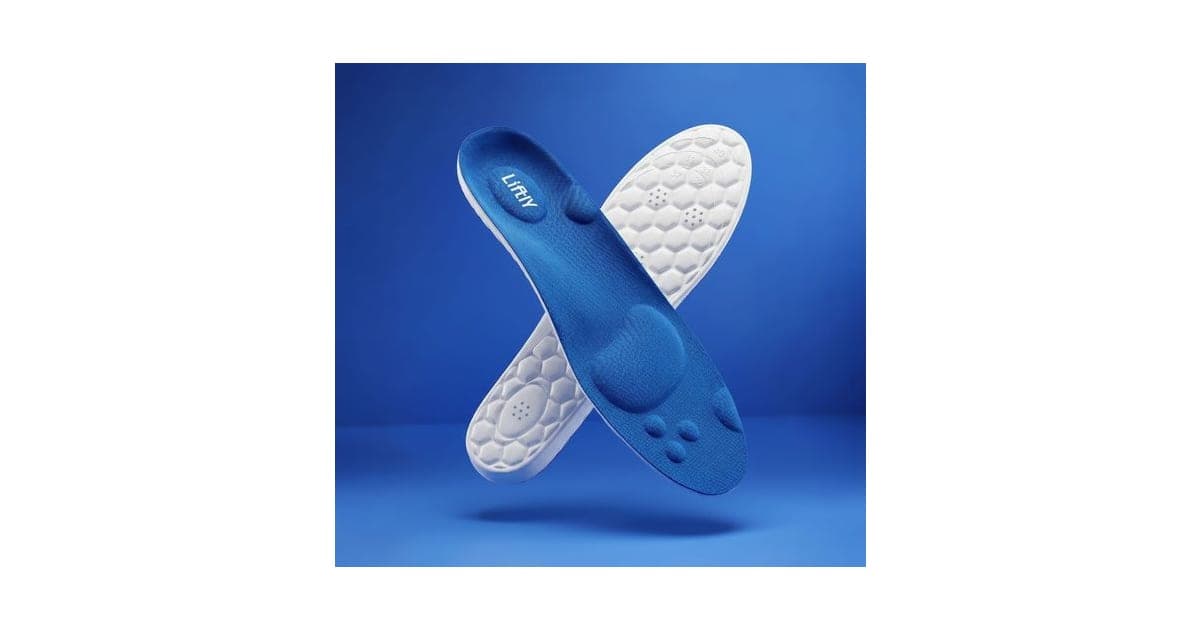
Score 5.4/10$29.99 at Liftly
Check price at Liftly (opens Liftly in a new tab)We may earn a commission if you buy through our links.
- Best for
- People on their feet all day who want softer, more supportive shoes
- Not for
- People with diabetes, neuropathy or poor circulation in the feet, who should get footwear advice from a clinician
$29.99 at Liftly
Check price at Liftly (opens Liftly in a new tab)We may earn a commission if you buy through our links.
On this page · 14 sections
- 01Our verdict
- 02The short version
- 03Pros & cons
- 04How it works
- 05Who it's for
- 06How much do Liftly insoles cost, and what sizes are there?
- 07How well do Liftly insoles work?
- 08Are Liftly's claims true?
- 09Are Liftly insoles better than firm orthotics or new shoes?
- 10Are Liftly insoles legit, and what should you check before buying?
- 11What do owners say, and how did we score Liftly?
- 12How to use Liftly for the best results
- 13What else do people ask about insoles?
- 14Frequently asked questions
Our verdict
Yes, if your shoes have thin, flat insoles and your feet ache after long days, and you want an affordable, cushioned upgrade with arch support. Liftly's trim-to-fit insoles combine soft foam, an arch, a heel cup and massage nodes, cost $29.99 a pair, and research suggests off-the-shelf insoles help many people with heel pain. But the page's list of conditions and "100% pain-free" promise go far beyond any insole, lookalikes are cheap, and evidence is thin. Liftly scores 5.4 out of 10, held back by overstated claims.
The short version
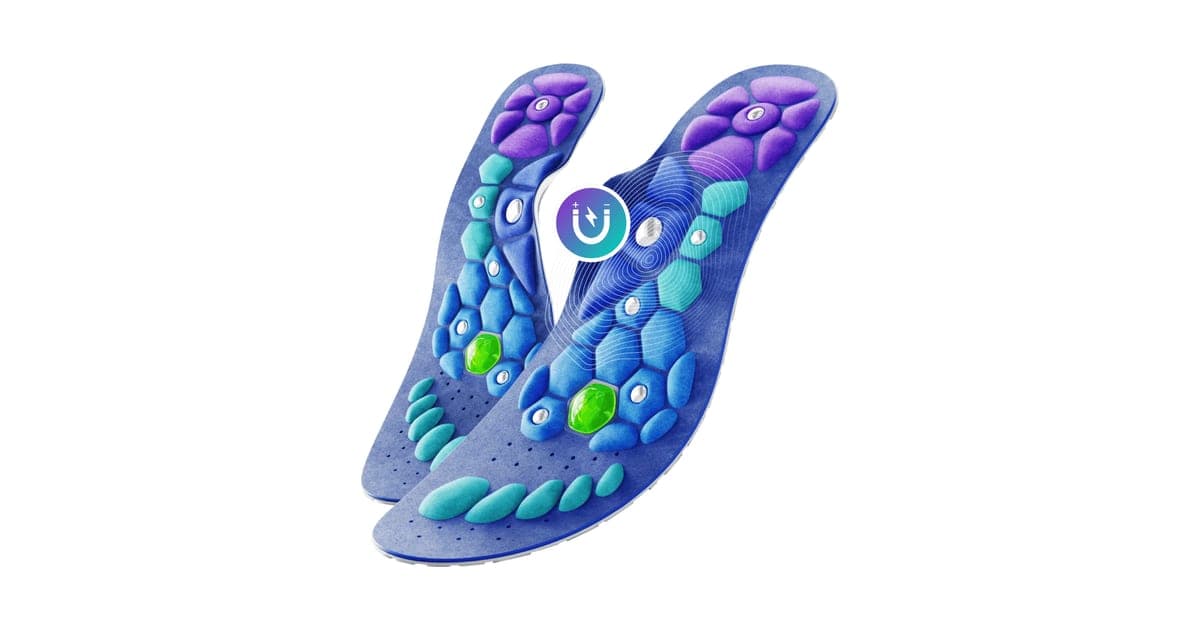
- Cushioned foam insoles with arch support, a deep heel cup and raised massage nodes.
- Trim-to-fit, in Standard (EU 37 to 41) and Large (EU 42 to 47).
- $29.99 a pair on 4 October 2026; three pairs $59.98 and six pairs $89.97.
- 1-year warranty and 30-day money-back guarantee.
- Last 12 months or more with daily wear, according to the FAQ.
- Off-the-shelf insoles with arch support can ease heel pain for many people.
- Claims to relieve a long list of conditions are not backed by product-specific evidence.
- Best trait: comfortable, adjustable support at a modest price.
- Biggest drawback: marketing that promises far more than an insole can deliver.
- Our score: 5.4 out of 10.
Pros & cons
Liftly sells a sensible kind of product. The cons are almost all about how it is described.
What we like
- Soft foam cushioning, a contoured arch and a deep heel cup, a combination often suggested for tired and sore feet
- Trim-to-fit in two size ranges, so most adults can get a good fit
- Washable, breathable and quick to fit; owners say no break-in period
- Prefabricated insoles with arch support are a reasonable, low-cost first step for heel pain, and research finds them comparable to custom orthotics for many people
- $29.99 a pair, cheaper per pair in bundles, with a 1-year warranty and 30-day guarantee
What we don't
- The page lists plantar fasciitis, Morton's neuroma, metatarsalgia and overpronation as if one insole addresses all of them
- "Walk, run, jump and stand 100% pain-free" and "total lower-body relief" are not realistic promises
- "Save 75%" sits next to a single-pair saving of 50% against a reference price
- Similar-looking "4D cloud" insoles are widely sold online, often cheaply
- No independent reviews; most coverage is paid advertorials and press releases
- One step image on the page is labelled with another product's name, a sign of a reused template
Sold by Liftly
Liftly Insoles$29.99
How it works
An insole sits between your foot and the shoe's sole. Thin, flat factory insoles offer little cushioning or arch support. Replacement insoles add foam to absorb impact, shape to support the arch, and a heel cup to cradle the heel's fat pad, spreading pressure more evenly.
Choose your size range and trim
Step 1: Pick Standard (EU 37 to 41) or Large (EU 42 to 47). Use your shoe's original insole as a template and trim the toe end of the Liftly insole to match.
Swap out the old insole
Step 2: Remove the shoe's original insole and slide Liftly in, heel first, so the heel cup sits at the back of the shoe and the arch lines up under your foot.
Walk and adjust
Step 3: Wear them for a few hours at first. The soft foam cushions impact, the arch supports the midfoot, and the raised nodes give a light massaging feel. If anything rubs, trim slightly more or check the fit.
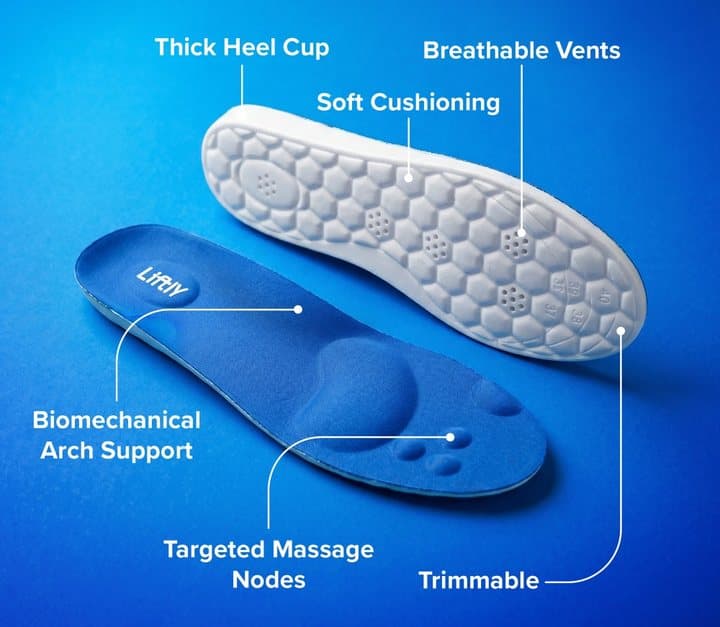
The brand's feature labels
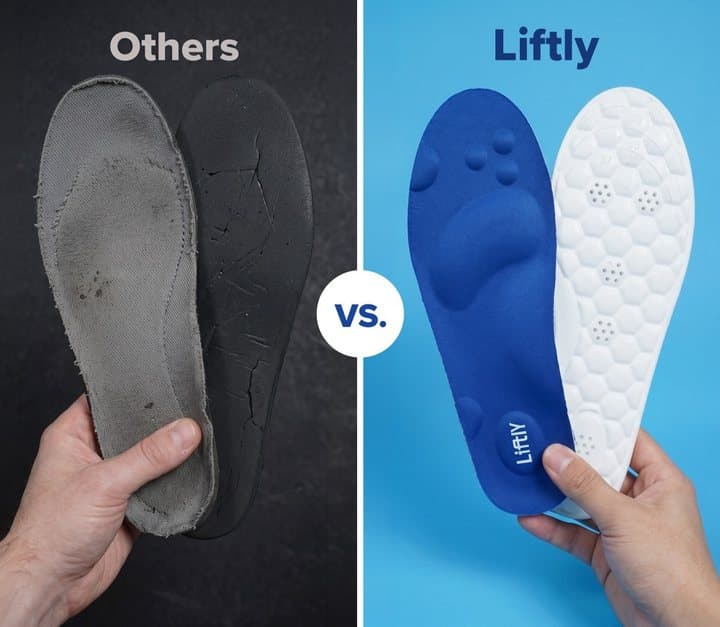
The brand's comparison with worn insoles
The cushioning
The page calls the foam "4D Cloud Cushioning". It describes a soft, squishy high-density foam that moulds to your movement. Soft foam feels comfortable immediately and absorbs impact on hard floors.
The arch and heel cup
The page's feature graphic labels biomechanical arch support and a thick heel cup. Arch support can reduce strain on the plantar fascia, the band of tissue along the sole, and a heel cup can keep the heel's natural padding under the bone.
The massage nodes
Raised "anatomical support nodes" give a textured feel underfoot. The page says they massage with every step; the FAQ calls it micro-stimulation that keeps feet from going numb on long shifts. Some people enjoy the sensation; others find raised nodes uncomfortable.
What the comparison photo shows
One page image compares old, worn, flat grey insoles labelled "others" with new Liftly insoles. It is a fair reminder that insoles wear out, but it compares a used insole with a new one. Any new insole looks and feels better than a worn-out one.
Trim-to-fit
Two size ranges cover most adults. You trim the toe end to your shoe's length, ideally using the original insole as a guide.
How the foot handles load
Each step puts a force of more than your body weight through the heel, and more when running. The foot spreads that load through the heel's fat pad, the arch and the ball of the foot. The plantar fascia, a thick band running from heel to toes, acts like a bowstring that supports the arch. When the arch flattens too much or the fascia is overloaded, the attachment at the heel can become painful. Cushioning reduces peak pressure at the heel; arch support shares load away from the fascia.
Common causes of foot pain
Everyday foot pain often comes from long hours standing on hard floors, unsupportive or worn-out shoes, a sudden increase in activity, weight gain, tight calf muscles and foot shape. Specific conditions include plantar fasciitis (heel pain worst with the first steps in the morning), metatarsalgia (pain under the ball of the foot), Morton's neuroma (burning or numbness between toes), Achilles problems and stress fractures. Different causes respond to different approaches, which is why a professional assessment helps if pain persists.
Size ranges explained
EU sizes 37 to 41 roughly cover US women's 6 to 10 and men's 4.5 to 8, and EU 42 to 47 cover roughly US men's 8.5 to 13, though brands vary. If you are between ranges, the larger one leaves more to trim. The page does not list a range for very small or very large feet.
Who it's for
Liftly suits people who stand or walk all day, such as nurses, retail and warehouse workers, teachers and travellers, and anyone whose shoes came with thin insoles. It suits people with mild heel or arch discomfort who want a low-cost first step.
It does not suit people who need medical foot care, such as those with diabetes or neuropathy, or anyone with severe or worsening pain.
Why Liftly appeals
Foot pain makes everything harder, and many people would rather try a $30 insole than book an appointment. The page's soft-looking foam, cloud language, list of conditions and photos of nurses, runners and older walkers promise comfort for everyone. Testimonials describe instant comfort without a break-in period.
The appeal of instant comfort
Soft cushioning gives an immediate "ahh" feeling when you step in, which is why it sells well. That first impression is real, but long-term comfort depends more on support and fit. A good insole should still feel supportive at the end of a long day and after a few months of wear, not just in the first minute.
A typical first day
You take out the thin insoles from your work shoes, trim the Liftly insoles to match, and slide them in. The shoes feel softer straight away, and the arch fills the gap under your midfoot. By the end of a long shift, your feet feel less tired than usual. Owners on the page describe exactly this.
A week later
After a week, most people know whether an insole suits them. Signs it is working: less end-of-day ache, no new rubbing, and shoes that still feel stable. Signs it is not: new pain in the arch or forefoot, heels slipping, or feet feeling hot and cramped. Use that first week, within the 30-day guarantee, to judge.
Who gets the most value
People who spend long hours on hard floors in shoes with poor insoles get the most value.
Who gets the least
People who already wear supportive shoes with good insoles, and people whose foot pain has a cause that cushioning cannot address, get the least.
What it will not do
It will not cure plantar fasciitis, Morton's neuroma or other conditions, correct structural foot problems, or replace assessment by a podiatrist or doctor for persistent pain.
As a gift
Insoles make a practical gift for people on their feet all day. Check their shoe size range first.
Nurses and healthcare workers
Long shifts on hard hospital floors are hard on feet, which is why the page features a nurse. Supportive work shoes plus cushioned insoles are a common combination. Compression socks can also help with leg fatigue for some people.
Older adults
Feet change with age: the fat pad under the heel thins, arches may flatten, and balance becomes more important. Cushioned insoles can make walking more comfortable. Very soft insoles can feel less stable for some older people, so check that shoes still feel secure. People with balance problems should get advice on footwear.
Walkers and travellers
Holidays often mean walking far more than usual. A cushioned insole in comfortable walking shoes can make long days of sightseeing easier. Try them for a week or two before a trip, not on the first day.
People who are overweight
More body weight means more load through the feet, and heel pain is more common. Cushioned, supportive insoles can help comfort while other changes, such as gradual weight loss and strengthening, take effect.
- People on their feet all day who want softer, more supportive shoes
- Anyone whose shoes came with thin, flat insoles
- People with mild heel or arch discomfort who want a low-cost first step before seeing a professional
Who should skip it
- People with diabetes, neuropathy or poor circulation in the feet, who should get footwear advice from a clinician
- Anyone with severe, worsening or night-time foot pain, numbness, or swelling, which needs assessment
- Runners and athletes who need sport-specific support or have a gait issue a specialist should assess
- People who already have prescribed orthotics
How much do Liftly insoles cost, and what sizes are there?
Liftly insoles cost $29.99 a pair on the offer page on 4 October 2026, with three pairs for $59.98 and six for $89.97. Each pair is trim-to-fit in one of two ranges, Standard (EU 37 to 41) or Large (EU 42 to 47), and combines soft "4D Cloud" foam with an arch, a deep heel cup and massage nodes. The page offers a 30-day money-back guarantee and a 1-year warranty.
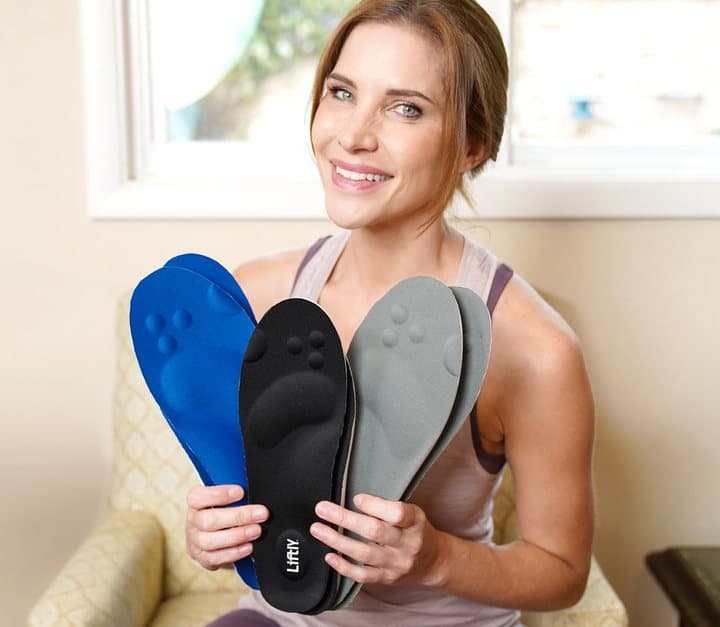
The page shows blue insoles with a white textured base; a photo also shows black and grey versions. Each pair is trim-to-fit in one of two size ranges.
Specifications
| Item | Detail |
|---|---|
| Type | Cushioned trim-to-fit insoles |
| Cushioning | "4D Cloud" high-density foam |
| Support | Arch support, deep heel cup |
| Texture | Raised massage nodes |
| Sizes | Standard (EU 37 to 41), Large (EU 42 to 47) |
| Breathability | Vented, breathable fabric, according to the page |
| Care | Washable |
| Lifespan | 12 months or more, according to the FAQ |
| Warranty | 1 year |
| Guarantee | 30-day money-back |
Liftly price and bundles
On 4 October 2026 the Liftly offer page (opens Liftly in a new tab) listed:
| Bundle | Price | Per pair | Retail shown |
|---|---|---|---|
| 1 pair | $29.99 | $29.99 | $59.99 |
| 3 pairs (buy 2, get 1 free) | $59.98 | $19.99 | $179.97 |
| 6 pairs (buy 3, get 3 free) | $89.97 | $14.99 | $359.94 |
The page's button says save 75%, which applies to the six-pair bundle against its retail price; one pair is $30 off a $59.99 reference price.
Lookalikes
Similar-looking "4D cloud" insoles with blue tops, textured white soles and massage nodes are widely listed on online marketplaces. That does not mean Liftly is the same product, but it suggests the design is common.
What this means for you: if you mainly want soft, arch-supported insoles, compare features and prices across brands. Liftly's warranty and guarantee are its main extras.
Is it good value?
At $29.99 a pair, Liftly sits mid-range among over-the-counter insoles. The bundles bring the price down if several people need them or you want pairs for different shoes.
Cost over time
If a pair lasts about a year, as the FAQ suggests, that is roughly $30 a year for one pair of shoes, or $15 a pair per year in the six-pack bundle. Custom orthotics cost many times more but can last several years. For most people with mild discomfort, an over-the-counter insole is the cheaper place to start.
Shipping
The page promises free, fast shipping in the US on qualifying offers and shipping to over 30 countries.
What this means for you: check the total at checkout for a single pair, and allow time before a trip or new job.
Who makes it
The page does not name a company or location. Press releases and advertorials make up most of the coverage, and we found no independent reviews.

Liftly InsolesScore 5.4/10
Best for: People on their feet all day who want softer, more supportive shoes
$29.99 at Liftly · Price checked October 4, 2026
Check price at Liftly (opens Liftly in a new tab)We may earn a commission if you buy through our links.
How well do Liftly insoles work?
Liftly insoles should add cushioning and arch support to shoes with thin, flat insoles, and research comparing off-the-shelf insoles with custom orthotics has generally found similar improvements in heel pain for many people. The American Academy of Orthopaedic Surgeons lists shoe inserts among the first non-surgical treatments for plantar fasciitis. But no single generic insole addresses every condition the page lists, and soft foam compresses over time.
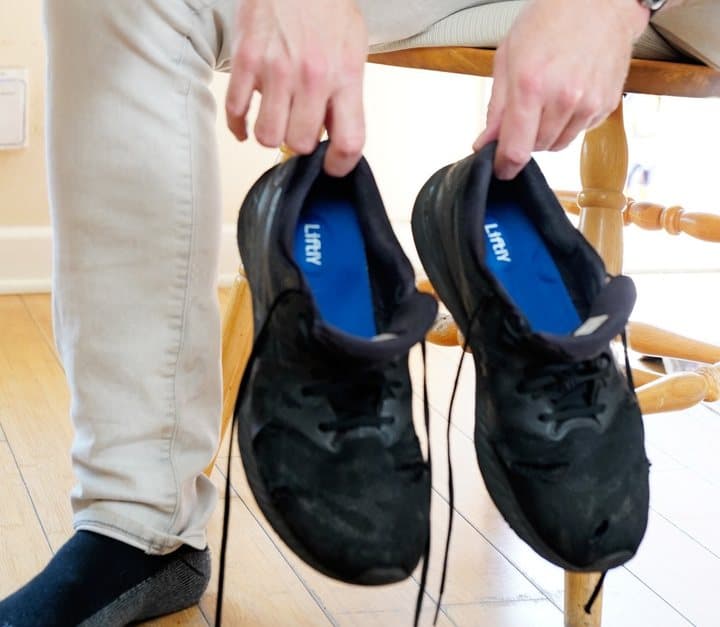
Nobody on our team has worn Liftly, so this section is based on the page, published evidence on insoles and how cushioned insoles generally perform.
What the research says about insoles and heel pain
Plantar fasciitis is one of the most common causes of heel pain. Research comparing prefabricated (off-the-shelf) insoles with custom orthotics has generally found similar improvements for many people, and the American Academy of Orthopaedic Surgeons lists shoe inserts among the first non-surgical treatments, alongside stretching and rest. The AAOS OrthoInfo page on plantar fasciitis describes these approaches. That evidence supports insoles in general; it is not specific to Liftly.
Cushioning vs support
Soft cushioning feels comfortable but can compress over time. Firmer arch support tends to matter more for plantar fasciitis than softness alone. Liftly combines both, which is a reasonable balance for everyday comfort.
The listed conditions
The page lists plantar fasciitis, fallen arches, Morton's neuroma, heel pain, arch pain, metatarsalgia and overpronation. These have different causes and often need different support: Morton's neuroma and metatarsalgia, for example, may benefit from padding under the forefoot or wider shoes. A single generic insole may help some of these some of the time, but it is not a treatment for all.
Plantar fasciitis in more detail
Plantar fasciitis classically causes sharp heel pain with the first steps in the morning or after sitting, easing with movement and returning after long periods on your feet. Most cases improve over months with a combination of stretching, calf strengthening, supportive footwear, insoles, activity changes and sometimes night splints or physiotherapy. Insoles are one useful tool within that plan, not a cure on their own.
Morton's neuroma and metatarsalgia
Both cause pain in the forefoot. Morton's neuroma involves an irritated nerve between the toes, often with burning or numbness; metatarsalgia is pain under the ball of the foot. Wider shoes, lower heels and a pad placed just behind the painful area often help more than general cushioning. Raised nodes under the forefoot could even irritate a sensitive neuroma for some people.
Overpronation
Overpronation means the foot rolls inward excessively. Firm arch support or motion-control shoes are the usual approach. Soft cushioning alone does little to control rolling.
The massage nodes
There is little evidence that massage nodes relieve foot conditions. They may feel pleasant or stimulating. People with sensitive feet may find them uncomfortable.
Durability
Foam insoles flatten with use. The FAQ's 12 months or more is plausible for moderate use; heavy daily wear on hard floors may shorten it. The 1-year warranty covers faults.
Heat and sweat
Foam insoles can feel warm, and sweat builds up inside shoes. The page says the fabric is breathable with vents and helps minimise odour. Washing regularly and letting insoles dry fully between wears helps. People with very sweaty feet may want two pairs to rotate.
Grip and slipping
A smooth insole can slide inside a shoe. Liftly's textured underside and heel cup should help it stay in place, though fit depends on the shoe. If it moves, check the trim and the shoe's inner shape.
What owners say about using them
The page shows four testimonials: an immediate comfort upgrade, help on busy days, no break-in period, and good shock absorption on hard surfaces. We found no independent owner reviews.
Reading the testimonials
The testimonials are short, positive and focused on comfort: softer shoes, less fatigue, no break-in, good shock absorption. None mentions a specific medical condition improving, which is actually a fair reflection of what cushioned insoles usually do: make feet more comfortable. One spells the product "Inshole", a small sign that testimonials may not be heavily edited.
What we would like to know
Who makes Liftly, what the foam is, how thick the insoles are at heel and forefoot, how firm the arch is, and how they hold up after six months of daily use. Those details would make it much easier to compare with established insole brands.
Template clues
One of the step images on the page carries a file name from a different product, SealPro, and the page's "save 75%" applies only to the largest bundle. Neither affects the insole, but they suggest reading the offer details carefully.
Are Liftly's claims true?
Liftly's comfort claims are plausible, since many people feel better straight away with cushioned insoles. Its bigger promises are not realistic. "Walk, run, jump and stand 100% pain-free" overstates any insole, a single generic design cannot address plantar fasciitis, Morton's neuroma, metatarsalgia and overpronation alike, and "total lower-body relief" goes beyond the evidence. We could not verify the "95% positive user rating".
"The insoles that relieve foot pain instantly"
Many people feel more comfortable immediately with cushioned insoles. Lasting pain relief depends on the cause.
"Walk, run, jump and stand 100% pain-free"
Not realistic.
"Helps relieve pain associated with plantar fasciitis, Morton's neuroma, metatarsalgia, overpronation and more"
Insoles can help some of these; a single generic insole cannot address all.
"Complete foot-to-leg support system... reduces stress on ankles, knees, hips and lower back"
Plausible for some people, but not evidenced for this product.
"95% positive user rating"
Unverified.
"Lasts 12 or more months, resists flattening better than gel or memory foam"
Plausible lifespan; the comparison is unverified.
"4D Cloud Cushioning"
A brand name for foam cushioning.
Claims scorecard
| Claim | Our view |
|---|---|
| Instant comfort | Plausible |
| 100% pain-free | Not realistic |
| Relieves many named conditions | Overstated |
| Foot-to-leg support | Plausible for some; unproven |
| 95% positive | Unverified |
| Lasts 12+ months | Plausible |
| Better than gel or memory foam | Unverified |
Are Liftly insoles better than firm orthotics or new shoes?
Liftly balances soft cushioning with arch support, which suits everyday comfort. Firmer arch-support insoles are often recommended for plantar fasciitis and flat feet because they hold the arch more consistently, so they may help more if heel pain is your main problem. Worn-out shoes are a common cause of foot pain, and supportive new shoes may do more than any insole in an old pair.
| Option | Typical cost | Best for | Notes |
|---|---|---|---|
| Liftly | $29.99 a pair | Everyday comfort, mild heel pain | Trim-to-fit, massage nodes |
| Other cushioned insoles | Varies | Similar | Compare arch firmness |
| Firm arch-support insoles | Varies | Plantar fasciitis, flat feet | Less plush |
| Custom orthotics | Much higher | Complex problems | Prescribed |
| Better shoes | Varies | Everything | Often the biggest change |
| Stretching and strengthening | Free | Plantar fasciitis | Strong evidence |
| Podiatrist or physiotherapist | Varies | Persistent pain | Diagnosis and plan |
Liftly vs firm orthotic insoles
Firmer arch-support insoles are often recommended for plantar fasciitis and flat feet, because they hold the arch more consistently. They feel less plush. If heel pain is your main problem, a firmer option may help more.
Liftly vs new shoes
Worn-out shoes are a common cause of foot pain. Supportive shoes with good cushioning and a firm heel counter may do more than an insole in an old shoe.
Liftly vs the insoles in good shoes
Many quality walking and running shoes come with decent insoles already. If yours do, replacing them may make little difference. Liftly makes the most sense in shoes with thin, flat factory insoles, or in older shoes where the insole has flattened.
Liftly vs heel cups
Silicone heel cups only cushion the heel. They suit people whose pain is limited to the heel and who want to keep their shoe's original insole. Full-length insoles like Liftly add arch support.
Liftly vs gel insoles
Gel insoles and heel cups are popular for heel pain. They absorb shock well but can feel heavy and warm. Foam insoles like Liftly are lighter and more adjustable. Both can help; personal comfort decides.
Liftly vs memory foam insoles
Memory foam moulds to your foot and feels very soft but can compress quickly and lose support. The FAQ says Liftly resists flattening better than typical gel or memory foam inserts, which we could not verify.
Liftly vs magnetic insoles
Our Akusoli insoles review covers acupressure-style magnetic insoles with their own claims. Liftly focuses on cushioning and arch support, which have a clearer rationale.
Other health products we have reviewed
Our Hume Body Pod review looks at a smart scale, our LifeVac review an anti-choking device, and our AirPhysio review a breathing device. Browse more in our health gadgets category. If sitting rather than standing is what hurts, our Serenesitz review covers a coccyx seat cushion.
If you are also considering acupressure insoles, our Akusoli vs Liftly comparison compares the two on comfort, heel pain, guarantees and owner evidence.
Liftly InsolesScore 5.4/10
Why people buy it: Soft foam cushioning, a contoured arch and a deep heel cup, a combination often suggested for tired and sore feet
$29.99 at Liftly · Price checked October 4, 2026
Check price at Liftly (opens Liftly in a new tab)We may earn a commission if you buy through our links.
Are Liftly insoles legit, and what should you check before buying?
Liftly insoles are a real product with a 30-day money-back guarantee and a 1-year warranty, but we found no Trustpilot profile or independent tests, and similar-looking insoles are widely sold for less. Before buying, see a doctor or podiatrist for pain that lasts more than a few weeks or comes with numbness, take extra care if you have diabetes, and check whether trimmed insoles can still be returned.
Persistent or severe pain
Some foot pain needs medical care.
What to do: see a doctor or podiatrist for pain that lasts more than a few weeks, is severe, wakes you at night, or comes with swelling, numbness or tingling.
Diabetes and neuropathy
Reduced sensation means rubbing or pressure can cause sores without you noticing.
What to do: get footwear advice from your diabetes team or podiatrist before trying new insoles, and check your feet daily.
Fit
Trimming too much is irreversible.
What to do: trim a little at a time using your original insole as a guide.
Allergies and skin
Some people react to foams, glues or dyes.
What to do: stop using them if you notice itching, redness or blisters, and check with a clinician if it persists.
Shoe depth
Thick insoles take up space.
What to do: remove the original insole first, and check your heel does not slip out of the shoe.
Returns after trimming
Trimmed insoles may not be accepted for return.
What to do: wear them untrimmed at home briefly if possible, or ask support whether trimmed insoles are covered by the 30-day guarantee before cutting.
Children
Children's feet are still developing, and the two size ranges are adult sizes.
What to do: see a podiatrist for children's foot pain rather than using adult insoles.
How to buy Liftly the smart way
- Check your shoe size against the two ranges, then order from the Liftly order page (opens Liftly in a new tab).
- Buy one pair first to see how the nodes and cushioning feel.
- Compare with similar insoles if price matters most.
- Note the 30-day guarantee and 1-year warranty; trimmed insoles may affect returns, so ask first.
- Trim carefully and break them in over a few days.
What do owners say, and how did we score Liftly?
Liftly scores 5.4 out of 10: claim accuracy 0.7, build durability 1.1, price competitiveness 1.3, usability 1.5 and owner satisfaction 0.8, each out of 2. The page shows four short testimonials praising an immediate comfort upgrade, support on busy days, no break-in period and good shock absorption. We found no Trustpilot profile or independent tests, and most coverage is paid advertorials and press releases.
Reviews on the page
The page shows four short testimonials: an immediate comfort upgrade, support on busy days, no break-in period and good shock absorption.
Independent reviews
We found no Trustpilot profile or independent tests of Liftly on 4 October 2026. Coverage in search is mostly paid advertorials and press releases, as one health review site also notes.
What we would test with Liftly in hand
If we test them ourselves, we will measure foam thickness and compression over weeks of wear, compare comfort with firm and soft insoles, check fit across both size ranges, and ask people with heel pain to compare. We will update this review with the results.
How we scored Liftly
Every score on the site follows the five criteria on our how we test page.
| Criterion | Score | Why |
|---|---|---|
| Claim accuracy | 0.7 / 2 | Condition list and pain-free promises overreach |
| Build durability | 1.1 / 2 | Foam flattens over time; 1-year warranty |
| Price competitiveness | 1.3 / 2 | Mid-range; bundles cheaper; lookalikes exist |
| Usability | 1.5 / 2 | Trim-to-fit, washable, no break-in |
| Owner satisfaction | 0.8 / 2 | On-page reviews only |
| Total | 5.4 / 10 |
The score would rise with claims limited to comfort and support, named company details, and independent reviews.
What we did, and did not, do
We read the offer page and FAQ, research on insoles for heel pain, AAOS guidance and press coverage, all on 4 October 2026. Nobody on our team has worn Liftly, and no figures here come from our own testing.
How to use Liftly for the best results
Remove your shoe's original insole, place it on top of the Liftly insole and trace around the toe, then trim a little at a time until it fits snugly. Slide it in heel first and press it flat. Wear the insoles for a few hours on the first days so your feet adjust to the arch, and combine them with calf and foot stretches if you have heel pain.
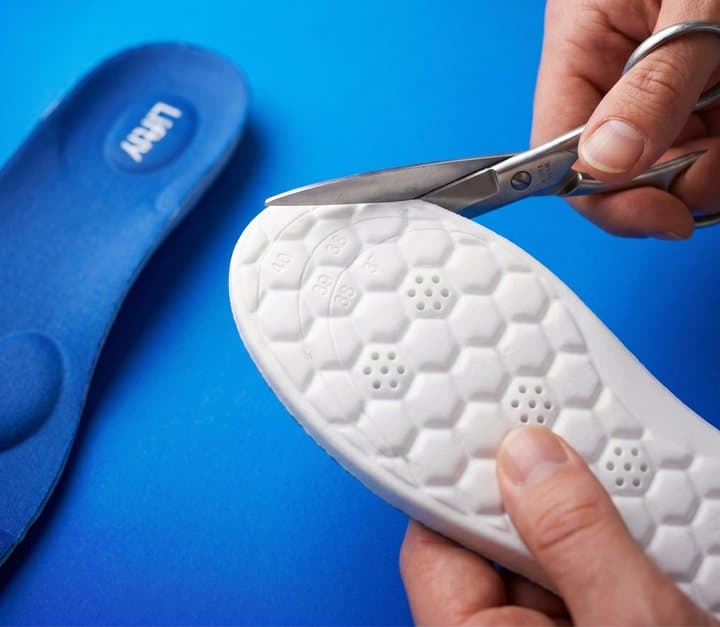
Trimming to size
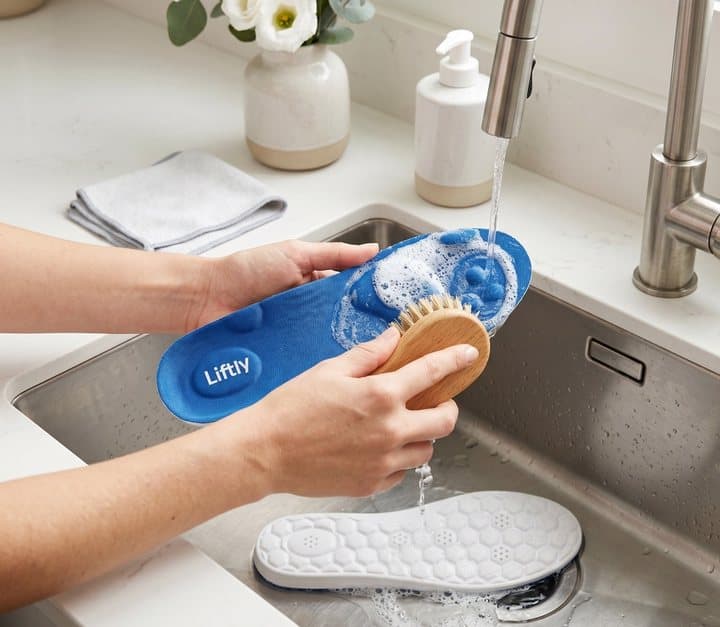
Hand-washing the insoles
- Remove your shoe's original insole.
- Place it on top of the Liftly insole and trace around the toe.
- Trim a little at a time until it fits snugly.
- Slide it in heel first and press it flat.
- Wear for a few hours on the first days.
- Combine with calf and foot stretches if you have heel pain.
- Wash and air dry regularly.
Breaking them in
Even with no break-in needed, give your feet a few days to adjust to arch support, especially if you are used to flat insoles. Wear them for part of the day at first, then full days.
Stretches that help heel pain
Gentle calf stretches against a wall, rolling the sole over a ball or frozen bottle, and stretching the plantar fascia by pulling the toes back are commonly recommended for plantar fasciitis. A physiotherapist can tailor exercises.
Moving insoles between shoes
You can move one pair between shoes of the same size, but having a pair in each pair of work shoes saves time and wear.
Combining with other treatments
For heel pain, insoles work best alongside daily stretches, supportive shoes, managing time on your feet and, if needed, advice from a physiotherapist. Ice after long days and avoiding barefoot walking on hard floors can also help.
When to replace them
Replace them when the foam looks compressed, the arch feels flat or comfort fades.
Caring for them
Remove insoles from shoes after heavy sweating or rain and let them air dry away from direct heat. Hand-wash with mild soap and a soft brush, as the photos show, rinse well and dry fully before refitting. Do not machine wash unless the instructions say you can, as agitation can tear foam and fabric layers apart. Avoid tumble dryers and radiators, which can warp foam.
Morning heel pain routine
If the first steps of the morning hurt, try gentle calf and foot stretches before getting out of bed, and put on supportive shoes with insoles rather than walking barefoot. Many people with plantar fasciitis find this simple routine makes the first steps easier.
Tracking progress
Keep a short note of pain levels each morning and evening on a one-to-ten scale for a few weeks. It helps you see whether insoles and stretches are making a difference, and is useful information if you see a professional later.
Building up activity
If you are starting a new walking routine or job with long hours standing, increase time on your feet gradually. Sudden jumps in activity are a common trigger for heel pain, insoles or not. Comfortable insoles make the build-up easier, but they do not remove the need for it.
Checking your shoes too
Look at the soles of your shoes. If the heels are worn down on one side or the midsole is creased and soft, the shoes may need replacing. An insole cannot fully compensate for a worn-out shoe.
Rotating shoes
Rotating between two pairs of shoes lets foam recover and dry between wears, which can extend both shoe and insole life. If you do, a pair of insoles in each pair of shoes is easier than moving them every day.
Matching insoles to shoes
Insoles work best in shoes with enough depth and a firm heel counter. In shallow shoes, consider a thinner, three-quarter-length insole instead. In sandals and slippers, look for footwear with built-in arch support.
Troubleshooting
| Problem | Likely cause | What to try |
|---|---|---|
| Shoe feels tight | Original insole still in | Remove it |
| Heel slips | Insole too thick for shoe | Try in deeper shoes |
| Nodes feel uncomfortable | Sensitive feet | Give it a few days or choose a smooth insole |
| Rubbing at toes | Not trimmed enough | Trim a little more |
| Pain persists | Cause not addressed | See a podiatrist |
| Odour | Sweat | Wash and air dry; rotate pairs |
Liftly InsolesScore 5.4/10
Before you buy: Check the final price, shipping and return terms at checkout.
$29.99 at Liftly · Price checked October 4, 2026
Check price at Liftly (opens Liftly in a new tab)We may earn a commission if you buy through our links.
What else do people ask about insoles?
Most questions are about whether insoles help and which type to choose. For many people with tired feet or heel pain, insoles are a useful first step. Soft insoles feel comfortable, while firmer arch support often helps plantar fasciitis more, and many good insoles combine both. Comfort may be immediate, but improvement in plantar fasciitis usually takes weeks, especially alongside stretching.
Do insoles really help foot pain?
For many people with tired feet or heel pain, yes. They are a common first step.
Soft or firm insoles?
Soft insoles feel comfortable; firmer arch support often helps plantar fasciitis more. Many good insoles combine both.
How long does it take to feel a difference?
Comfort may be immediate. For plantar fasciitis, improvement usually takes weeks, especially with stretching.
Can I wear them in running shoes?
Yes, though runners may prefer sport-specific insoles. Replace the original insole and check fit.
Should I wear insoles all day?
If they are comfortable, yes. Start with a few hours and build up, especially if your feet are not used to arch support.
Will insoles fix my posture?
They can change how your feet meet the ground, which may affect how you stand. Claims that an insole aligns your whole body are often overstated. Strength, mobility and footwear all matter.
Can I use Liftly in high heels?
High heels usually have little room and a steep slope, which full-length insoles do not suit. Look for slim heel or forefoot pads designed for heels.
How thick are Liftly insoles?
The page does not give a thickness. The photos show a noticeably thick heel area and a thinner forefoot. Shoes with removable insoles and some room will fit best.
Do Liftly insoles squeak?
Some foam insoles squeak against a shoe's base when new. A light dusting of talc under the insole, or making sure it sits flat, usually stops it.
Can I use Liftly for sport?
For casual exercise and walking, yes. For intense running or court sports, sport-specific insoles or shoes designed for the activity may give better stability.
How soon should I replace my shoes?
Many people replace walking or running shoes every 300 to 500 miles, or when the sole looks worn and the cushioning feels flat. Work shoes worn daily may need replacing at least once a year. New insoles in worn shoes help less than new shoes. If budget allows only one change, start with the shoes, then add insoles if you still want more cushioning or arch support for long days at work or on your feet. Good shoes and good insoles together usually beat either one alone.
Are Liftly insoles vegan?
The page does not say what materials are used beyond foam and fabric. Ask support if this matters to you.
What if one foot is bigger than the other?
Trim each insole to its own shoe. That is an advantage of trim-to-fit insoles.
Can I use Liftly in sandals?
Not usually. Insoles need an enclosed shoe to stay in place. Look for sandals with built-in arch support instead.
Will Liftly help standing at a desk?
Standing desks put long, static load through the feet. Cushioned insoles plus an anti-fatigue mat and regular movement can make standing more comfortable.
Are the colours different?
The photos show blue, black and grey versions; the page does not explain any difference beyond colour.
How do I know if I need a podiatrist?
See one if pain lasts more than a few weeks despite rest and good shoes, if you have diabetes or circulation problems, or if you notice changes in foot shape, numbness or swelling.
Can insoles cause pain?
Occasionally, especially if the arch is too high or in the wrong place for your foot, or the nodes press on sensitive spots. Stop if new pain develops.
Can insoles help knee or back pain?
For some people, better foot support changes how forces travel up the leg. Evidence is mixed; see a professional for persistent knee or back pain.
Can I wear Liftly in work boots?
Yes, if the boots have removable insoles and enough depth. Safety footwear may have specific insole requirements; check with your employer for safety-rated boots.
Do insoles help flat feet?
Arch support can make flat feet more comfortable for some people. Not all flat feet cause problems; see a professional if they hurt.
Are custom orthotics better?
Studies often find similar results for plantar heel pain. Custom orthotics may help with more complex foot problems.
Are massage nodes good for feet?
They feel stimulating to some people. There is little evidence they treat foot conditions.
Are Liftly insoles worth it?
If you want softer, supportive shoes for long days, they are a reasonable choice at $29.99, especially in bundles. Compare with similar insoles, and see a professional for persistent pain.
Frequently asked questions
What are Liftly insoles?
Liftly insoles are cushioned, trim-to-fit foam insoles with arch support, a deep heel cup and raised massage nodes. You replace your shoe's original insole with them for extra cushioning and support. They are designed for everyday comfort and mild heel pain.
How much do Liftly insoles cost?
On 4 October 2026 the offer page listed one pair at $29.99, three pairs for $59.98 and six pairs for $89.97. Similar-looking "4D cloud" insoles are widely sold online, often for less, so compare before buying. Bundles bring the per-pair price down.
What sizes do Liftly insoles come in?
Two ranges: Standard (EU 37 to 41) and Large (EU 42 to 47). You trim the toe end to fit your shoe, according to the FAQ. Trim a little at a time using your old insole as a template, because you cannot add material back.
Do Liftly insoles help plantar fasciitis?
Cushioned insoles with arch support are a common first step for plantar heel pain, and research suggests off-the-shelf insoles can help about as much as custom orthotics for many people. They work best alongside stretching and good footwear, and persistent pain should be assessed.
How long do Liftly insoles last?
The FAQ says 12 months or more with daily wear. Foam insoles gradually compress; replace them when they look flat or stop feeling supportive. Check them every few months for flattened heels or torn fabric, and replace them sooner if pain returns.
Will my shoes still fit?
The FAQ says remove your shoe's original insole first to make room. Shoes with very little depth, such as some dress shoes and flats, may feel tight. Shoes with a removable insole and some depth, such as trainers and work boots, usually fit them best.
Can I wash Liftly insoles?
The page says they are easy to clean, and the photos show hand-washing with a brush. Let them air dry fully before putting them back. Hand-wash them only, as the photos show, and let them dry away from direct heat before wearing them again.
What is the guarantee?
The page offers a 30-day money-back guarantee and a 1-year warranty. Check whether trimmed insoles can still be returned before you cut them, and keep your order confirmation. Foam that flattens or splits within a year may be covered by the warranty, so contact support with photos.
We may earn a commission if you buy through our links.
This content is for informational purposes and is not medical advice. Talk to a qualified professional before using any product that affects your health.
Prices accurate as of October 4, 2026. Check the seller's checkout for current pricing, promotions and terms.
What we checked: No hands-on use. Claims, features, sizes, prices, bundles, FAQ answers (fit, plantar fasciitis, durability, heat, nodes), warranty, guarantee, testimonials and images from the Liftly offer page our link opens (getliftlyinsoles.com) on 2026-10-04. Evidence on prefabricated insoles for plantar heel pain from published systematic reviews and a Canadian health technology review; plantar fasciitis guidance from the American Academy of Orthopaedic Surgeons. Marketplace listings of similar insoles and press releases about Liftly were read for context. We found no independent reviews of Liftly.
Compare Liftly Insoles

About the author
James Wilson, Consumer Tech Writer
James Wilson covers health and wellness technology for Top10Gadgets: breathing devices, massagers, hearing aids, dental and weight-loss products, and the other gadgets sold with a promise to make life easier. James write…
- Health and wellness gadgets
- Over-the-counter hearing aids
- Breathing and massage devices
- FDA clearance and registration
- Tech for beginners
Writing for Top10Gadgets since 2026Full profile