Cellphone Accessories / Power banks
Statik State Power Bank Review: A Semi-Solid MagSafe Battery Pack, What 'Fire-Safe' Really Means and Whether It Is Worth $59.99
A thin 5,000 mAh magnetic power bank for iPhones, built on a semi-solid battery. Semi-solid cells are a real safety step, but 'won't catch fire even if punctured' overstates things.

By Ethan Walker, Hardware & Gadget Tester at Top10Gadgets
Updated 26 min readHow we test
Quick answer
Yes, if you want a slim MagSafe battery for an iPhone and value a safer cell chemistry enough to pay extra. The Statik State is a 5,000 mAh magnetic power bank built on semi-solid battery cells, which really are less fire-prone than standard ones, and it gives about one phone charge with a 2-year warranty.
Score 5.0/10$59.99 at Statik
Check price at Statik (opens Statik in a new tab)We may earn a commission if you buy through our links.
- Best for
- iPhone 12 and later owners who want a slim snap-on battery
- Not for
- Anyone needing several phone charges from one pack
$59.99 at Statik
Check price at Statik (opens Statik in a new tab)We may earn a commission if you buy through our links.
On this page · 12 sections
- 01Our verdict
- 02The short version
- 03Pros & cons
- 04How it works
- 05Who it's for
- 06Is the Statik State really fire-safe and the world's first?
- 07How much does the Statik State cost, and what are the return terms?
- 08Is the Statik State better than other magnetic power banks?
- 09Is the Statik State legit, and what should you check before buying?
- 10How did we score the Statik State?
- 11How to use the Statik State for the best results
- 12Frequently asked questions
Our verdict
Yes, if you want a slim MagSafe battery for an iPhone and value a safer cell chemistry enough to pay extra. The Statik State is a 5,000 mAh magnetic power bank built on semi-solid battery cells, which really are less fire-prone than standard ones, and it gives about one phone charge with a 2-year warranty. But "world's first", "won't catch fire even if punctured" and a TSA badge borrowed from a luggage-lock scheme overstate it, and $59.99 is double a basic 5,000 mAh pack. It scores 5.0 out of 10.
The short version
- What it is: a thin 5,000 mAh power bank with magnetic wireless charging and USB-C, using semi-solid battery cells.
- Price: $59.99 plus shipping for one on 4 October 2026, $149.98 for three.
- Best trait: safer battery chemistry in a convenient snap-on design.
- Biggest drawback: marketing claims that go beyond what any lithium battery can promise, and a high price for the capacity.
- Our score: 5.0 out of 10.
Pros & cons
The pros come from the battery chemistry and the magnetic design. The cons are about the claims, price and return terms.
What we like
- Semi-solid battery cells are less prone to fire than standard liquid lithium-ion cells
- Snaps onto iPhone 12 and later for wireless charging, and also has a USB-C port
- About one full charge for a modern smartphone from 5,000 mAh (18.5 Wh)
- Well under airline carry-on limits for lithium batteries
- 2-year warranty from Statik
What we don't
- 'World's first' is doubtful; other brands sell semi-solid magnetic 5,000 mAh packs
- 'Won't catch fire even if punctured' is a promise no lithium battery maker can fully make
- The 'TSA-approved' badge uses a luggage-lock logo; TSA does not approve power banks
- Single packs add shipping, and the three-pack is preselected
- Returns within 30 days at your expense, with shipping not refunded
Sold by Statik
Statik State Power Bank$59.99
How it works
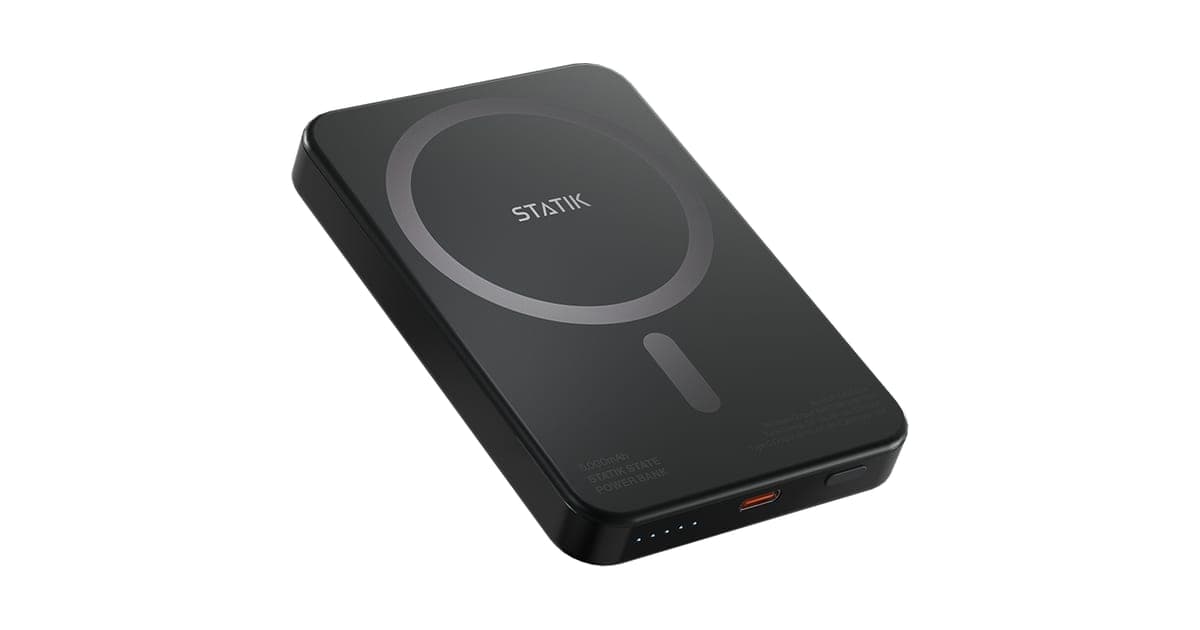
The Statik State is a flat battery pack with a magnetic ring on the back that lines up with the magnets in iPhone 12 and later models. When snapped on, it charges the phone wirelessly through Qi. A USB-C port charges the pack itself and can also charge any USB-C device by cable. Five lights show remaining charge.
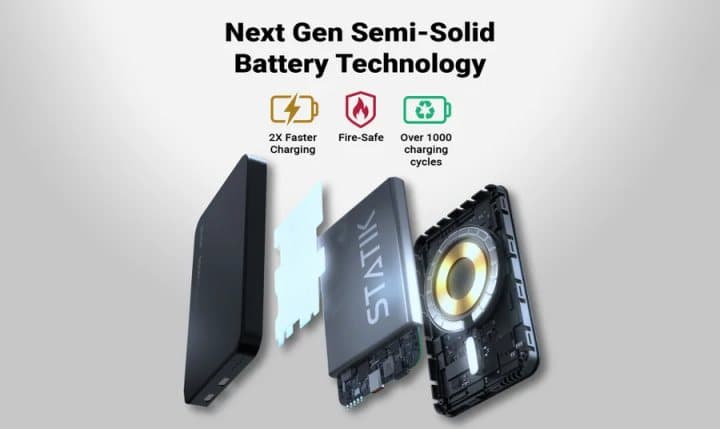
Statik says the pack uses semi-solid battery cells with about 95% less liquid electrolyte than standard lithium-ion cells. According to the page, that makes it resistant to puncture and crush damage, cooler during use and good for more than 1,000 charge cycles.
Charge the pack
Step 1: Recharge it through the USB-C port. Statik says it reaches full in about 1.5 to 2 hours with an 18 W USB-C PD charger.
Snap it on or plug in
Step 2: Snap it onto the back of an iPhone 12 or later, or a phone with a magnetic case, to charge wirelessly, or connect any device by USB-C cable.
Use low-power mode for small devices
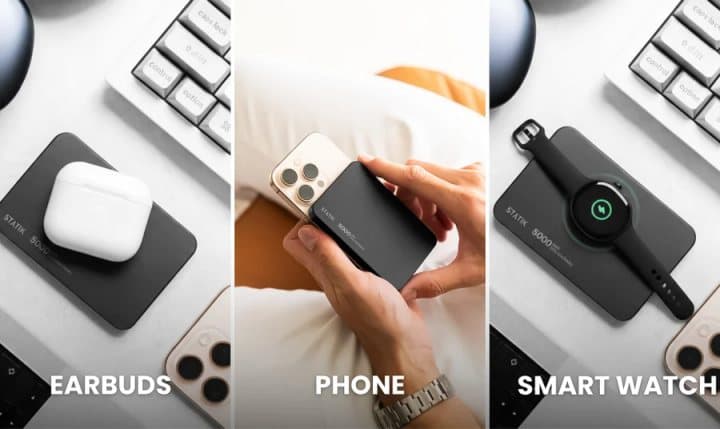
Step 3: Double-press the power button to switch to a low-power mode for earbuds and smartwatches, shown by four flickering lights.
Semi-solid batteries, explained
Standard lithium-ion cells contain a flammable liquid electrolyte. If a cell is damaged, overcharged or has a manufacturing fault, it can overheat in a chain reaction called thermal runaway, which can lead to fire. Semi-solid cells replace much of that liquid with a gel or paste. Less flammable liquid means a lower chance of fire and slower, less violent failures. It is an evolution of lithium batteries, not a new kind of battery that cannot fail.
How safety testing usually works
Battery makers test cells with nail penetration, crushing, overcharging and heat exposure. Liquid lithium-ion cells often vent and burn in nail tests, while many semi-solid cells smoke or swell without flames. Statik's graphics describe this kind of result but do not publish test reports. Independent safety certifications for the finished pack would add confidence.
Charge cycles
A charge cycle is using and recharging the equivalent of a full battery, whether in one go or several top-ups. If you use half the pack each day, that is one cycle every two days. At that rate, 1,000 cycles would take more than five years.
Capacity and real charge
5,000 mAh at about 3.7 volts is 18.5 watt-hours. After conversion losses, a cable charge typically delivers roughly two-thirds of that, enough for about one full charge of a phone with a 3,000 to 4,000 mAh battery. Wireless charging wastes more energy as heat, so expect a bit less when snapped on.
Recharging time
Statik says the pack recharges from empty in about 1.5 to 2 hours with an 18 W USB-C PD charger, compared with 4 to 6 hours for "other power banks". Many modern 5,000 mAh packs with fast input also recharge in around 2 hours, so this is a solid rather than unique figure. With a slow 5 W phone charger, expect much longer.
Wireless and wired speeds
The FAQ lists wireless output of 5, 7.5, 10 or 15 watts, USB-C output of up to about 20 W, and USB-C input of up to 18 W. iPhones often limit magnetic wireless charging from accessories without Apple's MagSafe or Qi2 certification to lower speeds, so wireless top-ups may be slower than 15 W in practice. The USB-C port is the fastest way to charge.
Weight and build
The page lists a weight of 141 grams and an aluminium alloy frame with an impact-resistant shell. That is similar to other 5,000 mAh magnetic packs. Snapped to a phone, it adds noticeable weight to the back, which is normal for this type of accessory.
Protection circuits
Statik lists over-temperature, over-voltage, over-current and short-circuit protection. These are standard in reputable power banks and do most of the work of keeping batteries safe in daily use. Cheap packs sometimes skimp on them, which is a bigger risk than cell chemistry alone.
Why airlines worry about power banks
Several airlines have restricted using power banks during flights after cabin fires linked to them. Power banks are kept in the cabin precisely so that crews can deal with a fire quickly. A less flammable chemistry is a sensible improvement, but it does not change the rules you must follow.
Who it's for
The Statik State suits iPhone 12 and later owners who want a slim battery that snaps on, frequent flyers who like the idea of a less fire-prone battery in their bag, and people who carry earbuds or a smartwatch as well as a phone. It suits people who need several phone charges from one pack, or who want the most capacity for their money, less well.
- iPhone 12 and later owners who want a slim snap-on battery
- Frequent flyers who want a safer battery chemistry in their bag
- People who carry earbuds and a smartwatch as well as a phone
Why the Statik State appeals
Power bank fires on planes and in homes have made headlines, and several airlines have tightened rules on using power banks in flight. A battery pack that markets itself on safety, with a semi-solid cell, low temperatures and a slim shape, speaks directly to that worry. The magnetic snap-on design also means no cable to carry.
People worried about battery fires at home
Power banks charging on beds, sofas or under pillows have caused house fires. A semi-solid pack lowers that risk, but the safest habit is charging any battery on a hard surface, away from flammable materials, and not overnight unattended.
Frequent flyers
Lithium battery incidents on aircraft are rare but taken seriously. Choosing a pack with semi-solid cells is a reasonable way to lower risk further. Remember that airline rules still apply: power banks go in carry-on, never in checked bags, and some airlines restrict using or charging them in flight.
Business travellers
Business travellers move through airports, taxis and hotels with phones on constant use. A pack that snaps on during a taxi ride and stays in a jacket pocket suits that routine. The 18.5 Wh rating avoids any airline paperwork.
iPhone owners
The snap-on design is most convenient with iPhones from the 12 onward. You can keep using the phone while it charges, and there is no cable to tangle. With a thick case, the magnets may not hold, so check your case supports MagSafe.
Android users with magnetic cases
Many Android phones support Qi wireless charging but have no magnets. A thin magnetic ring stuck to the phone or a magnetic case lets the pack snap on. Without one, the USB-C cable still works for any phone.
Accessory users
The FAQ describes a low-power mode for earbuds and smartwatches, entered by double-pressing the power button. Many power banks switch off when the current drawn is very low, so this mode is useful for small devices.
Students and remote workers
Students moving between lectures and remote workers in cafés often need a top-up by mid-afternoon. A slim pack that snaps to the phone is easier to carry every day than a brick with a cable. One charge covers most of those days.
Older iPhone owners
Owners of iPhone 11 and earlier have no MagSafe magnets, so the pack will not snap on without a magnetic case. The USB-C port works with a USB-C to Lightning cable. For older iPhones, a cheaper wired pack may make more sense.
Families
A five-pack at about $45 each suits a household with several iPhones. For mixed households, the USB-C port covers Android phones, tablets and handheld consoles by cable.
Commuters
A slim pack that snaps on during a commute and comes off at the office suits daily users well. One full charge covers most heavy days. Recharge it overnight alongside your phone.
Parents with tablets and consoles
The USB-C port can top up tablets and handheld consoles, though 5,000 mAh gives only a partial charge to devices with large batteries. A reviewer on the page mentions charging a Nintendo Switch. For long car journeys with several devices, a larger pack goes further.
Outdoor and festival use
Semi-solid cells are said to cope better with heat and rough handling, which suits festivals, camping and hot cars. Even so, do not leave any battery in direct sun or a closed car on a hot day.
Gift buyers
As a gift for an iPhone user who travels, the Statik State is a practical choice with a clear selling point. Check the recipient's phone model first, and keep the receipt in case they already have a magnetic pack.
Who should skip it
Skip the Statik State if you need two or more phone charges from one pack, since 5,000 mAh gives about one. Skip it if you use Android without a magnetic case. Skip it if you want the most capacity per dollar. And do not treat "fire-safe" as a reason to stop following normal battery care.
- Anyone needing several phone charges from one pack
- Android users without a magnetic case, who lose the snap-on advantage
- Buyers looking for the lowest price per watt-hour
- People who believe 'fire-safe' means no safety care is needed
Is the Statik State really fire-safe and the world's first?
Semi-solid cells are genuinely safer, but "world's first" and "won't catch fire" go too far. Statik says its battery uses 95% less liquid electrolyte, making it virtually non-flammable and resistant to puncture. Semi-solid cells do lower fire risk compared with standard lithium-ion packs. However, other brands, such as Sandberg, sell semi-solid magnetic 5,000 mAh power banks, and no lithium battery can be promised never to catch fire.
"The World's First High-Speed, Fire-Safe Power Bank"
Semi-solid power banks have been launched by several brands in recent years. Sandberg, for example, lists a SemiSolidState Magnet Powerbank 5000 with semi-solid cells, 15 W magnetic wireless charging and a 19.25 Wh capacity. We cannot verify who was first, but Statik is not the only one.
"Won't catch fire even if punctured or damaged"
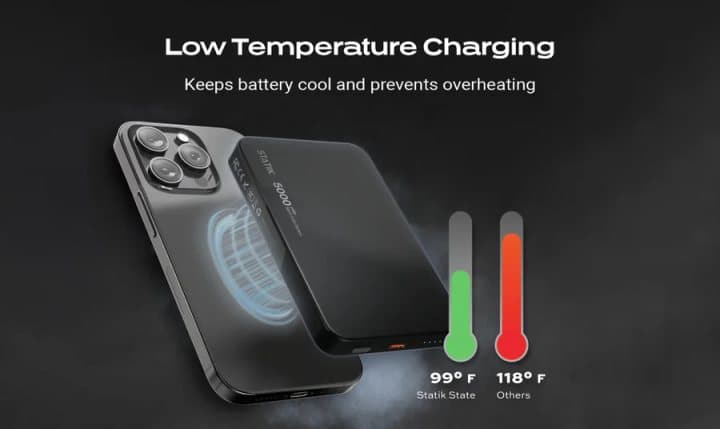
A graphic on the page calls it "the safest power bank on Earth" that "won't catch fire even if punctured or damaged". Semi-solid cells handle abuse tests better than liquid cells, and some makers show nail-puncture tests without fire. But no independent test results are shown for this pack, and safety also depends on the charging circuitry and build quality.
What this means for you: treat it as lower-risk, not risk-free. Stop using it if it swells, gets very hot or smells.
Why "virtually non-flammable" is closer to the truth
The feature list says "virtually non-flammable", which is more careful than the graphic's "won't catch fire even if punctured". Semi-solid cells contain less flammable material, but they still store a lot of energy in a small space. "Much less likely to catch fire" is the fair way to describe them.
"Runs 24-32% cooler" and "30% more efficient"
The temperature graphic compares 99°F for Statik with 118°F for "others", without saying which products or conditions. Efficiency figures are also given without a test method. These may be true in Statik's tests, but we cannot check them.
"Lasts over 1,000 charge cycles"
Many standard power banks are rated for around 300 to 500 cycles before capacity drops noticeably. Semi-solid cells often claim longer life. Over 1,000 cycles is plausible but untested by us.
What the FAA actually says
The FAA's PackSafe guidance on lithium batteries says spare lithium batteries, including power banks, must be carried in the cabin, not checked bags. Batteries up to 100 Wh are allowed without airline approval, and those between 100 and 160 Wh need approval. Chemistry does not change these rules.
"TSA-approved and airline-compliant"
The page shows a TSA-approved badge with a Travel Sentry logo. Travel Sentry is the system behind TSA-accepted luggage locks; it does not certify batteries. TSA does not approve power banks. What matters is that the pack, at 18.5 Wh, is well under the FAA's 100 Wh limit for spare lithium batteries in carry-on luggage.
Cooler running
Wireless charging produces heat in both the phone and the pack. A pack that stays cooler helps the phone charge faster, because phones slow charging when they get warm. If Statik's lower temperature claim holds, that is a real everyday benefit, not just a safety one.
"Trusted by aviation industry professionals"
The page quotes a flight attendant among its reviews. We could not verify that pilots or crews use it in any official way.
"Special low-power mode protects expensive devices"
Low-power modes keep a steady, gentle current for small devices. Earbuds and watches already have their own charging protection, so the main benefit is that the pack does not switch itself off mid-charge, rather than protection from damage.
"Credit card-thin design (11.5 mm)"
At 11.5 mm, the pack is slim for a power bank but about 15 times thicker than a credit card. The comparison is about the shape, not the thickness.
How much does the Statik State cost, and what are the return terms?
On 4 October 2026, one Statik State cost $59.99 plus shipping, three cost $149.98 and five cost $224.97, with free shipping on the multi-packs and the three-pack preselected. The page lists a 2-year warranty and a 30-day money-back guarantee. Statik's return policy, shown on its other offer pages, puts return postage on you and does not refund shipping costs.
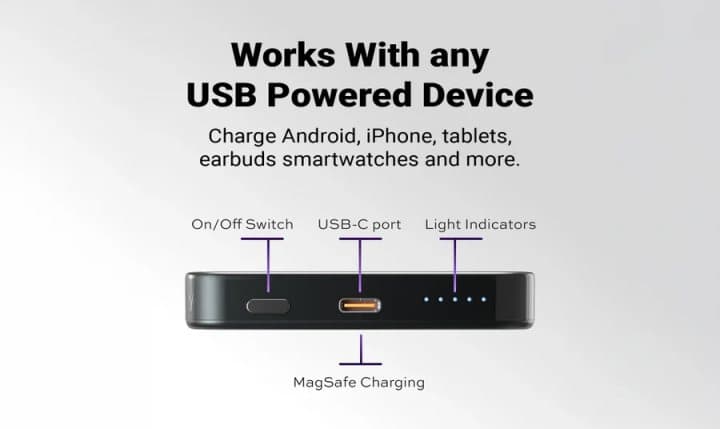
Ports and controls
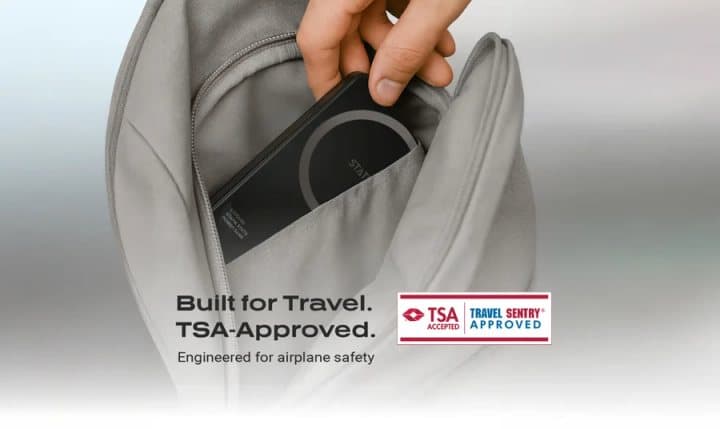
Statik's travel graphic
Statik State price and bundles
| Bundle | Price | Per pack |
|---|---|---|
| 1 power bank | $59.99 plus shipping | $59.99 |
| 3 (buy 2, get 1 free) | $149.98 | About $49.99 |
| 5 (buy 3, get 2 free) | $224.97 | About $44.99 |
The crossed-out prices use $74.99 per pack as the reference.
What the reference prices mean
The crossed-out $74.99 per pack is the seller's reference price. We did not see it charged anywhere. The real choice is between $59.99 for one and lower per-pack prices in the multi-packs.
Cost per watt-hour
At $59.99 for 18.5 Wh, the Statik State costs about $3.24 per watt-hour. A standard 5,000 mAh pack such as Anker's Nano, at a $29.99 list price, costs about half that. You pay for the magnetic design and the semi-solid cells.
Shipping on a single pack
The single pack adds shipping at checkout, while the multi-packs ship free. If shipping is several dollars, the real price of one pack rises above $60. Check the total before paying.
What you get for the extra money
Compared with a basic pack, the extra money buys the semi-solid cells, magnetic wireless charging, an aluminium frame and a 2-year warranty. Whether that is worth $30 more depends on how much the safety and convenience matter to you.
Statik's return policy
Statik's policy, as shown on its offer pages, accepts returns within 30 days of receipt. You must email support@statik.co first, send the product to its warehouse at 860 Bonnie Lane, Elk Grove Village, Illinois 60007, and provide a tracking number. Return postage is at your expense, and shipping costs are not refunded. Unfulfilled orders can be cancelled within 12 hours.
What to do: email before sending anything back and keep the tracking number.
Comparing semi-solid prices
Semi-solid packs tend to cost more than standard ones because the cells are newer and made in smaller volumes. As the technology spreads, prices are likely to fall. If you are not in a hurry, comparing a few semi-solid brands may find a better deal.
Warranty
The page lists a 2-year warranty, and Statik's policy says it covers defects in materials and workmanship for two years from delivery on purchases after 2024. It does not cover the devices you charge.
Cost over its life
If the pack really lasts more than 1,000 cycles, and you use it a few times a week, it could last many years. That longer life narrows the price gap with cheaper packs, which may lose noticeable capacity after a few hundred cycles. The 2-year warranty covers defects, not capacity loss.
Is the three-pack good value?
At about $50 each, the three-pack makes sense for a household with several iPhones or a family that travels together. For one person, one pack is enough.
Customs and duties
The FAQ warns that buyers outside the US may pay customs, duties or VAT on delivery.
Who sells it
The Statik State is a Statik product. Statik also makes the smaller Snap-N-Charge magnetic pod and shares a returns warehouse in Illinois with the KeySmart brand.

Statik State Power BankScore 5.0/10
Best for: iPhone 12 and later owners who want a slim snap-on battery
$59.99 at Statik · Price checked October 4, 2026
Check price at Statik (opens Statik in a new tab)We may earn a commission if you buy through our links.
Is the Statik State better than other magnetic power banks?
It is a good choice if you specifically want semi-solid cells, and an expensive one if you do not. Standard magnetic 5,000 mAh packs from established brands often cost less, and plain USB-C packs cost about half. Other semi-solid magnetic packs, such as Sandberg's, compete directly. The Statik State's case rests on its safety-focused chemistry, warranty and slim build.
| Statik State | Snap-N-Charge | Anker Nano 5,000 mAh | Standard magnetic 5,000 mAh | |
|---|---|---|---|---|
| Price seen | $59.99 plus shipping | $29.99 plus shipping | $29.99 list | Varies |
| Capacity | 5,000 mAh | 3,000 mAh | 5,000 mAh | 5,000 mAh |
| Battery type | Semi-solid | Standard lithium | Standard lithium | Usually standard |
| Wireless | Magnetic, up to 15 W | No | No | Yes |
| Wired | USB-C | Magnetic tips | Built-in USB-C | Usually USB-C |
Choosing by priority
If safety chemistry matters most, the Statik State or another semi-solid pack is the pick. If price matters most, a standard USB-C pack is cheapest. If wireless speed matters most, a Qi2-certified pack is best. If size matters most, a small pod like Snap-N-Charge wins.
Statik State vs Snap-N-Charge
Statik's Snap-N-Charge is a 3,000 mAh pod that connects through magnetic tips in the phone's port. It is smaller and cheaper, with about half a charge for a large phone. The Statik State holds two-thirds more energy and charges wirelessly.
Statik State vs a 10,000 mAh magnetic pack
Larger magnetic packs give about two phone charges but weigh more and pull harder on the phone when snapped on. If one charge is not enough for your day, a 10,000 mAh pack is the better tool, even with standard cells.
Statik State vs Anker Nano
Anker's Nano plugs straight into a USB-C phone with a folding connector and charges at up to 22.5 W. It is cheaper and faster by wire, but not magnetic and not semi-solid.
Statik State vs Rush Charge Universe
Our Rush Charge Universe review covers a larger power bank with built-in cables, better if you need more capacity.
Statik State vs other semi-solid packs
Sandberg's semi-solid magnetic 5,000 mAh pack has similar specifications. Compare current prices, warranties and return terms; the chemistry is the main shared selling point.
Statik State vs Apple's own battery packs
Apple has sold MagSafe battery packs of its own in the past, with certified charging and tight integration with iPhones. Third-party packs like Statik's are often cheaper and higher in capacity. Check current options from Apple and certified Qi2 brands if fast, certified wireless charging matters most.
Statik State vs Qi2-certified packs
Qi2 is the newer wireless charging standard with magnetic alignment, and certified packs can charge compatible iPhones at higher speeds than uncertified magnetic packs. The page calls the Statik State "MagSafe compatible" but does not mention Qi2 or MagSafe certification. If wireless speed matters, look for certification.
When something else wins
Choose a larger pack for multi-day trips, a plain USB-C pack for the lowest price, and the Statik State for a slim, safety-focused snap-on battery. To keep a desk's cables in order, our CordBrick review covers a weighted cable holder.
Statik State Power BankScore 5.0/10
Why people buy it: Semi-solid battery cells are less prone to fire than standard liquid lithium-ion cells
$59.99 at Statik · Price checked October 4, 2026
Check price at Statik (opens Statik in a new tab)We may earn a commission if you buy through our links.
Is the Statik State legit, and what should you check before buying?
Yes. Statik is an established accessory brand, the pack has a 2-year warranty and returns go to a US warehouse. The checks are about expectations and fine print: semi-solid is safer, not fireproof; the TSA badge means nothing official; a single pack adds shipping; and returns within 30 days are at your expense, with shipping not refunded.
Check your phone and case
What to do: confirm your iPhone is a 12 or later and your case is MagSafe-compatible. Android users need a magnetic ring or case for snap-on use.
Check the return window
The 30-day window runs from delivery. Test the pack's wireless and wired charging in the first week, so any problem shows in good time.
Ask for safety certifications
What to do: if safety is your main reason for buying, ask Statik support for the pack's safety certifications, such as UL or IEC test marks, and any independent test reports for the semi-solid cells.
Check the preselected bundle
The three-pack is preselected. Change it to one unless you need more.
Check how many you need
One pack per person is usually enough. If you are buying for a family, consider whether everyone uses a MagSafe iPhone, since the snap-on design is the main reason to pay this price.
Flying with it
Under FAA rules, spare lithium batteries, including power banks, must travel in carry-on luggage. At 18.5 Wh, this pack is below the 100 Wh limit that needs no airline approval. Some airlines restrict using or charging power banks during flights, so check your airline's current rules.
Disposing of it
When the pack reaches the end of its life, recycle it at a battery collection point. Do not put lithium batteries, including semi-solid ones, in household rubbish, where they can cause fires in bin lorries and recycling centres.
Battery care still matters
Do not leave it in hot cars or direct sun, avoid charging it on soft surfaces like beds, and stop using it if it swells, smells or gets very hot. Use good-quality cables and chargers.
Check the box contents
What to do: ask support whether a USB-C cable is included. Without one, budget for a good-quality cable and an 18 W or faster USB-C PD charger.
Keep your paperwork
Keep the order confirmation, delivery date and packaging during the first 30 days, and the confirmation for two years for the warranty.
How to buy the Statik State the smart way
- Check your phone and case support magnetic charging.
- Open the Statik State order page (opens Statik in a new tab) and change the bundle to the number you need.
- Note the shipping charge on a single pack.
- Charge it fully and test it with your phone in the first week.
- Email support within 30 days if you want to return it.
How did we score the Statik State?
The Statik State scores 5.0 out of 10: claim accuracy 0.8, build durability 1.3, price competitiveness 0.9, usability 1.4 and owner satisfaction 0.6, each out of 2. The semi-solid chemistry, slim magnetic design and 2-year warranty are genuine strengths. Points come off for "world's first" and fireproof claims, a misleading TSA badge, a high price per watt-hour, return postage at your cost and no independent ratings.
What owners say
We found no independent rating source for the Statik State on 4 October 2026. Short reviews on the page describe it passing airport security and being used for phones, tablets and a Nintendo Switch. Reviews collected by the seller are not counted in our score.
How the score breaks down
We use the five criteria on our how we test page, each out of 2.
| Criterion | Score | Why |
|---|---|---|
| Claim accuracy | 0.8 / 2 | Semi-solid claims hold; "first", fireproof and TSA badge overstate |
| Build durability | 1.3 / 2 | Aluminium frame, long cycle life claimed, 2-year warranty |
| Price competitiveness | 0.9 / 2 | Twice a basic 5,000 mAh pack |
| Usability | 1.4 / 2 | Snap-on wireless plus USB-C and a low-power mode |
| Owner satisfaction | 0.6 / 2 | No independent ratings found |
| Total | 5.0 / 10 |
What we did, and did not, do
Nobody on our team has used the Statik State. We read the offer page and FAQ on 4 October 2026, Statik's return and warranty policy, FAA battery rules and listings for rival packs. Our cellphone accessories hub lists the other phone accessories we have reviewed.
How to use the Statik State for the best results
Charge the Statik State fully with an 18 W USB-C PD charger, snap it onto your iPhone when the phone drops to around 30 to 40 percent, and use a USB-C cable when you need the fastest top-up. Double-press the button for low-power mode with earbuds and watches, keep it out of heat, and recharge it before trips.
- Charge it fully. About 1.5 to 2 hours with an 18 W PD charger.
- Use a MagSafe case. So the magnets hold securely.
- Snap on early. Top up from 30 to 40 percent for the most useful boost.
- Use the cable for speed. Wired charging is faster and more efficient.
- Low-power mode. Double-press for earbuds and smartwatches.
- Keep it cool. Avoid charging under pillows or in the sun.
- Store at half charge. For long periods without use.
First charge
Charge the pack fully before first use, then use and recharge it normally. Lithium batteries do not need special conditioning cycles, but a full first charge confirms that it works and charges in the expected time.
Keeping the phone usable
With the pack snapped on, you can still text and browse, though the phone is thicker and heavier. For calls, it is usually fine. For photos, check the pack does not block the camera on your model.
Using it in a bag
You can leave it snapped to your phone in a pocket or bag, but heat builds up in enclosed spaces. If the phone feels very warm, take the pack off and let both cool.
Wireless versus wired
Wireless charging is convenient but loses more energy as heat. When you need every percent, such as on a long travel day, use a USB-C cable. Snap it on for convenience at other times.
Travelling with it
Keep it in your carry-on bag, ideally in an easy-to-reach pocket. At security, it can stay in the bag unless officers ask. On board, follow the airline's rules on using power banks during the flight, which have tightened on some carriers.
Charging overnight
If you charge the pack overnight, place it on a hard surface such as a desk or bedside table, away from bedding and papers. Semi-solid cells lower the risk, but good habits still matter.
Pass-through charging
The page does not say whether the pack can charge a phone while it is itself being charged. Assume not, and charge the pack first.
Charging accessories wirelessly
Some earbud cases charge wirelessly. Place a Qi-compatible earbud case on the magnetic pad to charge it. Many smartwatches need their own charger, so check before relying on the pack.
Reading the indicator lights
Five lights show the remaining charge, roughly 20% each. Four flickering lights indicate low-power mode, according to the FAQ.
Cleaning
Wipe the magnetic surface with a dry cloth to remove dust and grit, which can scratch the phone or weaken the magnetic grip. Keep the USB-C port free of lint.
Low-power mode tips
Low-power mode keeps the pack from switching off when a small device draws little current. Use it for earbuds cases and smartwatches. For phones and tablets, normal mode charges faster.
Hot weather
Heat speeds up battery ageing. On hot days, keep the pack in a bag in the shade rather than in a car or on a sunny windowsill.
Storing it
Lithium batteries, including semi-solid ones, age best stored at around half charge in a cool place. Top it up every few months if unused.
When it stops holding charge
All batteries lose capacity with age. If the pack gives much less charge within the 2-year warranty, contact Statik support with your order number. After that, recycle it and replace it.
Other questions about magnetic power banks
Will it interfere with my cards? Strong magnets can affect some cards with magnetic stripes. Keep cards away from the magnetic ring.
Can I use it with a phone case? Yes, if the case is MagSafe-compatible and not too thick.
Does it get warm? Wireless charging produces some heat; Statik says its pack runs cooler than others.
Can I charge two devices at once? The page does not say. Assume one device at a time.
More questions about the Statik State
Does it come with a cable? The page does not list box contents. Assume you need your own USB-C cable and charger, and ask support if unsure.
How much does it weigh? The page says 141 grams, which is light for a power bank of this capacity.
Can it charge a laptop? At around 20 W wired output, it can top up some small laptops very slowly, but it is designed for phones and accessories.
Does it work with the iPhone 16 and 17? It is described as compatible with iPhone 12 and newer models with MagSafe.
Statik State Power BankScore 5.0/10
Before you buy: Check the final price, shipping and return terms at checkout.
$59.99 at Statik · Price checked October 4, 2026
Check price at Statik (opens Statik in a new tab)We may earn a commission if you buy through our links.
Frequently asked questions
Is the Statik State power bank really fire-safe?
Its semi-solid battery uses much less liquid electrolyte, about 95% less according to Statik, which makes fires less likely than with standard lithium-ion packs. No lithium battery can be called completely fireproof, so normal care still applies: avoid crushing it, heat and damaged cables.
Can I take the Statik State power bank on a plane?
Yes, in carry-on luggage. At 18.5 Wh, it is well below the 100 Wh limit that FAA rules set for spare lithium batteries without airline approval. Like all power banks, it must not go in checked bags.
How much does the Statik State power bank cost?
On 4 October 2026, one cost $59.99 plus shipping. Three cost $149.98 and five cost $224.97, both with free shipping, with the three-pack preselected. The page lists a 2-year warranty and a 30-day money-back guarantee.
How many charges does it give?
Statik says about one full charge for a modern smartphone and up to six for accessories such as earbuds. Wireless charging is less efficient than a cable, so a USB-C cable gets more from each charge.
Does it work with Android phones?
Yes. Android phones with Qi wireless charging can use it, but need a MagSafe-compatible case or magnetic ring to snap on. Any phone can charge through the USB-C port with a cable.
Is it better than an Anker power bank?
Anker's 5,000 mAh Nano with a built-in USB-C connector has a $29.99 US list price, but uses standard lithium-ion cells and is not magnetic. Statik State costs twice as much for magnetic charging and semi-solid cells.
Is Statik State legit?
Yes. Statik is an established accessory brand, the pack has a 2-year warranty, and returns go to its Illinois warehouse. The cautions are overstated 'first' and fireproof claims, a misleading TSA badge and return postage at your cost.
We may earn a commission if you buy through our links.
Prices accurate as of October 4, 2026. Check the seller's checkout for current pricing, promotions and terms.
What we checked: No hands-on use. Features, specifications, photos, bundle prices and FAQ answers from the Statik State offer page our link opens on 2026-10-04, plus Statik's return and warranty policy as shown on its other offer pages that day. FAA lithium battery rules and listings for other semi-solid and 5,000 mAh power banks were read the same day. No independent rating data was found.

About the author
Ethan Walker, Hardware & Gadget Tester
Ethan Walker covers hardware for Top10Gadgets: audio, computing, phone accessories, chargers, tools, car gadgets and sports equipment. Ethan believes a product should be judged on what happens when people actually use it…
- Headphones and speakers
- Chargers and phone accessories
- Tools and emergency gear
- Car accessories
- Durability and real-world performance
Writing for Top10Gadgets since 2026Full profile